Marley's chain
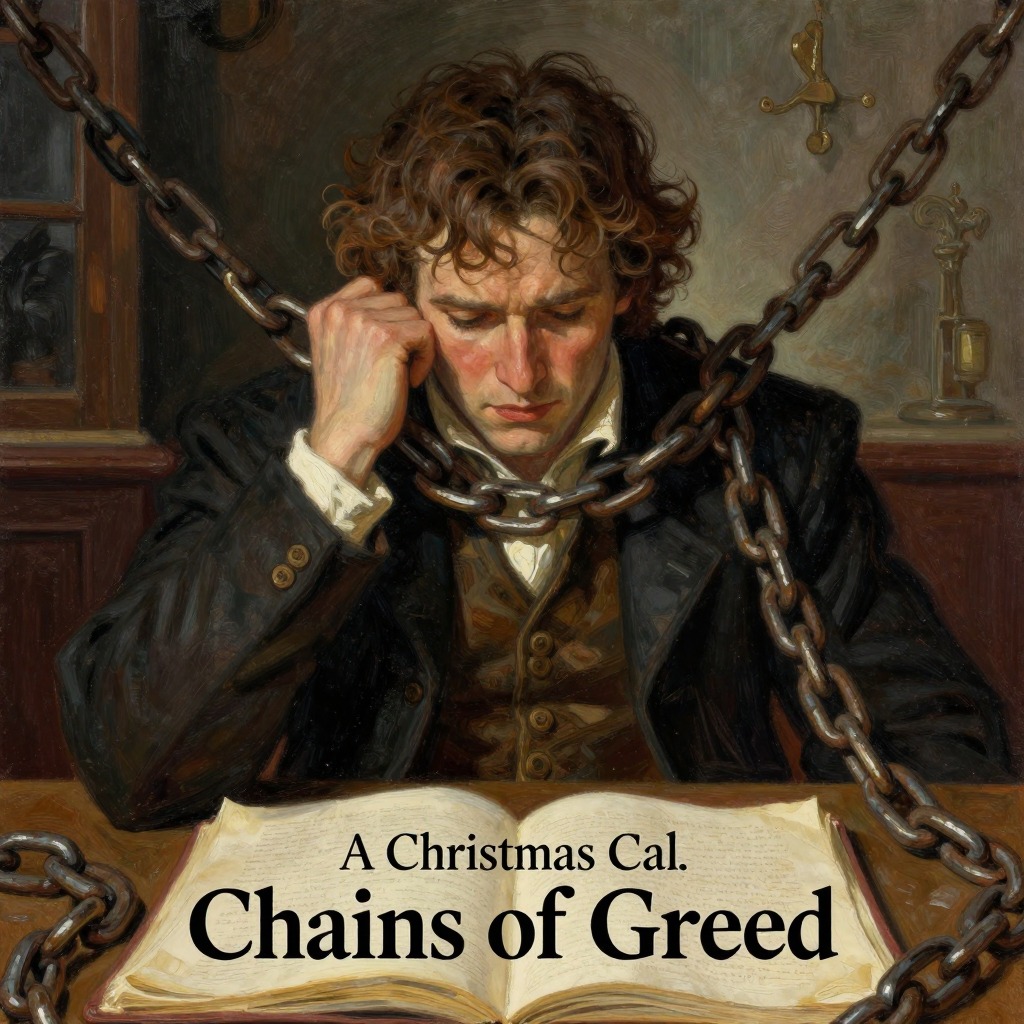
A Christmas CarolMarley's chain is the most potent physical symbol in Charles Dickens's A Christmas Carol, a material embodiment of spiritual corruption and the inescapable consequences of a life lived without charity or human connection. Forged by Jacob Marley himself during his earthly existence, the chain is not a punishment imposed from without but a self-wrought burden, and it appears to Ebenezer Scrooge as a terrifying omen of his own potential fate. The chain's detailed construction, its weight, and its universal application to other wandering spirits establish it as the story's central metaphor for the moral ledger that every person unknowingly accumulates.
Appearance and Composition
When Marley's Ghost first appears to Scrooge, it is immediately identifiable by the chain it drags. The chain is clasped about the ghost's middle, long and wound about him like a tail. Scrooge observes it closely and notes its extraordinary composition: it is made of cash-boxes, keys, padlocks, ledgers, deeds, and heavy purses wrought in steel. These are not arbitrary objects; they are the very tools and symbols of Marley's trade as a money-lender and businessman. The chain is thus a direct, material translation of his professional life into an instrument of torment. The ghost's body is transparent, allowing Scrooge to see through his waistcoat to the buttons on his coat behind, a detail that underscores the chain's solid, inescapable reality against the spectre's insubstantial form.
Origin and Meaning
The chain's origin is explicitly tied to Marley's own choices and actions. When Scrooge asks why he is fettered, the Ghost replies, "I wear the chain I forged in life. I made it link by link, and yard by yard; I girded it on of my own free-will, and of my own free-will I wore it." This explanation establishes the chain as a product of free will, not divine punishment. Every act of avarice, every refusal of charity, every moment of cold indifference added another link. The Ghost further reveals that Scrooge himself has been forging a similar chain. Seven Christmas Eves ago, when Marley died, Scrooge's chain was already as heavy and as long as Marley's, and he has laboured on it since. This revelation transforms the chain from a mere ghostly prop into a direct, personal warning for Scrooge, who glances about him on the floor in the expectation of finding himself surrounded by iron cable, though he can see nothing—yet.
The Chain as a Universal Symbol
The chain is not unique to Marley. When Scrooge looks out of his window after the Ghost's departure, the air is filled with phantoms wandering in restless haste, every one of them wearing chains like Marley's. Some few, whom the narrator suggests might be guilty governments, are linked together; none are free. Many of these phantoms were personally known to Scrooge in their lives. One old ghost in a white waistcoat, with a monstrous iron safe attached to its ankle, cries piteously at being unable to assist a wretched woman with an infant. The misery with them all is that they seek to interfere for good in human matters but have lost the power forever. This vision universalizes the chain's meaning: it is not merely Marley's punishment but the common fate of all who prioritize business over humanity. The chain represents the missed opportunities for kindness and connection that, once the spirit has passed, can never be reclaimed.
Thematic Significance
Marley's chain functions as the story's primary moral instrument, converting abstract concepts of sin and redemption into a concrete, visual weight. It embodies the idea that every action has consequences that extend beyond the grave. The chain's composition—cash-boxes, ledgers, and deeds—directly critiques the values of Victorian commerce, suggesting that a life measured solely by financial gain is a life that builds a prison. The Ghost's lament, "Mankind was my business. The common welfare was my business; charity, mercy, forbearance, and benevolence were, all, my business," directly contrasts the chain's material components with the immaterial values that truly matter. The chain is thus a warning that the pursuit of wealth, when divorced from human sympathy, creates a burden that outlasts life itself. Scrooge's redemption is measured by his ability to recognize this truth and to actively un-forge his own chain through generosity and connection, a process that begins with his purchase of the prize turkey for the Cratchits and culminates in his embrace of Christmas as a principle to live by all year.