Scrooge's chambers
A Christmas CarolScrooge's chambers are the gloomy, once-shared residence of Ebenezer Scrooge and his deceased partner Jacob Marley, serving as the primary setting for the supernatural visitations that catalyze Scrooge's moral transformation. Located in a dark, labyrinthine building that seems to have lost its way among the city's offices, these rooms function as a spatial emblem of Scrooge's isolation, his entrapment in a cold and solitary existence, and ultimately, the site of his joyful rebirth on Christmas morning.
Location and Description
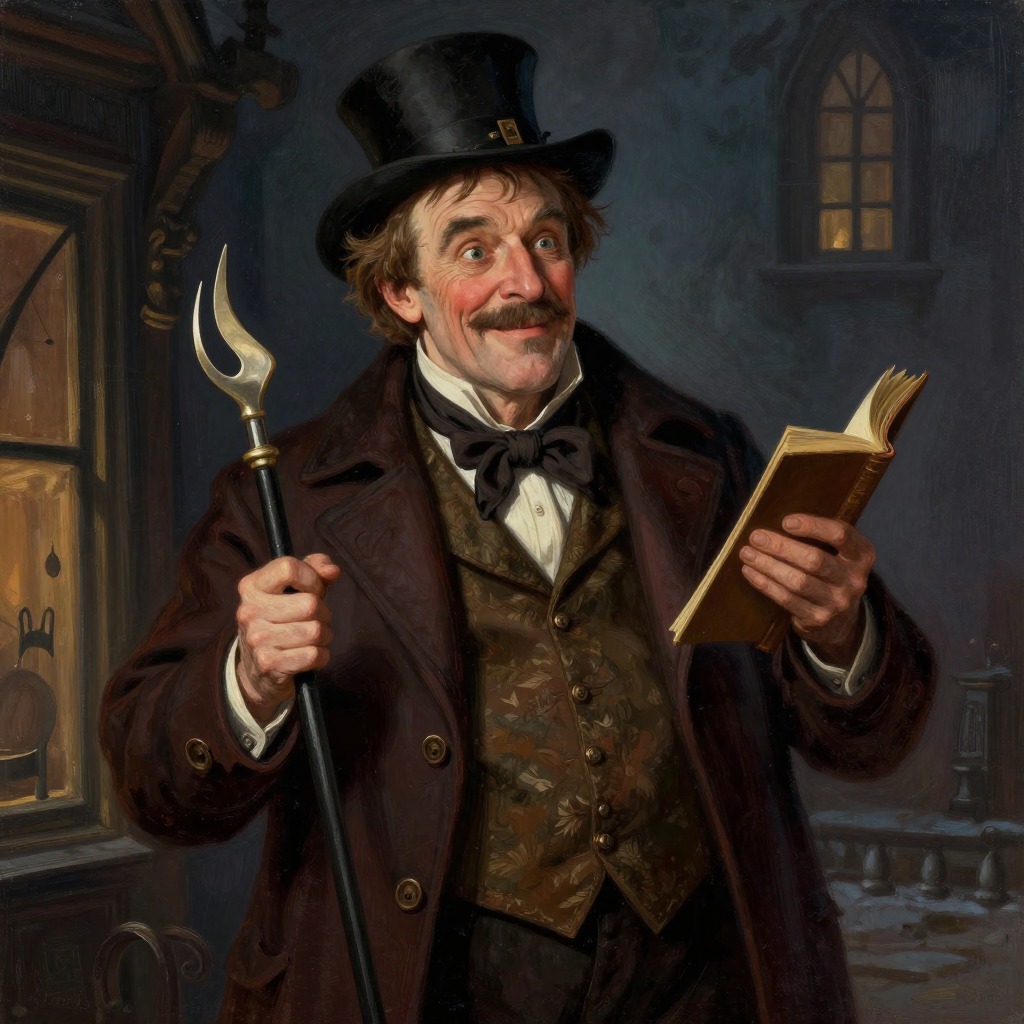
Scrooge lived in chambers that had once belonged to his deceased partner, Jacob Marley. They were a gloomy suite of rooms in a lowering pile of building up a yard, where it had so little business to be that one could scarcely help fancying it must have run there when it was a young house, playing at hide-and-seek with other houses, and had forgotten the way out again. It was old enough now, and dreary enough; for nobody lived in it but Scrooge, the other rooms being all let out as offices. The yard was so dark that even Scrooge, who knew its every stone, was fain to grope with his hands. The fog and frost so hung about the black old gateway of the house that it seemed as if the Genius of the Weather sat in mournful meditation on the threshold. The chambers themselves comprised a sitting-room, a bedroom, and a lumber-room. The sitting-room contained a small fire in the grate, a spoon and basin ready, and a little saucepan of gruel upon the hob. The bedroom was similarly sparse, and the lumber-room held old fire-guard, old shoes, two fish baskets, a washing-stand on three legs, and a poker. The fire-place was an old one, built by some Dutch merchant long ago, and paved all round with quaint Dutch tiles designed to illustrate the Scriptures, featuring Cains and Abels, Pharaoh's daughters, Queens of Sheba, Angelic messengers, Abrahams, Belshazzars, and Apostles putting off to sea in butter-boats.
The Site of Supernatural Visitations
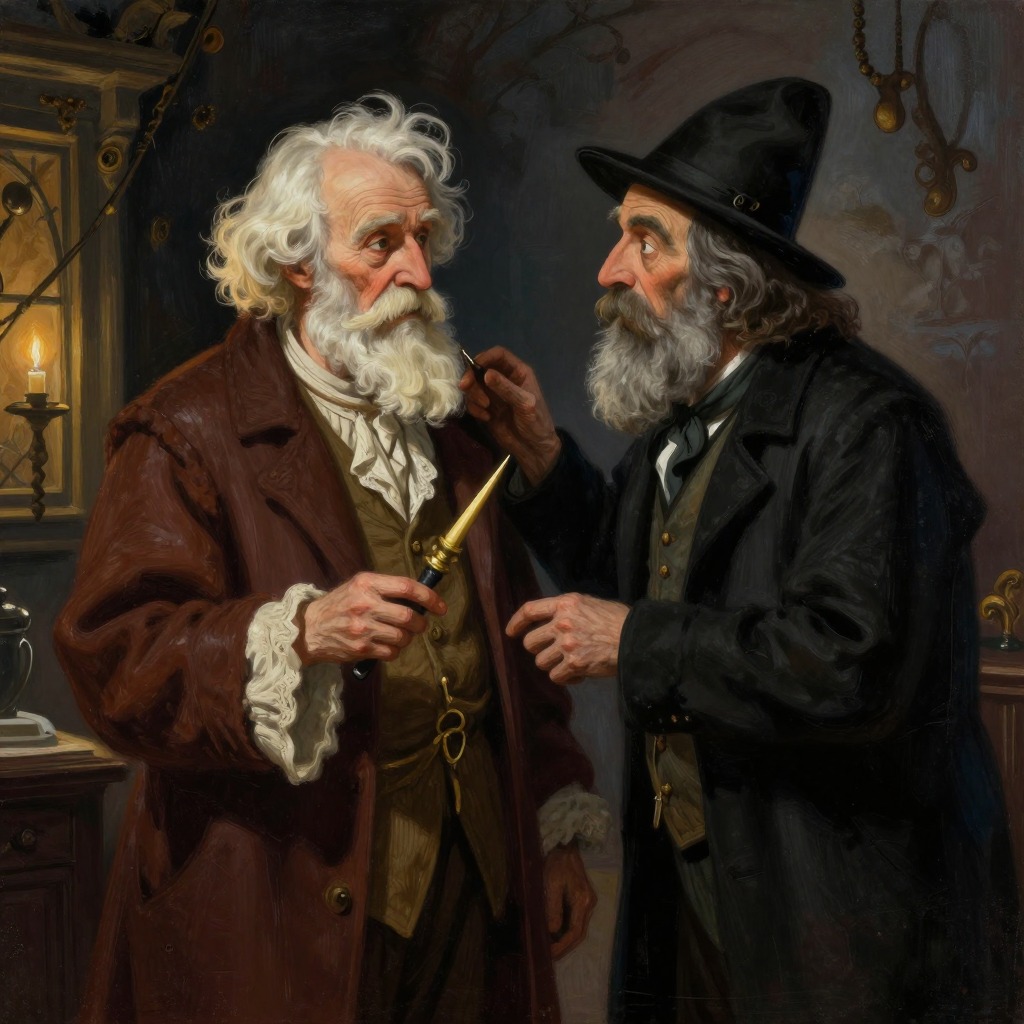
The chambers were the stage for all four ghostly encounters. On Christmas Eve, after returning from his usual melancholy tavern, Scrooge saw in the door knocker—without any intermediate process of change—Marley's face. The face had a dismal light about it, like a bad lobster in a dark cellar, and looked at Scrooge as Marley used to look, with ghostly spectacles turned up on its ghostly forehead. After entering, Scrooge double-locked himself in, which was not his custom. The ghost of Jacob Marley then entered through the heavy door, dragging a chain made of cash-boxes, keys, padlocks, ledgers, deeds, and heavy purses wrought in steel, his body transparent so that Scrooge could see the two buttons on his coat behind. The Ghost of Christmas Past appeared when the curtains of Scrooge's bed were drawn aside by a hand, revealing a strange figure like a child yet like an old man, with a bright clear jet of light springing from the crown of its head. The Ghost of Christmas Present transformed the room into a perfect grove hung with living green, holly, mistletoe, and ivy, with a mighty blaze roaring up the chimney and a throne of turkeys, geese, game, poultry, brawn, great joints of meat, sucking-pigs, sausages, mince-pies, plum-puddings, barrels of oysters, chestnuts, apples, oranges, pears, twelfth-cakes, and bowls of punch. The Ghost of Christmas Yet to Come, a solemn Phantom draped and hooded, approached like a mist along the ground, shrouded in a deep black garment that concealed its head, face, and form, leaving nothing visible save one outstretched hand.
Symbolism and Transformation
The chambers embody Scrooge's spiritual condition. The cold within him froze his old features, and he carried his own low temperature always about with him, icing his office in the dog-days and not thawing it one degree at Christmas. The darkness and gloom of the building mirror his secret, self-contained, and solitary nature. The fire-place, with its Dutch tiles depicting biblical scenes, stands in ironic contrast to Scrooge's own lack of spiritual warmth; yet even these hundreds of figures could not distract him from the face of Marley, seven years dead, which came like the ancient Prophet's rod and swallowed up the whole. The disused bell that communicated with a chamber in the highest story of the building begins to swing softly, then rings out loudly, followed by every bell in the house, heralding the supernatural. The chambers are also the site of Scrooge's climactic transformation. After his struggle with the Ghost of Christmas Yet to Come, he finds himself in his own bed, the bedpost his own, the bed his own, the room his own. He is so fluttered and glowing with his good intentions that his broken voice would scarcely answer to his call, and his face is wet with tears. He frisks into the sitting-room, perfectly winded, and identifies the saucepan that the gruel was in, the door by which the Ghost of Jacob Marley entered, the corner where the Ghost of Christmas Present sat, and the window where he saw the wandering Spirits. Running to the window, he opens it and puts out his head to find no fog, no mist, but clear, bright, jovial, stirring cold, golden sunlight, heavenly sky, sweet fresh air, and merry bells. The chambers, once a prison of isolation, become the launching point for his new life of generosity and connection.