The bed-curtains
A Christmas CarolThe bed-curtains are a deceptively ordinary domestic object that, in the hands of Charles Dickens, becomes a powerful emblem of death, desecration, and ultimately of resurrection. They appear in two sharply contrasting contexts: first as the plundered spoils of a corpse, stripped from a bed by a callous charwoman, and later as the first physical evidence Scrooge seizes upon to confirm that his own life has been spared and his fate reversed. The journey of the bed-curtains from a symbol of utter human degradation to a token of joyful redemption encapsulates the entire arc of Scrooge's transformation.
Theft and Desecration
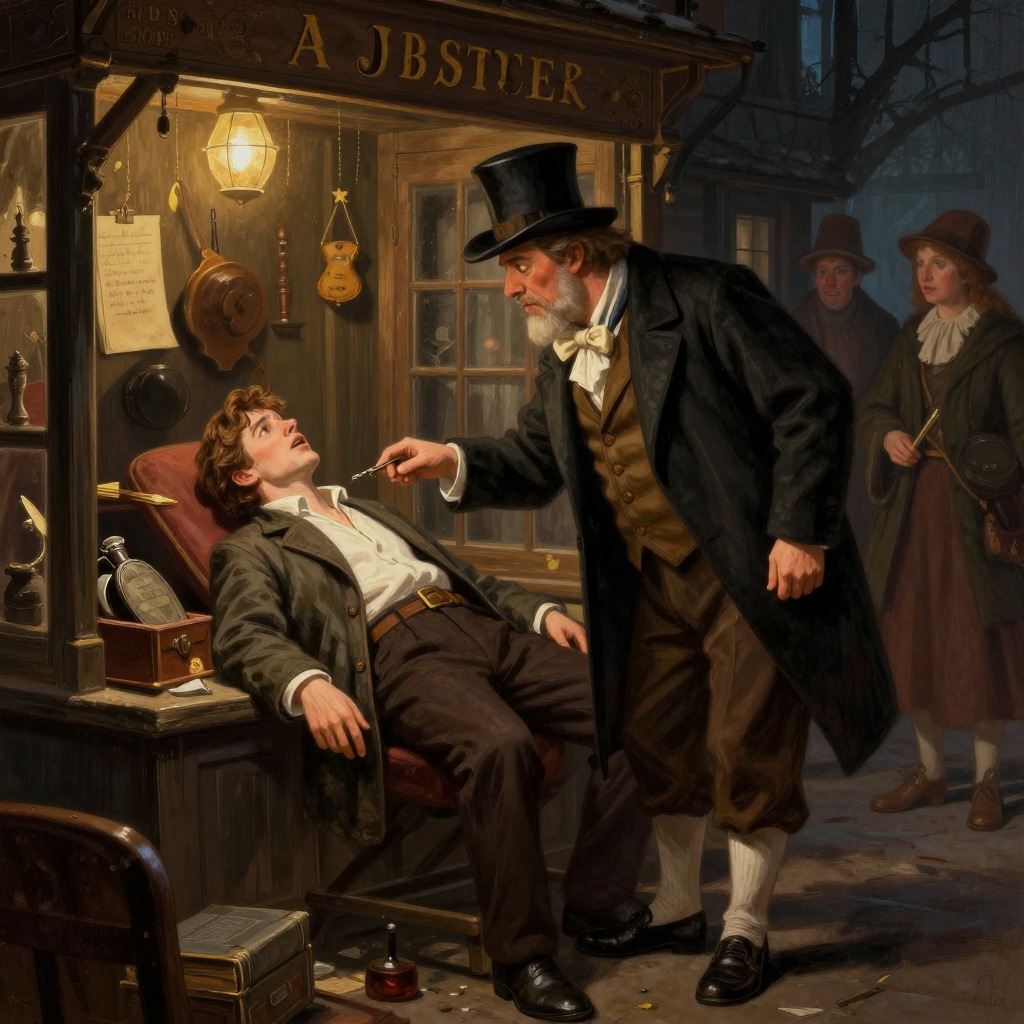
The bed-curtains are introduced in the grim vision shown by the Ghost of Christmas Yet to Come. Scrooge is taken to a squalid shop in a foul, narrow quarter of the city, where a grey-haired rascal named Old Joe buys stolen goods. Three figures arrive almost simultaneously: a charwoman, a laundress (Mrs. Dilber), and an undertaker's man, each carrying a bundle plundered from the home of a man who has just died. The charwoman, who entered first, proudly displays her haul. When Old Joe asks, "You don't mean to say you took 'em down, rings and all, with him lying there?" she replies without a trace of shame, "Yes, I do. Why not?" She boasts that she would not "hold my hand, when I can get anything in it by reaching it out, for the sake of such a man as He was." The bed-curtains are thus presented as the most intimate and audacious of the thefts—objects that should have remained with the dead man as a final dignity, torn down while his body still lay in the bed. The charwoman even boasts that she stripped the shirt from the corpse as well, declaring that if calico is not good enough for burial, "it isn't good enough for anything." Scrooge listens to this dialogue in horror, viewing the trio as "obscene demons, marketing the corpse itself." The bed-curtains, in this context, represent the ultimate reduction of a human life to mere commodity, stripped of all sanctity by those who were supposed to care for the dying man.
The Revelation of the Corpse
Immediately after the transaction, the scene shifts to a dark, bare, uncurtained bed. The absence of the curtains is now a visible sign of the dead man's utter abandonment. The bed is "plundered and bereft, unwatched, unwept, uncared for." The very object that should have provided warmth and privacy has been ripped away, leaving the corpse exposed to the cold and to the gaze of the reader. Scrooge, trembling, understands that this desolate scene could be his own future. The missing bed-curtains are a physical manifestation of the spiritual emptiness of a life lived only for gain: a life so devoid of human connection that even the most basic tokens of respect are stolen before the body is cold.
Joyful Recovery
The bed-curtains reappear in the triumphant final chapter, transformed into a symbol of Scrooge's redemption. Waking on Christmas morning, Scrooge is delirious with joy. He seizes one of his own bed-curtains, folds it in his arms, and cries out, "They are not torn down, rings and all. They are here—I am here—the shadows of the things that would have been may be dispelled." The precise detail—"rings and all"—echoes the charwoman's boastful question, creating a direct contrast between the two scenes. Where the dead man's curtains were torn down by a stranger, Scrooge's curtains remain intact, a tangible proof that he has been given a second chance. The bed-curtains, once an object of horror, become the first physical evidence that Scrooge's fate has been reversed. They are no longer a shroud for a forgotten corpse but a banner of a new life.
Narrative and Thematic Significance
The bed-curtains function as a narrative hinge, connecting the darkest vision of the future with the brightest moment of the present. They are a concrete object that allows Scrooge—and the reader—to measure the distance between the man he might have become and the man he now chooses to be. The fact that Scrooge immediately thinks of the bed-curtains upon waking shows that the lesson of the Ghost of Christmas Yet to Come has been fully absorbed. The object that once symbolized the ultimate degradation of a miserly life now symbolizes its opposite: the preservation of a life that will be lived in connection with others. The bed-curtains, in their journey from stolen goods to cherished possession, embody the central promise of the story: that it is never too late to change, and that the shadows of what might have been can be dispelled by an altered life.