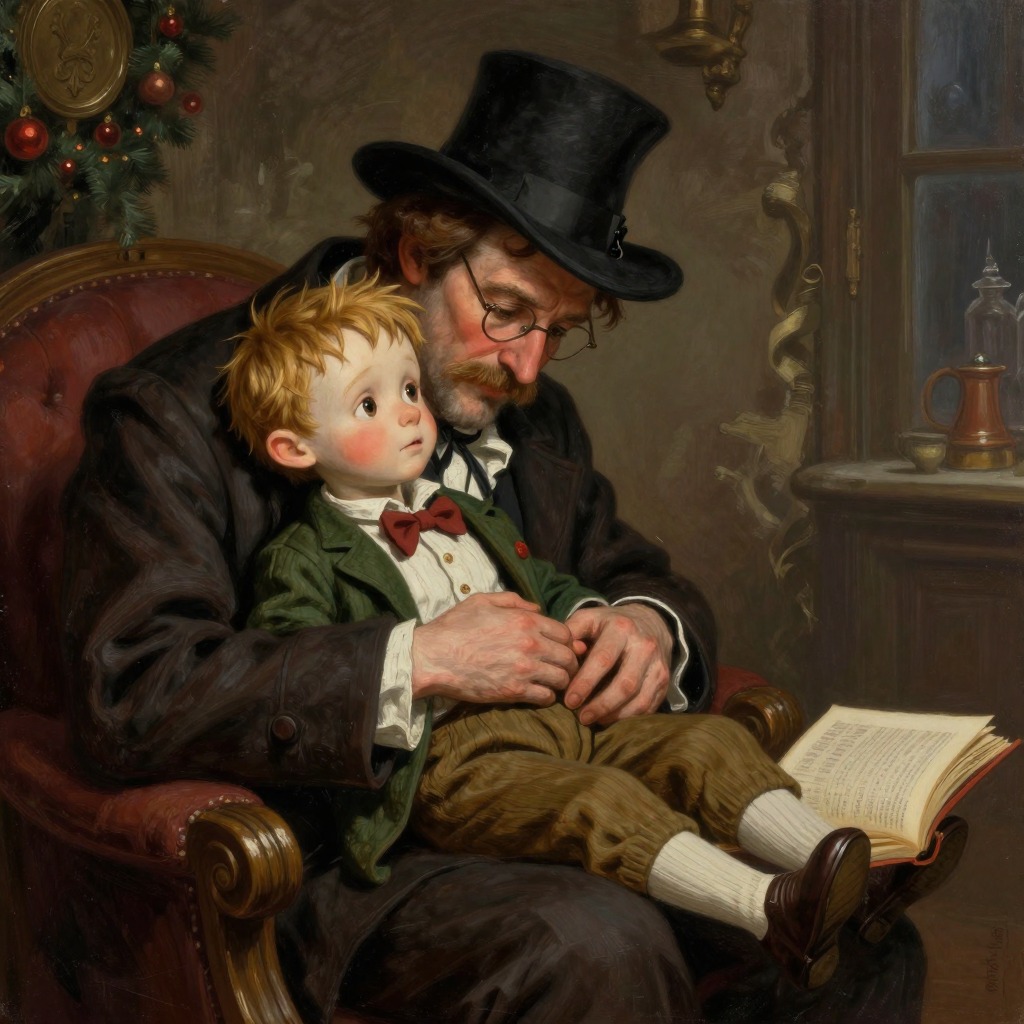
Tiny Tim's crutch
A Christmas CarolTiny Tim's crutch is the most poignant material object in A Christmas Carol, a physical emblem of the poverty, vulnerability, and threatened loss that lie at the heart of the Cratchit family's Christmas. More than a mere aid, the crutch becomes a narrative instrument that measures Scrooge's moral distance from human sympathy and, ultimately, the completeness of his redemption. Its presence, its use, and its imagined absence structure the emotional climax of the story, transforming a piece of wood and iron into a symbol of life itself.
Identity and Material Reality
The crutch is introduced as part of Tiny Tim's very first appearance, when Bob Cratchit carries his son home on his shoulder. The boy is described as bearing "a little crutch" and having his limbs supported by "an iron frame" . This detail immediately establishes the severity of Tim's condition: he is not merely frail but requires external mechanical support to stand or move. The crutch is not a temporary inconvenience but a permanent fixture of his daily existence, as indicated by the sound of his "active little crutch" being heard upon the floor when he returns to the fireside . The object is thus both a tool of mobility and a constant, audible reminder of his physical limitation.
Narrative Function and Symbolic Weight
The crutch's most powerful narrative function emerges when Scrooge, moved by the Ghost of Christmas Present's vision of the Cratchit home, asks directly about Tiny Tim's fate. The Ghost's reply is devastatingly concrete: "I see a vacant seat... in the poor chimney-corner, and a crutch without an owner, carefully preserved" . The crutch here is transformed from a living boy's accessory into a relic of a lost child. The image of the crutch preserved but unused—a memorial object—is far more affecting than a mere statement of death. It is the object that outlives its owner, and its careful preservation speaks to the family's enduring love and grief. The Ghost's cruel echo of Scrooge's own words—"If he be like to die, he had better do it, and decrease the surplus population" —directly links the crutch to the miser's earlier callousness, making the object a rebuke to his philosophy.
The Crutch and Scrooge's Transformation
The crutch also serves as a measure of Tiny Tim's character. Bob Cratchit reports that Tim, sitting by himself, thinks "the strangest things," hoping that people seeing him in church "might be pleasant to them to remember upon Christmas-day who made lame beggars walk and blind men see" . The crutch is thus not a source of bitterness but of gentle, Christian reflection. This makes the threat of its vacancy all the more tragic. Scrooge's final, ecstatic act of redemption is directly tied to the crutch's fate. When he sends the prize turkey to the Cratchits, he whispers that it is "twice the size of Tiny Tim" , and the narrative's concluding assurance is that "to Tiny Tim, who did NOT die, he was a second father" . The crutch, which the Ghost had shown as ownerless, is now implicitly returned to its living owner. The object that symbolized impending death becomes, through Scrooge's intervention, a symbol of life restored.
Thematic Significance
Tiny Tim's crutch operates at the intersection of several of the story's central themes. It is a concrete manifestation of the poverty that the charity collectors describe and that Scrooge dismisses with his talk of prisons and workhouses. It is the physical evidence of a child's suffering that the miser must learn to see. The crutch also embodies the story's Christian moral framework: the lame child who walks in faith, the object that might become a relic of loss but instead remains a tool of life. In the end, the crutch is not discarded or miraculously healed away; it is simply no longer the focus of fear. Scrooge's redemption does not erase Tiny Tim's disability but ensures that the boy lives, and the crutch remains as a quiet testament to the power of human kindness to alter the shadows of the future.