“Be Still” command
A Dog's JourneyThe “Be Still” command is Margaret’s instruction for Toby to lie down and remain motionless, a learned behavior that becomes central to his work with people who are ill. Its significance lies not simply in obedience: by learning when not to jump, play, or signal, Toby can safely offer company to patients whose needs differ from those of the people he once cared for. The command turns stillness into an active form of comfort.
Learning the Command
Margaret first teaches Toby “Be Still” by holding him down and repeating the instruction. He interprets the restraint as an invitation to wrestle and tries licking, squirming, and other ways of engaging with her. Her repeated corrections tell him that he is doing something wrong, but not yet what she wants. When he finally stops struggling out of frustration, Margaret praises him and gives him a treat, even though he has not understood the lesson.
Over several days, the connection becomes clear: “Be Still” means to lie down and not move. Toby can then stay in place for as long as Margaret asks, though he remains eager for the reward. The training depends on repetition and on his gradually connecting a spoken cue with a bodily action. What first feels to him like an obscure demand becomes a reliable instruction he can follow in unfamiliar situations.
Margaret tests the behavior beyond their initial training. She takes Toby through parts of the building where women are sitting, standing, or eating, and asks him to remain still in people’s laps. In another test, Toby lies on a blanket beside a woman resting on a couch. He wants to lick her face, but holds himself back and receives a treat. Several women watch; one then agrees that Margaret may take him to work to see how he does. These trials establish that Toby can restrain his impulses not only in a familiar training exchange but also in the presence of people he wants to approach.
Use at the Hospice
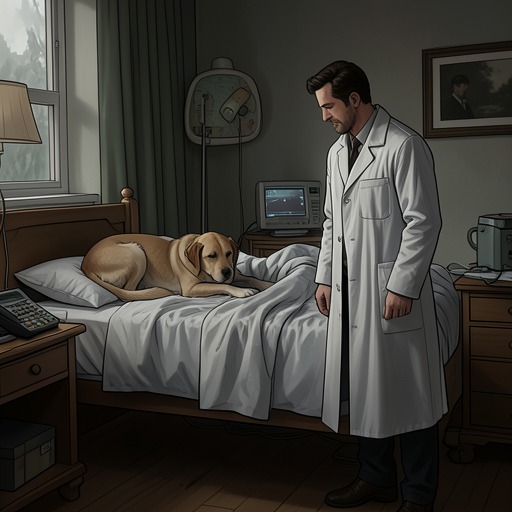
Margaret takes Toby by car to the hospice, where he encounters sick people in a quiet building with soft floors. Some patients pet and hug him; others lie still in their beds and gaze at him. Margaret gives the command, and Toby concentrates on not moving because he has learned that illness changes what people can comfortably tolerate. His task is not to make every patient play or respond, but to remain beside them in the manner the situation allows.
The command also marks a boundary between comforting a patient and sounding an alert. Toby detects on some patients the strong, familiar scent he remembers from Trent’s breath, but he does not signal. He understands that “Pray” is the instruction to signal in those circumstances; no one gives it. “Be Still” therefore directs his conduct without replacing the separate signal command. Toby can notice a scent and still refrain from acting on it when the situation calls for quiet presence instead.
Margaret later brings Toby to a walled yard, where he runs and plays with a rope toy, then returns him inside to a cage with a new pillow. The contrast makes the command’s use more legible: Toby has energy and a desire to play, but can settle when the people around him need calm. In the days that follow, Margaret and other women, including Fran, Patsy, and Mona, take him to visit people lying in beds. Some want to play; some pet him; others nap. Toby lies beside them when asked, and senses their joy. The same instruction accommodates different visits without requiring each patient to interact with him in the same way.
Restraint as Care
Toby’s understanding of the command deepens through an uncomfortable mistake. He once steps on a man’s stomach, prompting a sharp cry that stays in his memory. He recognizes that people in bed may be in pain and that climbing on them to play can hurt them. He distinguishes himself from Duke, whom he remembers as unable to control his rambunctiousness: Toby has learned that he can be still.
The patient, Bob, becomes the focus of Toby’s effort to make amends. When visiting alone, Toby first jumps onto a chair beside Bob’s bed and then onto the blankets, avoiding another painful landing. Bob is asleep each time, so Toby’s visits do not produce a spoken reconciliation. Instead, Toby changes his behavior to avoid repeating the harm. The episode gives “Be Still” a practical, ethical dimension: restraint is not just compliance with Margaret’s cue, but an adaptation to what another body can bear.
That attention extends to people near death. When Toby senses Bob easing away from life, he lies quietly beside him. He understands his purpose as comforting people who are ill and considers his presence especially important in their final breaths. At another deathbed, he lies beside Dawn’s mother as she dies. Dawn and the other children are sad and clutch Toby; he remains still for them. Fran and Patsy are there, while CJ is absent. The command allows Toby to offer comfort to the family as well as to the person in the bed.
A Learned Purpose
Toby’s hospice work differs from a relationship centered on one person. At the hospice, many women play with him, talk to him, and feed him; he comes to understand himself as a dog who loves many people. His stillness makes that broad care possible. When patients want sleep, he can lie beside them; when families need contact after a death, he can be held without turning the moment into play.
The command also carries experience across Toby’s life. Lying with people recalls visits with CJ’s friends, who cried while he stayed beside them on the couch. But at the hospice, the practice takes on a more sustained role: Margaret’s initial training becomes part of Toby’s daily visits with Fran, Patsy, and Mona, and part of his presence with patients and bereaved families. “Be Still” is thus both a specific learned cue and the form Toby gives to a larger purpose—being attentive to people who need comfort, and changing his behavior so that his closeness does not cause harm.