“Pray” Scent Alert
A Dog's JourneyThe “Pray” Scent Alert is Max’s use of a familiar command to signal that he detects the odor of Trent’s cancer. Its significance lies in the gap between the people’s interpretation and the dog’s purpose: “Pray” initially belongs to mealtime, but Max responds to it as an opportunity to warn them. The misunderstanding delays recognition, while the repeated cue eventually makes a hidden danger legible to CJ and Trent.
A Familiar Command in a Medical Routine
The alert takes shape within the household’s ordinary care routines. Trent checks CJ’s blood pressure and asks whether she has taken her amino acids; CJ, tired of her low-protein diet, complains that she wants “a hamburger with a steak on top of it.” In this setting, attention to health already has a place in daily conversation. Yet Max’s signal is not presented as a medical procedure the humans have taught him. It emerges through a word and a scent that the people have not connected.
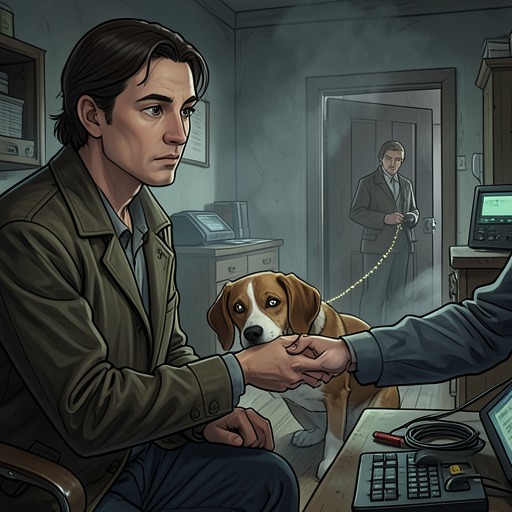
At dinner, CJ holds Max’s bowl up and tells him, “Okay, Max. Pray.” Trent explains that Max always does it for him too, then repeats the command. Max is hungry and wants his food, but the word has another significance for him: it makes sense in connection with the odor that sometimes lingers on Trent’s breath. When Trent leans down, Max catches the scent and signals. Trent praises him, CJ sets down the bowl, and Max races to eat. The alert occurs inside an unremarkable domestic exchange, easily mistaken for obedience before its purpose is understood.
From Routine to Recognition
The first signal does not immediately explain itself. CJ’s hands-on-hips attention and Trent’s question about what is wrong register that something has shifted, but the meaning remains uncertain. Later, CJ asks Trent to repeat the action. He bends toward Max, the odor is particularly strong, and CJ calls, “Pray!” Max signals again. This time CJ reacts with fear, puts a hand to her mouth, and Max goes to nuzzle her. He senses her distress without understanding its cause; his physical response is immediate, even while the people begin to interpret what he has done.
The command’s repetition changes the scene. At first, it is embedded in a familiar routine and followed by food; when CJ deliberately calls it again, the same action becomes evidence. Max does not explain the odor or identify an illness in words. His signal is meaningful because it recurs when Trent bends close and the scent is present. CJ’s recognition supplies the missing interpretation: Max has been trying to tell them about Trent, not performing a prayer or merely asking for dinner. The narrative lets the humans’ understanding arrive after the dog’s response, making the delay itself central to the alert’s meaning.
CJ Names What Max Has Done
On a warm summer day, CJ sits in the grass with Max in her lap, strokes his head, and tells him that she knows what he was doing. She connects his earlier signals to Trent’s cancer and asks whether Molly told him, wondering aloud whether Molly is an “angel dog” watching over them and whether Max is one too. Max likes hearing CJ speak Molly’s name and wags. The exchange links his present warning to CJ’s memory of Molly, but leaves the proposed explanation in the form of CJ’s questions rather than confirming how Max knew.
CJ also states the consequence directly: “We got it in time, Max. Because of you they got it and it hasn’t come back.” She calls him the dog who saved her husband and asks him to thank Molly if he talks to her. The scene thus gives the alert a concrete outcome—Trent’s cancer was found in time and, by the time CJ speaks, has not returned—without describing a diagnostic test or treatment. CJ’s gratitude turns the action from a behavior the household had misread into a recognized act of protection.
The Signal After the Danger
Trent’s recovery alters the sensory evidence that once gave the command its meaning. His hair grows back, and Max can no longer detect the metallic odor when Trent bends over. When Trent says “Pray,” Max sits and stares at him in frustrated confusion, no longer signaling. Trent and CJ laugh, clap, say “Good dog!” and give him a treat, although this time Max has done nothing. The same cue now produces the human reward without the warning that had made the alert necessary.
The episode also sharpens the limits of communication between species. Max can detect an odor, respond to it, and repeat his signal, but he cannot know what the people expect from the command or explain what he smells. The narrative makes that limit explicit when Max reflects that understanding what people want cannot be a dog’s purpose because it is impossible. In the alert, however, his action matters even before it is understood: the command gives CJ a way to notice the warning, and her eventual recognition turns Max’s repeated response into consequential knowledge.