A Dog’s Purpose and Life Mission
A Dog's JourneyA Dog’s Purpose and Life Mission is the dog’s changing understanding of why he is reborn and what he owes the people he loves. The answer begins as a single devotion to Ethan, then widens into a continuing responsibility to protect Clarity Mahoney and CJ. Across those changes, purpose is neither a fixed job nor merely a lesson supplied by humans: it is something the dog remembers, questions, recognizes in relationships, and enacts through learned work.
A Purpose Reconsidered at the End of a Life
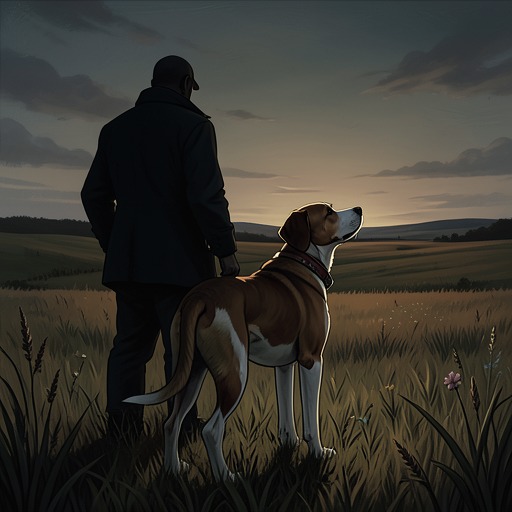
As Buddy grows old on The Farm, he measures his life against the earlier forms it has taken. In his first life as Toby, he had no special purpose beyond playing with other dogs; as Bailey, he met Ethan and made loving the boy his central focus; as Ellie, his work was to find people and save them. In Buddy’s life, he has been Ethan’s companion through the final years of Ethan’s life. He believes that this devotion has fulfilled the reason he was made a dog, and that the deep sleep awaiting him will end his existence rather than begin another life.
That certainty is bound to grief. It is the second summer without Ethan, and the pain of losing him has eased from its first sharp intensity into something more like a constant ache. Sleep briefly relieves it: in dreams, Ethan still runs beside Buddy. Remembering this bond makes the prospect of death seem like a fitting end to a completed mission. The phrase good dog is not a claim about status or obedience alone; it is Buddy’s judgment that he has loved Ethan as well as he could.
Yet the ending he expects is unsettled by a child approaching the dock. Clarity Mahoney is unsteady on her feet, and Buddy imagines pulling her from the water by her shirt if she falls in. His impulse to protect her arrives even as he believes his purpose is finished. The moment places his declared completion beside an immediate, practical responsibility: the old dog’s attention has already turned toward someone who may need him.
From Ethan to Clarity Mahoney
Buddy’s new mission begins as an inference about Ethan’s wishes. He has seen Clarity Mahoney get into trouble before, including crawling beneath a bird feeder and eating fallen seeds. Because she is a baby, he is unsure how to respond; when he finally barks, Gloria becomes angry. The incident shows the limits of his ability to communicate, but it also establishes that he is watching the child closely and trying to distinguish ordinary mischief from danger.
At the pond, the question becomes more urgent. Hannah is too far away to reach Clarity Mahoney in time, and Buddy understands that babies are only permitted in the water when an adult is holding them. He whimpers, then whimpers more loudly as the child nears the edge. Gloria tells him to hush without opening her eyes. Although he does not understand the word, he recognizes its sharp tone. The scene makes his protective purpose concrete: he perceives a risk, tries to alert a human, and is not understood.
Buddy’s belief that watching over Clarity Mahoney is his new purpose does not replace Ethan’s importance. He thinks Ethan would want him to keep her safe, so the new responsibility grows out of the old attachment. After rebirth, when Clarity Mahoney pets him and explains that her mother will not let her have a dog, Buddy recognizes her and concludes that he still has work to do. His promise to watch over her preserves the same commitment in a changed life: the person he protects is different, but the act of care continues.
Rebirth and the Problem of Continuity
When Buddy is born again as a puppy, memory arrives alongside the newborn body. His eyes have barely opened, but he remembers being Buddy and remembers earlier puppy lives. The persistence of memory gives his successive lives an inward continuity; the body and circumstances change, while the question of purpose carries forward.
That continuity does not immediately explain what the rebirth means. Buddy had believed that everything he learned had culminated in helping Ethan and guiding him through the last years of his life. If that was the purpose, he wonders, why is he a puppy again? He considers whether a dog might have more than one purpose, or whether rebirth will continue without end. These questions mark a limit in his understanding rather than a settled doctrine: his earlier conclusion had been sincere, but the new life makes it incomplete.
The sequence of names and roles gives the uncertainty shape. Toby, Bailey, Ellie, and Buddy are not presented as interchangeable labels for one unchanging task. Each life adds a different kind of activity—play, intimate companionship, finding and saving people, and devotion to Ethan—while the remembered self tries to understand how these experiences belong together. Rebirth therefore turns purpose into a process of revision: each apparent ending invites a new account of what the dog is for.
Love, Recognition, and CJ
In Molly’s life, affection for CJ brings the question of purpose into a new relationship. At one point Molly spends a whole day playing with Del, a boy whose dark hair and age remind her of Ethan. Only when she realizes that she has not seen CJ since breakfast does she feel like a bad dog and go to the door, hoping to get inside and check on her. Del’s resemblance to Ethan has made her miss her former boy, but it also sharpens her recognition that she loves CJ as much and in the same way.
Molly then asks, in effect, whether loving Ethan was her sole purpose or whether she now has a distinct purpose to love and protect CJ. She cannot tell whether these are separate missions or parts of something larger. The uncertainty matters: her attachment is not simply transferred from one human to another, as if the first bond could be discarded. Rather, the old love becomes a point of comparison through which she recognizes the force of the new one.
A small exchange over Molly’s possible breed links these relationships in a more tangible way. When CJ calls her a Doodle, Molly recalls Ethan calling her a doodle dog. The name carries the love of the boy who first gave it to her and reminds Molly of the connection between Ethan and CJ. Its significance is personal rather than biological: a familiar word bridges lives and helps Molly recognize continuity between the people she has loved.
Purpose as Learned Work
The idea of mission also extends beyond guarding an individual person. Molly learns to signal cancer-related odors by watching Luke. Andi explains that dogs may detect the odor without knowing how to indicate that they have detected it; Molly, however, has watched Luke cross his paws and learned the signal by observation. Andi has not heard of a dog acquiring the behavior this way and identifies imitation as the explanation for Molly’s action.
This ability makes purpose both relational and practical. Molly’s new skill depends on attention to another dog, not simply on an innate command or a human explanation. Andi recognizes the significance of what Molly has learned, praises her, and invites her to join the program, with CJ’s participation also offered as community service. The invitation gives Molly’s capacity a wider use: the dog who has understood her life through watching over particular loved ones can also help in a structured effort to detect illness.
A Mission That Expands
The successive lives hold together through a repeated pattern: the dog forms attachments, pays close attention, and turns that attention into action. Sometimes the action is playful companionship; sometimes it is an attempt to warn or protect; in Molly’s cancer-detection work, it becomes a learned signal with potential value beyond her immediate household. Purpose thus remains emotionally rooted without being confined to one relationship or one task.
The novel’s account does not resolve every question Buddy raises about why rebirth continues. Instead, it gives the uncertainty a direction. He first believes that loving Ethan has completed his work; Clarity Mahoney’s vulnerability makes him suspect that care must continue, and CJ’s presence deepens that realization. Molly’s learned work broadens the pattern again. The recurring good dog is therefore not simply the dog who has finished a single mission, but one whose capacity for attention and loyalty can find new forms as life—and the people and animals around him—change.