Andi’s dog rescue
A Dog's JourneyAndi’s dog rescue is a working animal-rescue facility that also houses Andi’s effort to train dogs to detect cancer by scent. Its kennels and daily care routines make it a place of immediate, practical need; its open areas and human participants give Andi room to test whether a dog can recognize a concerning odor outside a laboratory. For Molly, the facility becomes the setting where an unexplained smell from her past acquires a purpose—and where a familiar gesture becomes a trained alert.
Setting and Rescue Work
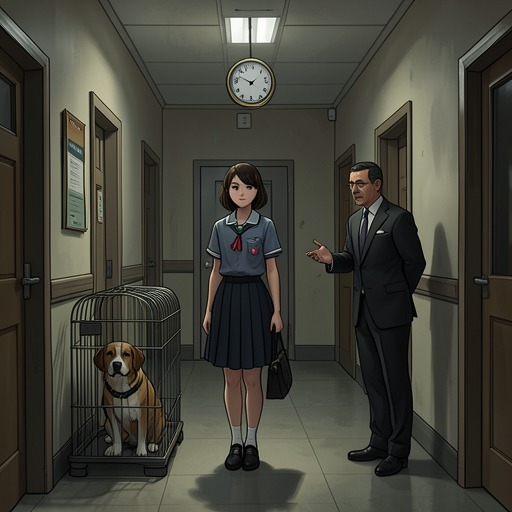
CJ first brings Molly to the facility after a car ride, arriving at a large building where dogs can be heard barking before they are even inside. Andi greets them and leads them into an open space lined with kennels. The dogs housed there bark at Molly and at one another, but Molly is allowed to move freely among them as a special-status dog while the others remain in their kennels.
The rescue’s day-to-day work is substantial. Andi tells CJ that help with feeding and watering the dogs, cleaning their kennels, and walking them outside will free her to concentrate on training. The distinction matters: CJ initially expects to learn dog training, but Andi needs practical assistance so that she herself can do that work. The facility is therefore not a research center detached from animal care. Its experimental program depends on the labor required to look after the dogs rescued there.
Winter weather shapes how that care is organized. The dogs are not allowed to play outside in the snow; they go out only for leash walks. While CJ cleans kennels, Molly plays with the dogs in a fenced area inside the main room. Some of the dogs are old and content merely to sniff her before lying down. Others do not know how to play and snarl or snap, so they are put in a separate indoor pen one at a time while their kennels are cleaned. The scene shows a mixed population with different needs, not a uniform group of eager trainees.
Cancer-Detection Research
Andi explains that the organization’s primary function is dog rescue, but a grant allows her to use the facility for cancer-detection research. She points to studies suggesting that dogs’ sense of smell can be as much as a hundred thousand times more intense than humans’ and that dogs may detect cancer on a person’s breath before any other diagnosis. Because early detection can matter to treatment, Andi is adapting methods from existing studies and trying to put them into practice.
Her ambition is not limited to having a dog sniff a specimen in a laboratory. Other trainers, she notes, have dogs smell samples in test tubes; she wants to explore whether detection might work in the field, perhaps at a health fair or community center. The facility’s open room becomes a testing ground for that question. The research is presented as an attempt to apply existing methods in a new setting, not as a proven diagnostic service already operating for the public.
The Testing Exercise and Molly’s Alert
Molly watches Andi work with three dogs: Luke, a large brown male, and two females, one yellow and one black. Several older people sit apart from one another in metal chairs. Andi leads the dogs to sniff them one at a time; the people do not interact with the dogs beyond sitting nearby. After each round, the dogs return to their kennels while the people change seats. The repeated rearrangement allows the dogs to encounter the participants in different positions rather than simply following a fixed route through the room.
Luke provides a clear example of the exercise’s alert behavior. When led to a bald man, he sniffs carefully, then lies down, crosses his paws, and rests his head on them. Andi rewards him with a treat and praise. Molly imitates the posture, hoping for a treat, but neither Andi nor CJ treats her gesture as part of the work. At this point, the behavior is not yet a signal she has been taught to use.
On a later pass through the participants, Molly reaches a woman whose hands smell of fish and detects the same odd odor she had previously encountered as Buddy. It recalls the odor on the bald man who had spoken with CJ. Molly senses a slight tension in Andi as they move away, recognizes that the exercise concerns this smell, turns back, and lies down with her paws crossed. Andi immediately recognizes the response and rewards her. The moment joins Molly’s private sensory memory to the facility’s research: she has detected a pattern through smell before she understands the human explanation for it.
Training and Consequences Beyond the Facility
Andi offers to involve Molly in the program and invites CJ to take part as well, noting that the work could count toward CJ’s community service. CJ jokes about giving up the less appealing task of shoveling dog waste, but Molly’s role develops from that encounter. From then on, when she and CJ are with Andi, Molly leads her to meet people and signals whenever she detects the unusual odor. Such alerts are uncommon; most people simply smell like people. The facility’s work is thus intermittent and attentive rather than a sequence of constant positive results.
The training later matters away from Andi’s building. While living with Trent, Max detects a metallic odor on Trent’s breath and signals, using the response he had been trained to perform long before. CJ eventually understands that Max had been trying to alert them to Trent’s cancer. She tells Max that the cancer was found in time and had not returned, crediting his warning with helping to save her husband. Her recollection links Max’s signal to what Molly had done and to the earlier training. In this way, the rescue’s research reaches beyond its rooms: an experimental behavior learned there becomes a means of communication in a family setting.
Andi’s dog rescue consequently brings together two forms of care without making them identical. The kennels require feeding, cleaning, walking, and attention to frightened or aging animals; the detection project asks handlers to observe what dogs perceive and to interpret a repeatable response. Molly’s nose registers the clue before human diagnosis, while her crossed paws make that perception legible to Andi. The facility’s narrative significance lies in that translation: rescue work gives the research its setting, and training turns an animal’s sensory knowledge into an alert that people can act upon.