Animal Rescue Ethics in Shelters and Euthanasia
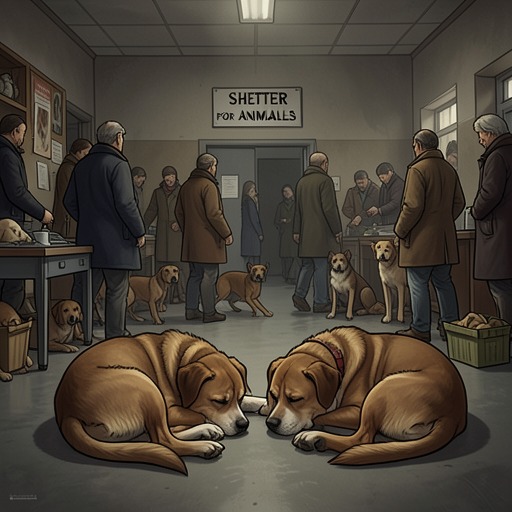
A Dog's JourneyAnimal Rescue Ethics in Shelters and Euthanasia concerns the moral choices made when crowded shelters must decide which animals they can keep, place, or euthanize. Through Max’s aggression assessment and the shelter’s limited reclaim period, the novel shows how institutional rules can turn fear into a verdict and scarcity into a justification for ending a life. It also complicates that critique: the staff face continuing arrivals and limited placement options, while one person’s willingness to recognize and care for a particular dog can alter his prospects.
Assessment and the Meaning of Aggression
The shelter’s aggression test is presented as a decision point with immediate consequences. A worker explains that dogs who fail are short-tracked: they receive only four days before euthanasia. Dogs who pass may be given longer, depending on how crowded the shelter is. The account makes the assessment inseparable from resource pressure; the same behavior can determine not merely how an animal is managed, but how much time he has left.
The test is described as beginning with food. The evaluator lets a dog smell a bowl and become accustomed to it, then uses a plastic hand to pull the food away. A snap or growl counts as aggression. Max’s experience, however, includes a man approaching him with a large stick while he is hungry and expecting to be fed. Having learned during his time with CJ that sticks can signal danger, he is frightened and growls when the stick is pushed toward his nose. The worker immediately calls the result aggressive and assigns him to the short track. The scene does not deny that a growl is a warning; it places that warning in circumstances that make fear, rather than an uncomplicated disposition, a plausible part of what the test records.
The result also illustrates the limits of judging an animal through a single encounter. Max has not understood why he is in the shelter or what the men intend to do. The evaluator’s conclusion is decisive even though Max’s behavior emerges from hunger, fear, and an approaching stick. The gap between the institutional label and the dog’s experience is central to the ethical problem: a procedure meant to assess risk can register the conditions of the assessment itself as evidence against the animal.
Scarcity, Time, and Institutional Triage
The four-day period is not described as an isolated rule detached from circumstance. Staff explain that dogs may be given longer when the shelter is not crowded, but that it is usually packed. One worker says that dogs brought in by owners are often accompanied by assurances that the owners will return, yet he has learned not to rely on those promises. His blunt certainty contrasts with a newer worker’s hesitation, which is met with a warning that anyone working there must quickly accept the routine or fail to last.
That exchange presents shelter work as both necessary and morally wearing. The staff member’s practical stance has developed in an environment where assurances repeatedly go unfulfilled; the conversation gives no indication that he regards euthanasia as easy. At the same time, his insistence that the outcome is settled closes down the possibility of reconsidering Max’s fear or finding more time. The institution’s language turns a pressured decision into procedure, while the newer worker’s objection briefly keeps its human cost audible.
Max’s case later makes the consequences of scarcity explicit. Gail tells CJ that Max is scheduled for euthanasia the following morning. The shelter is not a no-kill facility; staff try to transfer dogs to no-kill shelters when possible, but those shelters are full too. New dogs arrive every day, and Max has not warmed to anyone. Though puppies can usually be placed, he is overdue for a placement, and the shelter needs space. The explanation is not that Max’s life has no value; it is that the available capacity cannot meet every animal’s needs. The moral conflict lies precisely in that collision between care for the dog present and responsibility toward animals still arriving.
Max, Recognition, and the Possibility of Rescue
Gail’s account of Max’s last day at the shelter gives the system’s timetable an intimate face. She tells him she is sorry, says she still thinks he is wonderful, and explains that she cannot keep dogs in her apartment, even a small puppy. Max is due to be euthanized the next morning. His individual story is therefore caught between affection and practical limits: Gail’s regard for him does not give her a home in which to keep him, and the shelter’s capacity does not allow indefinite waiting.
When CJ passes the cages carrying two bags and without the larger dog, Max yips at her. She looks directly into his eyes, pauses, then continues walking. Max cries and scratches at the fence, fixed on her; Gail hears his distress, comes over, and puts a leash on him. When CJ later handles him, Gail observes that he clearly likes her. CJ calls him sweet, but is shocked to learn how soon he may be euthanized. The scene makes recognition more than a sentimental idea: CJ’s response gives staff a concrete relationship to consider where the shelter’s earlier assessment had left Max isolated and marked as aggressive.
Gail asks CJ to take Max, explaining that he has never warmed to anyone except her and that he snapped even at the person who feeds him. She offers to waive the fee. CJ has recently taken in a cat and hesitates over whether she can take on a dog; Gail answers that dogs and cats raised together often do well and stresses that CJ would be saving Max’s life. The evidence establishes an appeal and a possible route out of the shelter, not an effortless solution. Rescue depends on an available person accepting responsibility, and even a striking bond must meet the practical fact of an existing household and another animal.
Care Beyond the Shelter
The shelter scenes sit within a wider pattern in which care depends on noticing vulnerability and adjusting behavior to it. Before Buddy’s death, he approaches Hannah despite pain, puts his head beside her on the blanket, and looks at her to communicate what he needs. Hannah understands that it is time. The episode offers a contrast to Max’s test: one person attends to a distressed animal’s signals as communication, while the shelter assessment translates a frightened response into a category with severe consequences. The situations are not identical, but together they emphasize how much depends on interpreting behavior in context.
Toby’s hospice work extends the contrast from rescue to sustained care. He learns to lie still because some patients are in pain; after accidentally stepping on Bob’s stomach, he remembers the man’s cry and changes how he reaches the bed, using a chair to avoid hurting him. Later, Toby stays quietly beside Bob as he dies. At the hospice, CJ visits patients, while Toby remains beside them and lets family members hold him for as long as they need. These acts do not solve the shelter’s shortage of space or provide an alternative placement for every dog. They do, however, frame the novel’s ethical ideal of care as attention to a particular being’s needs, limits, and relationships rather than a judgment made in the abstract.
CJ’s own final request to Toby makes that reciprocity especially clear. She tells him she is weary and wants to be with her husband, asks him to stay with her in her final moments, and says she knows she will be brave if he is there. Fran sits with CJ on a clear spring afternoon as Toby rests his head on her chest; when her hand goes still, Fran takes it, and CJ dies with Toby beside her. The ending does not equate human hospice care with shelter policy. It completes the article’s broader ethical contrast: care can mean allocating scarce time, recognizing the limits of what one person can provide, or remaining faithfully present at the end. The shelter’s decisions are shaped by scarcity, but the novel keeps the individual animal—and the human or animal capable of answering its need—in view.