CJ Helps Dawn Face Her Eating Disorder
A Dog's JourneyCJ helps Dawn face her eating disorder by recognizing in the young woman the bodily signs and secrecy that marked CJ’s own high-school experience. Rather than beginning with a diagnosis or an ultimatum, CJ draws Dawn into a quiet conversation, discloses what she once did to herself, and offers to be called when the urge to purge returns. Dawn initially recoils from that recognition, but the connection endures: later, she sits with the dying CJ and says that CJ saved her life, while CJ credits Dawn with saving herself.
The encounter beside Dawn’s mother
The first conversation takes place while Dawn’s mother lies in bed, suffering and breathing with a strong metallic tang. The family is distressed: the mother is asleep, her husband is present, and three children are about the age CJ had been when Toby knew her as Molly. One of the children picks Toby up and puts him beside the woman. Toby responds with the trained stillness of “Be Still,” remaining near the sleeping patient as CJ turns her attention to the oldest child, Dawn.
Dawn is taller than CJ, with long, light hair that smells of flowery soap; her hands carry a strong scent of apples. These details reach Toby through smell and observation, establishing Dawn as a particular presence before the conversation reveals what she is hiding. CJ asks her to join her for coffee. Dawn looks first at her sleeping mother and then at her father, who nods permission. The small pause makes the invitation a step away from the sickroom, but not a departure from the family’s immediate strain.
From comfort food to disclosure
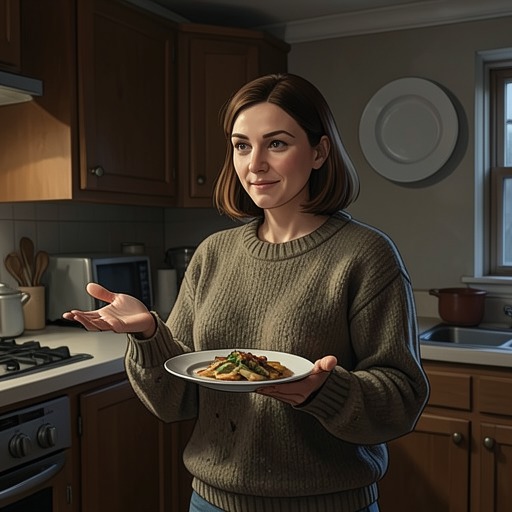
Once the two are seated, CJ asks Dawn about her comfort foods. Dawn laughs wryly and names peanut butter and heat-and-serve lasagnas. CJ observes that eating can help with stress, then gently asks what happens when Dawn has eaten too much. The question changes the atmosphere: alarm passes through Dawn, she sits upright, and she asks what CJ means. CJ answers by telling her own history rather than pressing Dawn to confess first.
CJ recalls that in high school she could make herself feel better by eating, but that each bite was accompanied by self-hatred and fear of gaining weight. She describes feeling already fat and imagining her body growing, then getting rid of what she had eaten. The disclosure is concrete and personal: CJ gives Dawn both the pattern of the behavior and the distress surrounding it. When Dawn asks how she did this, CJ does not spell out the method; she replies that Dawn knows. Dawn inhales sharply, a bodily reaction that confirms the painful recognition without requiring her to name it.
CJ then points to signs she has noticed in Dawn: little red spots in Dawn’s eyes and cheeks swollen like CJ’s own had sometimes been. The comparison makes the recognition visible, but also reveals its cost. Dawn says she has to go, and when CJ asks her to stay a little longer, Dawn admits that she thinks her mother knows, though her mother has never spoken to her about it. With her mother now ill, the unspoken problem has acquired another pressure: Dawn does not know how to bring it into the open.
An offer without forced disclosure
CJ tells Dawn that there is a program, but Dawn sharply refuses and pushes her chair back. CJ does not treat that refusal as the end of the conversation. She acknowledges how awful it can be to keep the secret and to hate oneself, grounding her offer in the experience she has just shared rather than demanding immediate acceptance of formal help. Dawn wants to return to her mother’s room. Both stand, and Toby senses strong feelings in each of them; he also registers that CJ is less tense than Dawn.
Before Dawn leaves, CJ says she is on her side and asks her to call in the coming days or weeks whenever the urge becomes uncontrollable. Dawn’s next concern is whether CJ will promise not to tell her father. CJ agrees only on the condition that she knows for sure Dawn is not going to hurt herself. The exchange sets a boundary alongside the offer of trust: CJ will respect Dawn’s confidence, but not at the cost of ignoring an immediate danger. The conversation does not show Dawn accepting the program or disclosing the behavior to her parents. Its immediate outcome is narrower and more personal: she has been recognized, and she has a way to reach someone who understands.
Dawn’s later account
Dawn returns to CJ’s life later, when CJ’s voice has grown weaker and many people visit her room. Toby recognizes Dawn as the girl with apple-scented hands. She sits beside CJ and talks for hours, remaining there even while Toby leaves to check on Fran or Patsy. Their sustained companionship gives the earlier invitation a longer consequence: Dawn is no longer only the frightened young person who wanted to leave the table, but someone who can stay with CJ and speak openly about her future.
Dawn explains that people keep asking what medical specialty she wants, while she is focused on getting into medical school and does not yet know which field will appeal to her. CJ tells her she will get there. Dawn says CJ has always believed in her and that CJ saved her life. CJ refuses the credit, answering that Dawn saved her own life and recalling the program’s principle that no one else can do it for a person. In that exchange, support is neither dismissed nor mistaken for rescue: CJ’s belief and willingness to listen matter, but Dawn’s own action remains central. The later conversation thus completes the earlier one without claiming that CJ’s offer alone cured Dawn. Toby jumps beside CJ when she coughs, and her hand strokes his back as the two women continue their exchange, linking the care he provides in the sickroom with the care CJ has offered Dawn.