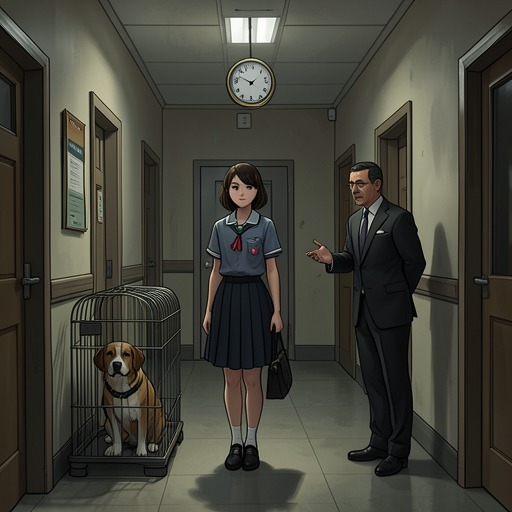
CJ Skips School to Care for Molly and Is Investigated by School Officials
A Dog's JourneyCJ Skips School to Care for Molly and Is Investigated by School Officials is an episode in which protecting Molly becomes a direct reason for CJ to miss school. The conflict unfolds through small acts of concealment and care—a secret outing, time spent tending the puppy, and an excuse offered at the door—before a truant officer makes CJ’s absences an institutional concern. Told through Molly’s dog-centered perspective, the episode makes the stakes legible less through abstract explanations than through who stays, who leaves, and who comes looking for CJ.
Keeping Molly Close
CJ takes Molly out while she is still being kept secret. She tells the puppy to be quiet, carries her through a gate into the backyard, and then brings her along on a walk, a front-seat car ride, and a day playing at a park. The outing is a striking change from Molly’s confinement: for a while, the two are together in public and mostly by themselves. When a small black dog named Get Back Here Milo runs up, Molly lowers herself submissively, recognizing that a puppy must show she is no threat. CJ picks her up when the other dog pushes her over, holding her as Jennifer had when feeding her. The gesture gives the outing its emotional center: CJ is not merely transporting a hidden pet but responding protectively when Molly is vulnerable.
That freedom remains temporary. CJ says her mother leaves the next day and will be gone for a week, and asks Molly to endure one more quiet night. The timing explains why concealment governs their routine: CJ is trying to keep Molly hidden until her mother is away. It also makes the later school absence part of the same practical problem. CJ has an obligation to attend school, but the puppy she has taken responsibility for cannot simply be left openly in the house.
School Against Care
The tension becomes explicit when Trent asks whether CJ is going to school. She says she is not. Trent tells her she cannot keep skipping, and CJ answers that Molly needs her. His response points beyond a single missed day: he asks what about the other times, noting that CJ has had Molly for only three days. The exchange establishes that her absences are already recurring, while also showing how CJ understands the immediate choice. In her account, caring for Molly is not an excuse detached from her circumstances; it is the need that presently outweighs school.
Molly hears her own name and reacts to the conversation, but her interpretation remains grounded in the puppy’s experience rather than CJ’s full situation. Later, when CJ leaves her in the basement for hours, returns to play, clean up, and feed her briefly, then calls for her again in the afternoon, Molly concludes that CJ is doing school. She compares it with Ethan’s schooling and dislikes it just as much. The misunderstanding creates a quiet contrast: CJ’s time away is school attendance, while Molly experiences that same interval as being left alone. Their needs are connected, but they are not identical; the puppy cannot know what CJ is doing beyond the boxes and the space beneath the stairs.
The Truant Officer’s Visit
A doorbell brings the school’s concern to the house. Molly runs to the front door and barks, while CJ warns her to stay back and opens the door only a crack. Officer Llewellyn identifies herself as a truant officer and asks why CJ is not at school. CJ says she is sick and coughs to support the claim. When asked where her mother is, CJ says she is shopping for a prescription. Molly, eager to meet the visitor, wags her tail; the dog’s uncomplicated welcome sits against the guarded exchange at the threshold.
Officer Llewellyn says that the school has left several messages for CJ’s mother and received no call back. She hands CJ a piece of paper for her mother, explains that CJ has missed a lot of school, and says people are worried about her. The officer asks CJ to give the notice to her mother and says she will expect a call, adding that her mother can leave a message if she is unavailable. CJ agrees. The visit therefore establishes more than that an official has noticed an absence: the school has tried to reach the household before, and those attempts have gone unanswered. The requested call also leaves the matter unresolved; the officer has delivered the concern, but the scene does not show whether CJ’s mother responds.
A Secret Becomes a Routine
The visit takes place against a pattern already forming around Molly’s care. Every morning, CJ leaves her in the basement, blocked into the small space beneath the stairs for hours. She returns to spend a short time with her, clean up messes, and feed her, then comes back in the afternoon and remains home until the next morning. Molly experiences this schedule as separation punctuated by reunion. The physical arrangement—boxes barring the puppy’s way out—makes concealment a daily task rather than a single emergency measure.
CJ also trains Molly to remain quiet when she is shut beneath the stairs. At night, she blocks the space with boxes and stays nearby. If Molly cries or barks, CJ moves the boxes and sharply tells her no; if Molly sits quietly, CJ restores the barrier and gives her a treat. They extend the quiet intervals gradually. For Molly, the rule becomes clear: she is expected to stay silent when CJ is just on the other side. The training is an effort to preserve the secret, but it does not make confinement easy for the puppy, who would rather play. In this way, care carries a cost for both of them: CJ devotes time to keeping Molly safe and hidden, while Molly’s safety depends on being quiet and alone.
Consequences and Significance
The episode brings two kinds of responsibility into collision. CJ is accountable to the school for repeated absences, and Officer Llewellyn’s visit turns that concern into a direct request for contact with her mother. At the same time, CJ has made Molly dependent on her for food, comfort, company, and protection from discovery. Trent voices the problem from outside their private arrangement; CJ’s answer, that Molly needs her, gives the attachment its plainest expression without resolving the conflict.
Molly’s perspective also shapes the episode’s irony. She does not understand truancy, official notices, or the reasons for CJ’s absences. She understands being carried to the park, being lifted away from a rough encounter, hearing CJ return, and being shut behind boxes while CJ is gone. The school’s concern and the puppy’s need are thus presented as simultaneous realities rather than as a simple choice between duty and affection. The visit marks a change in pressure: what had been managed through secrecy and household routine is now visible to school officials, while Molly remains dependent on the same arrangements that brought CJ under scrutiny.