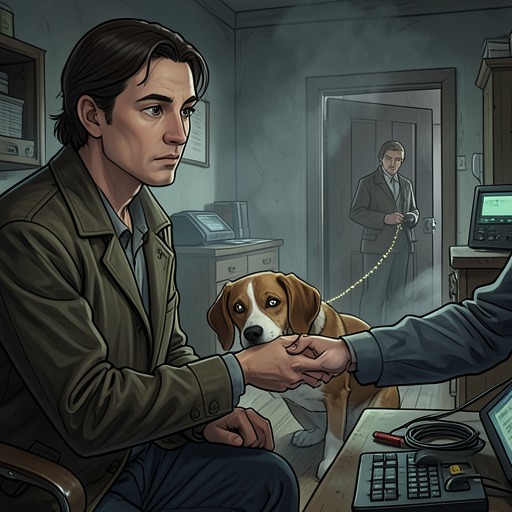
Canine Cancer Scent Detection
A Dog's JourneyCanine Cancer Scent Detection is both a research project and a recurring sensory thread linking Buddy, Molly, and Max. Dogs’ ability to notice an odor humans do not recognize gives the narrative a form of knowledge that precedes diagnosis: an obscure metallic taste becomes a signal, and a signal becomes a chance to act. The method is not presented as effortless canine expertise. It depends on a dog learning how to communicate what its nose has detected—and on people learning to take that communication seriously.
A Bodily Clue Before a Diagnosis
Buddy first experiences the illness-related cue not as an abstract scent but as a taste that invades his mouth and nose. It recalls the unpleasant metal taste left after he once licked a thin pan clean and experimentally crunched it; unlike that taste, the new one cannot be spat out. The sensation persists and grows stronger over several days. When Gloria applies an eye-watering chemical to the fur between her toes, its smell briefly overwhelms the taste, making the contrast between odors part of Buddy’s bodily experience.
The cue returns as Buddy’s rear leg becomes painful. On the way to the veterinarian, he has the awful taste again. Doctor Deb explains that the cancer in his leg might already have spread; removing the leg could make an eleven-year-old dog less comfortable without guaranteeing more time, so she recommends painkillers as one option. The book does not identify the metallic taste as a formal diagnostic result. Instead, the later scenes retrospectively connect Buddy’s persistent sensation with the cancer odor that Molly and Max will encounter on other people.
That sensory knowledge remains intermittent rather than neatly legible. Through the winter, the bad taste never leaves Buddy, though at times it is strong and at others he forgets it; his leg pain likewise ranges from manageable to a sharp stab that wakes him from a nap. The repeated, bodily clue precedes any systematic use of dogs for detection, establishing how an animal may register a change before the people around it have a name for it.
From Rescue Work to Cancer Research
The concept becomes an organized practice at Andi’s dog rescue, where a grant supports research alongside the center’s main rescue function. Andi explains that dogs’ sense of smell may be as much as a hundred thousand times more intense than humans’, and that studies indicate dogs can detect cancer on a person’s breath before another diagnosis has been made. She is adapting research methods in the hope of moving detection beyond laboratory specimens: rather than having a dog sniff a test tube, she wants to see whether trained dogs can work in the field, going from person to person at a health fair or community center.
The practical program depends on ordinary rescue labor as well as research. Andi needs help feeding and watering the dogs, cleaning their kennels, and walking them outside because one employee has taken a full-time job and another is on maternity leave. CJ initially suspects the work will mainly mean picking up dog waste. Andi nevertheless offers to involve her and Molly in the detection program, which could count toward CJ’s community service. The arrangement places experimental work inside the daily demands of a rescue facility rather than separating it from care for the dogs.
Learning to Make the Signal
Molly’s first clear success shows the difference between detecting an odor and communicating its significance. While accompanying Andi from person to person, she encounters a woman whose hands smell of fish and recognizes the same distinctive cue she had encountered on a bald man’s breath. As Andi begins to move on, Molly senses a slight tension in her and turns back to the woman, lying down and crossing her paws. Andi praises her and gives her treats: Molly has made the behavior legible to her trainer.
Andi’s explanation is important to the method. She thinks dogs may all be able to detect the odor, but that detection alone does not mean they will connect it to a signal humans can recognize. Molly has been watching Luke, another dog, and copies his crossed-paw posture. Andi says she has never heard of a dog learning the signaling behavior by watching another dog, but concludes that this is what happened. The alert is therefore not just a matter of a sensitive nose: it is a learned, socially transmitted action that turns private perception into information shared with people.
Molly’s participation remains selective. From then on, when she is with Andi, she leads CJ to meet people and signals when she picks up the bad odor, but this happens infrequently; most people simply smell like people. The distinction matters because the program is not portrayed as treating every encounter as a warning. Molly also learns that the work has its own rewards, including treats and attention, while CJ is invited to participate as part of her community service. CJ affectionately calls her a “goodle dog,” joining Molly’s intelligence to her poodle identity.
Alerts and Their Consequences
Molly’s signals bring the research into the lives of particular people. She recognizes the cue on the bald man who speaks with CJ and identifies it as the same metallic tang associated with Buddy’s earlier experience. The man says that he has throat cancer and acknowledges having smoked; he also tells CJ that he started smoking at her age. His breath’s smell gives Molly a sensory connection between a disclosed diagnosis and the alerting behavior she is beginning to learn.
The alert concerning Sheryl carries the method into CJ’s family circle. When Gloria asks what happened after a woman has left, CJ explains that Molly signaled for cancer and had signaled that Sheryl had cancer. The scene gives the signal a consequence beyond a training exercise: what began as a dog’s response to an odor becomes news that changes what the people present understand about someone close to them. The account does not detail the full medical process that follows, but it makes the signal’s personal stakes clear.
The idea later returns through Max and Trent. While Trent is putting wet food on top of Max’s dry food, Max detects a metallic, unmistakable odor on Trent’s breath and gives the signal he had been trained to use. CJ eventually understands that Max was not saying grace, as she had once supposed; he was trying to communicate that he could smell Trent’s cancer. She tells Max that it was caught in time and had not returned, and credits him with saving her husband. Her later recognition supplies an explanation for the behavior and confirms its importance within their family, even though Max cannot explain what he has perceived in human language.
Sensory Knowledge and Continuity
The detection motif depends on a gap between canine perception and human interpretation. Buddy’s taste is vivid to him but initially has no shared diagnostic meaning; Molly’s crossed paws become useful only when Andi recognizes them as an alert; Max’s signal is first misunderstood before CJ connects it to Trent’s illness. In each case, the dog’s body registers something before human understanding catches up. Smell functions as a kind of knowledge, but one that must cross the boundary between species through observation, training, and trust.
The recurrence across Buddy, Molly, and Max also gives the practice a larger narrative shape. What first appears as Buddy’s private, persistent symptom becomes Molly’s trained participation in a research program and then Max’s warning within a marriage. Molly’s learned gesture makes an invisible odor communicable; Max’s alert demonstrates what may follow when someone finally understands that communication. The concept thus joins experimental detection to the book’s continuing bond between dogs and people: care is not only something humans give animals, but also attention to forms of warning that humans could not produce on their own.