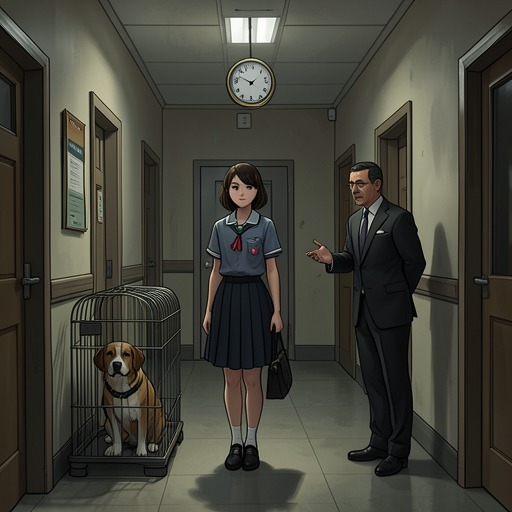
Clarity Stops Animal Control from Taking Molly Away
A Dog's JourneyClarity Stops Animal Control from Taking Molly Away is a rescue scene in which a puppy’s sudden capture is reversed by the person who claims her as family. Told through Molly’s sensory, bodily perspective, the encounter makes the difference between being handled as a stray and being recognized as someone’s dog immediate: a loop tightens around her neck, a cage shuts behind her, and Clarity arrives to insist that she belongs with her.
Setting and Circumstances
Before the encounter, Molly has been exploring the street without a leash. The houses recall the home Ethan lived in before moving to the Farm: their front yards are spacious enough for play and often bordered by shrubs. Molly encounters the dense smells of flowers, people, dogs, and cats, while cars add metallic and oily odors as they pass. There are no ducks or goats among the scents. She feels rather like a bad dog wandering loose, but reasons that Gloria must have permitted it because Gloria set her free.
The outing changes when a man approaches with a pole and a dangling loop. He calls to Molly and invites her closer, but she sees the equipment and anticipates the rope around her neck before it touches her. She dances backward. When she tries to duck away and run past him, he lunges, catches her, and twists her against the pole. The scene turns on Molly’s recognition that this is not an ordinary approach: she does not want to go with the stranger, and her body moves to escape before any explanation is possible.
Capture and Threat of Removal
The man pulls Molly toward his truck. The line tightens around her neck and forces her head toward a tire; then he scoops her up and places her in a metal cage in the truck’s back. The sequence narrows her freedom in successive steps—from roaming the street, to being caught at the end of the pole, to being enclosed behind metal. Molly is afraid and understands the capture as wrong, even though she cannot control where the man is taking her.
Clarity’s voice and approaching footsteps interrupt the removal. Molly recognizes her and puts her paws against the cage, wagging with relief. Clarity says that Molly is her dog and angrily objects to the man taking her. He answers that complaints have been made and Molly was running loose. The dispute is therefore not simply over whether the puppy is wanted: the officer cites complaints and her lack of restraint, while Clarity challenges the treatment of a puppy as a problem to be removed.
Clarity’s Plea and the Reversal
When the man says that Molly can be collected at the shelter after noon the next day, Clarity tries to stop him from leaving with her. She points out that Molly is only a puppy and asks who would complain about one. Her appeal becomes more personal as tears run down her face: she explains that Molly is a rescue dog who has already been abandoned once, says she does not know how the puppy got out, and promises that it will not happen again. Molly whimpers, wanting to comfort Clarity, while remaining confined in the cage. Their distress is communicated in parallel, but Clarity can turn it into a direct plea to the person with power to decide Molly’s immediate fate.
The officer’s response changes after he takes a breath and considers her request. He agrees to let Molly go, but makes the release conditional on Clarity getting her chipped and vaccinated, having her spayed in a few months, and obtaining a license, which he says the law requires. Clarity promises to do these things. The decision does not erase the reason for the seizure: Molly had been found loose, and the officer specifies responsibilities Clarity must meet. But it changes the immediate outcome from transport to the shelter to return to Clarity.
Release and Significance
The resolution is enacted physically. The man opens the cage; Clarity reaches inside and pulls Molly out. She hugs the puppy, and Molly kisses her face before looking toward the man as if to see whether he, too, wants a kiss. The gesture follows the scene’s sharp opposition between capture and contact: the pole and cage had separated Molly from the person she trusted, while Clarity’s arms restore their closeness. The officer’s brief acceptance of Molly’s affectionate attention also leaves the encounter on a note less hostile than the capture itself.
The scene matters because Clarity does more than identify Molly as hers: she stays, challenges the officer’s decision, explains the puppy’s history of abandonment, and accepts concrete obligations in exchange for her release. Molly, meanwhile, is not merely cargo in a dispute between adults. Her wariness of the loop, fear in the cage, recognition of Clarity, and wish to soothe her sadness shape how the danger is experienced and why the reunion carries emotional weight. The rescue is therefore both practical and relational: Clarity secures Molly’s return, and the puppy’s welcome confirms the bond the capture had threatened to break.