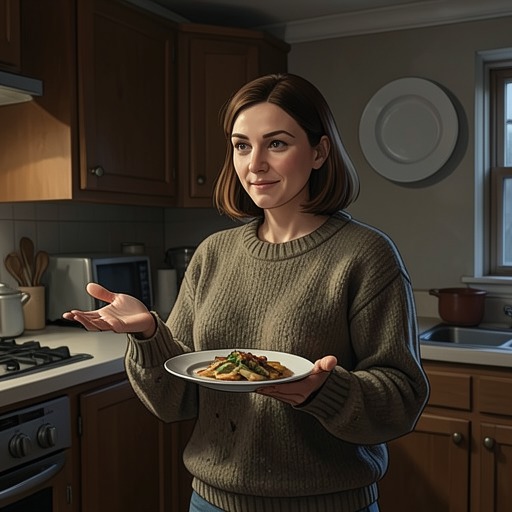
Dawn’s Binge-Purge Eating Disorder
A Dog's JourneyDawn’s Binge-Purge Eating Disorder becomes visible through a quiet exchange in which CJ recognizes the physical signs of a struggle she once kept herself. Rather than expose Dawn to her family or treat the problem as a matter of willpower, CJ draws on her own experience, offers a route to support, and lets Dawn decide whether to accept it. Their later reunion shows the relationship continuing beyond that first disclosure: Dawn returns to CJ’s bedside, speaks of a future in medicine, and describes CJ as someone who helped save her life.
Signs and Recognition
Dawn first appears as the eldest of three children in a family gathered around their suffering mother. CJ invites her for coffee, and the two sit together before CJ asks about comfort foods. Dawn names peanut butter and heat-and-serve lasagnas, then laughs wryly. When CJ observes that eating can ease stress, Dawn falls quiet. The shift from an ordinary conversation about food to a more personal one gives CJ an opening to ask what happens after Dawn has eaten too much.
Dawn reacts with alarm and asks what CJ means. CJ does not begin by labeling or interrogating her; she explains that, in high school, she used food to feel better, while hating herself as she ate and fearing the weight she thought she was gaining. She then describes getting rid of what she had eaten. The disclosure makes the conversation specific: CJ is not guessing from a distance, but speaking about a pattern she has experienced herself.
She also names bodily signs that Dawn may recognize. CJ says that her own eyes had frequently contained small spots of blood and that her cheeks sometimes swelled; she sees the same signs in Dawn. CJ later explains that acid from the behavior damaged her teeth, which she lost when young and replaced with implants in college. These details give the disorder a physical history extending beyond a private feeling of shame. They also show why CJ’s recognition matters: her account connects what Dawn may have concealed to consequences that can persist for years.
Disclosure, Fear, and Support
Dawn tries to leave, and CJ asks her to stay a little longer. Dawn shuffles her feet, frightened, as CJ continues. The scene does not present disclosure as an easy release: Dawn asks whether CJ will tell her father, while also saying she thinks her mother may know but has never spoken to her about it. The question reveals how much the problem is bound up with secrecy and the fear of losing control over who knows.
CJ responds by acknowledging the secret’s emotional burden and telling Dawn that a program exists. The evidence does not specify the program’s methods, and Dawn rejects the offer immediately, pushing her chair back. CJ does not force agreement in that moment. Instead, she tells Dawn she is on her side and asks her to call whenever the urge returns in the coming days or weeks. The offer is concrete and ongoing: help is available at the point when the behavior feels uncontrollable, not only during this one conversation.
Dawn’s concern about disclosure remains central. She asks CJ to promise not to tell her father. CJ makes her reassurance conditional: she will keep the confidence only if she knows Dawn is not going to hurt herself. That answer balances respect for Dawn’s trust with concern for her safety. It does not claim that one conversation resolves the disorder; it establishes a relationship in which Dawn can return for help while making clear that serious danger cannot simply be kept secret.
A Relationship That Continues
Years later, Dawn visits CJ while CJ is gravely ill. She is no longer the frightened girl with apple-scented hands whom CJ first approached; she is grown, and she sits beside CJ talking for hours. The repeated visits mark a lasting bond rather than a single intervention. CJ’s other visitors and the children around her bring moments of happiness, but Dawn’s long conversations make especially clear that their connection has endured beyond the original disclosure.
Dawn now speaks about trying to get into medical school and not yet knowing which specialty will appeal to her. CJ tells her that she will succeed. Dawn answers that CJ has always believed in her and says, “You saved my life.” CJ refuses to make herself the sole author of Dawn’s survival: “No, you saved your own life. You know what they say in the program—no one else can do it for you.” Dawn agrees that she knows. The exchange gives the earlier offer of a program a later human consequence, without suggesting that support and Dawn’s own action are interchangeable.
The story does not spell out when Dawn entered the program, how treatment proceeded, or whether every symptom disappeared. Its evidence instead rests on a movement from guarded recognition to sustained connection: CJ sees what Dawn fears revealing, shares the cost of her own experience, and offers help without claiming ownership of Dawn’s recovery. Dawn’s later presence at CJ’s bedside, and her aspiration to become a doctor, show a life extending beyond the secret that first brought them together.