Dogs
A Dog's JourneyDogs are central to the novel not merely as companions but as attentive beings with purposes, memories, preferences, and the capacity to learn how to care for people. The canine narrator’s successive lives—as Toby, Bailey, Ellie, Buddy, Molly, Max, and Toby again—trace a changing understanding of that purpose: loving one person is not the only way to be a good dog, and service can mean rescuing someone, warning of danger, or simply bringing comfort.
Identity, Purpose, and Reincarnation
The narrative gives its canine point of view a distinctive account of identity across lives. In an early life as Toby, the dog recalls having no particular purpose beyond playing with other dogs. As Bailey, he meets Ethan and comes to understand loving his boy as the focus of his existence. As Ellie, he has work that is more overtly practical: finding people and saving them. Later, as Buddy, he believes his purpose has been fulfilled and that his approaching death will be final. He measures his life by whether he has loved Ethan as well as he could, and regards that devotion as the work that made him a good dog.
That belief changes when Buddy sees a very young child from Ethan’s family wobbling toward the end of the dock. Though he thinks his life may be nearly over, the sight prompts him to imagine jumping into the water to pull her to safety. In the next life, as Molly, the dog recognizes Clarity and concludes that he has been reborn to watch over her. His purpose is no longer confined to the boy he first loved: he understands his new guardianship of Clarity as a continuation of care, not a betrayal of Ethan. Across these lives, reincarnation gives the dog continuity of affection and intention even as the people around him, his body, and his tasks change.
Protection and Practical Work
Dogs’ protective instincts are shown as choices made under pressure, not as effortless fearlessness. When the horse Troy threatens the baby Clarity, Buddy recognizes the danger of Troy’s size and hooves and feels the instinct to retreat. He nevertheless pushes through a gap into the kennel, places himself between horse and child, and barks, bares his teeth, and lunges. As Troy’s hooves strike close to him, Buddy continues to hold the line, even biting at a hoof that passes near his ear. The episode establishes that protecting a person can require the dog to override self-preservation.
Molly later responds to danger in a different setting. When a man reaches for CJ after pulling at her blanket, Molly senses CJ’s fear and leaps against the bed, snarling and thrusting her face toward him. The man stumbles into a shelf, knocking books and photographs down, and falls to the carpet. Molly keeps barking until CJ touches her and reassures her. The scene echoes Buddy’s defense of Clarity: in both cases, the dog reads a person’s vulnerability and intervenes physically, though the threats and circumstances are different.
The book also presents canine work as learned and potentially useful beyond a household. At Andi’s dog rescue, a grant supports research into cancer detection alongside the center’s rescue work. Andi explains that dogs’ sense of smell is far more intense than humans’ and that studies indicate dogs can detect cancer on a person’s breath before other diagnoses. Her aim is to put research methods into practice outside a laboratory, potentially at a health fair or community center. The dogs are therefore not only objects of rescue or companions to people; their abilities may allow them to participate in early detection in public settings.
Molly’s participation demonstrates that this work involves learning a signal, not just noticing an odor. Andi believes dogs can detect the scent without necessarily connecting it to a signal for their handlers. Molly learns by watching Luke cross his paws, copying his behavior in a way Andi has not encountered before. Andi interprets the observation as evidence that Molly has learned the signaling behavior from another dog and invites her into the program. The episode gives canine learning a social dimension: a dog can acquire a useful task by attending to another dog, not only by following human instruction.
Social Life, Play, and Learning
Dogs in the novel are represented as strongly oriented toward shared activity with people. The narrator contrasts dogs walking beside people with cats, who are described from the dog’s perspective as generally walking by themselves. On a walk with CJ, Molly’s later life as Max, and Duke, Max stays close to CJ while Duke pulls at his leash after one smell and another, repeatedly tugging her off balance. Max sees the difference as a matter of training and attentiveness; his own careful pace makes him feel like the better walking companion. This is a canine judgment, colored by the narrator’s pride in being a good dog.
That pride does not prevent play or companionship between dogs. Max’s relationship with Duke softens from their first wariness because Duke is submissive during their games, falling onto his back and letting Max climb over him and chew at his face. At the dog park, Max races freely while Duke and Sally follow. When Beevis chases and corners him, Duke charges into the encounter, disrupting the threat and making Beevis less hostile. Max then returns to CJ, who lifts him into her lap. The outing joins the pleasures of running among other dogs with the security of returning to a trusted person.
The bond between dogs persists through separation as well as shared play. During CJ’s illness, Trent brings Duke to visit. Max greets his old companion by rising onto his hind legs, licking Duke’s lips, and wrestling with him as Duke rolls onto his back. Their reunion is exuberant, a contrast to the restraint Max has learned to practice around a sick person. Canine companionship is thus presented as its own relationship, not simply as an extension of a dog’s bond with a human household.
Rescue, Confinement, and Vulnerability
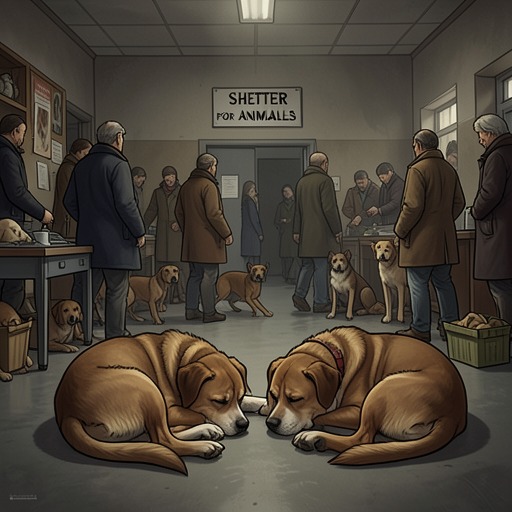
The novel also depicts dogs’ vulnerability to the systems that take them in. After Gloria abandons Molly by presenting her as a stray, Molly recognizes the shelter as a place like the dog rescue she had visited with CJ, but with many more dogs, a low ceiling, and cramped aisles of cages rather than a large space for people to sit. Her own kennel has a cement floor and only a few feet between the gate and a doghouse. The carpet inside bears the smell of many dogs, while barking fills the air. When staff bring food or water, Molly rushes to the gate, wagging and hoping to be let out; the woman is kind, but does not release her. The contrast between her desire to run and play and the limits of confinement makes the shelter’s conditions immediate from a dog’s perspective.
A later transfer to another facility intensifies that sensory experience. In a cage aboard a truck, Molly hears and smells the dogs before a door opens. The building’s slick floor gives her little traction, and the barking is so loud that she cannot hear her own nails scrabbling as she tries to stand securely. She is taken up a ramp to a metal table, where two men hold her while a handler identifies her as friendly. A hand grips the fur behind her head and a sharp pain follows. Molly wags with her ears lowered, trying to communicate that despite being hurt, she is not hostile. The episode places the dog’s trusting response beside the unfamiliar procedures imposed on her, showing how friendliness does not protect a dog from fear or physical vulnerability.
Care, Restraint, and the Good Dog
As Max, the dog learns that affection must change its form to suit the person receiving it. Having watched Duke’s rambunctious conduct around CJ, he concentrates on being calm and comforting when she and Trent are dealing with illness. Earlier, his role had been to keep threats away; now he tries to keep sadness away. He accompanies CJ to a place where people fuss over her, and he lies quietly rather than jumping around the room. The same bond that once called for active defense now calls for stillness.
In the hospice, Toby extends that quieter kind of care to many people. Earlier, he had devoted himself to one person at a time, first Ethan and then CJ, eventually understanding that love for CJ did not diminish his love for Ethan. At the hospice, he has no single person to whom he belongs; his purpose is to love each of the people there, and that attention makes them happy. His role expands from exclusive devotion to shared companionship without making his earlier attachments meaningless.
Toby learns the importance of restraint through a concrete mistake. He understands why he is told to Be Still after once stepping on a patient’s stomach during play and hearing the man cry out. The sound stays with him, and he feels awful about having caused pain. To visit the patient, Bob, again, Toby works out how to leap first onto a chair beside the bed and then onto the blankets without stepping on him. The adjustment combines memory, remorse, and practical learning: care means noticing how a dog’s body may affect someone who is weak or hurting.
The dog’s final understanding of goodness is therefore broader than obedience or a single heroic act. He can defend a child or CJ, learn cancer-signaling behavior by watching Luke, play with Duke, and remain still beside hospice patients. Over several years, Toby becomes comfortable as a dog who belongs to no one person and yet to everyone. At Thanksgiving and Christmas, he finds crowds, treats, and familiar communal rituals; the celebration reinforces his sense that his work matters. The recurring idea of being a good dog gathers these different forms of action into one identity: purposeful love can be brave, social, teachable, or quiet.