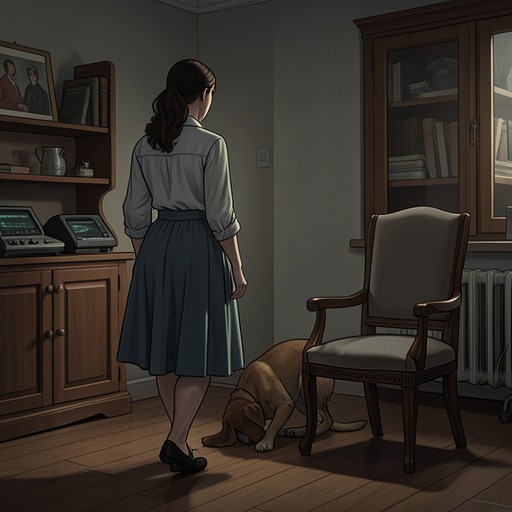
Gloria’s No-Dogs-at-Home Rule
A Dog's JourneyGloria’s No-Dogs-at-Home Rule begins as a demand to exclude dogs from the home, but its stakes quickly exceed household arrangements: Gloria uses the ban to assert control over CJ, while CJ treats keeping Molly as inseparable from caring for her. The conflict moves from covert confinement beneath the stairs to an ultimatum, a proposed court fight, and, eventually, Molly’s return to the family home and regular visits to Andi’s dog rescue.
Definition and Early Attitudes
The rule is stated most plainly when Gloria rejects Molly as a member of the household. After Clarity Mahoney brings the puppy home and Gloria sees them together, Gloria insists that Molly is not Clarity Mahoney’s dog and orders them out. She makes the restriction explicit: “You cannot have a dog in my house!” Clarity Mahoney answers that she is keeping Molly. The exchange turns a household boundary into a direct contest between a parent’s authority and a child’s determination to protect an animal she has taken in.
Gloria’s objection has an earlier echo at Hannah’s home. While Clarity Mahoney is still a baby, Gloria asks Hannah to keep Buddy outside whenever Gloria and her daughter visit. Hannah refuses, saying that Buddy is part of the family. This is a separate household and a different dog, but it establishes a contrast: Hannah will not treat a dog as disposable or exclude him from family life, whereas Gloria’s later rule makes exclusion a condition of life under her roof. The comparison gives the ban a relational dimension before Molly even enters the story.
Concealment Beneath the Stairs
Faced with the prohibition, Clarity Mahoney tries to keep Molly hidden. She carries the puppy to a low space beneath the stairs, calls it her special clubhouse, and provides a pillow and water. She tells Molly to stay quiet while she leaves for a short time. When Molly slips out as Clarity Mahoney blocks the entrance with boxes, Clarity Mahoney puts her back and repeats the instruction: “Be good, Molly,” followed by “Remember, stay quiet. Don’t bark.”
The hiding place exposes the practical cost of the rule. Molly is not simply kept out of Gloria’s sight for an afternoon: she is confined in a cramped space, and Clarity Mahoney leaves her there while going out. Molly scratches at the boxes, naps, chews a plastic toy, and eventually has to relieve herself in the corner. When she barks, the enclosure throws her small sounds back at her; no one comes to let her out. The scene makes the conflict concrete: preserving the secret requires a vulnerable puppy to endure confinement, while Clarity Mahoney’s wish to keep Molly close cannot yet be reconciled with Gloria’s ban.
Open Defiance and Escalating Threats
The concealment ends when Gloria encounters Molly at the house. Clarity Mahoney picks the puppy up as Gloria approaches, and Gloria responds with an order to leave. Clarity Mahoney refuses and insists that she is keeping Molly. The confrontation also reveals the pressure surrounding Clarity Mahoney’s absences from school: Gloria says a delinquency officer has visited and warns that Clarity Mahoney is in trouble for missing so much school. The dog dispute is therefore entangled with questions about parental responsibility and the consequences of Clarity Mahoney’s efforts to stay with Molly.
Clarity Mahoney later tries to turn that pressure into leverage. She proposes going to court and says she will tell the judge that she lied about attending school, so that Gloria will not be blamed for her truancy. The proposal makes keeping Molly part of a larger challenge to the way Gloria exercises parental authority. Rather than accept the conflict as settled by a household rule, Clarity Mahoney is prepared to ask a judge to decide whether she should remain in Gloria’s care.
The prohibition continues to frame their arguments after the conflict has widened. Gloria repeats that the trouble began when CJ brought home the dog and says CJ must get rid of Molly. She invokes Rick’s advice, argues that her own account of having offered a babysitter would defeat CJ’s claim, and points to an expensive cruise as evidence that CJ had sometimes been included in her plans. Against this appeal to control and proof, CJ answers that she will not give Molly up. Gloria then jabs a finger at Molly and threatens to make life miserable for both CJ and the dog, declaring that she does not care where Molly goes or what happens to her so long as the dog is not in the house. Molly’s presence has become the visible focus of the mother-daughter conflict, and the rule is enforced through threats rather than a practical arrangement for the animal’s care.
Compromise and the Rule’s Limits
CJ eventually proposes that she and Gloria take the dispute to court. She says she will hire a lawyer and seek to have Gloria declared an unfit mother, while Gloria can fight for custody. This is a significant change in the terms of the argument: the rule no longer stands as an unquestioned command inside the home, because CJ openly contests Gloria’s authority through the legal process she has invoked. The evidence does not describe a court ruling, so the subsequent change is shown through what happens in the household rather than through a formal judgment.
That evening, CJ and Molly move back into their room at Gloria and CJ’s house. Trent visits with Rocky, and Molly is delighted to see her brother again. Afterward, CJ takes Molly by car most mornings to spend time with Andi and her dogs instead of leaving for school. Molly’s return shows that Gloria’s ban does not succeed in removing her from CJ’s daily life or from the home. At the same time, the regular trips to Andi’s place mark a practical accommodation around the conflict: Molly remains with CJ, but also has access to a setting where she can be with other dogs. The rule’s lasting significance lies in its failure to contain the relationship it was meant to prohibit. It provokes secrecy and threatens separation, yet CJ’s resistance ultimately restores Molly to the household and makes her care a continuing part of their lives.