Jennifer
A Dog's JourneyJennifer is a dog fosterer whose home becomes a refuge for a litter of puppies separated from their mother. She is defined by care expressed through attentive, repeated work: recognizing when the puppies are in trouble, helping restore their access to nourishment, and feeding and comforting them herself. Her kindness is not simply a wish to keep every animal; she understands fostering as a continuing cycle of rescue and adoption.
Identity and Fostering
Jennifer’s home carries the scent of many dogs, although the puppy narrator initially sees only one: a large, slow-moving male who walks close to the ground, his floppy ears nearly dragging. The Man thanks Jennifer for taking in Bella and her puppies, and she explains that fostering is her work. She has just adopted out a boxer and expects that another group of dogs will arrive in its place. Her matter-of-fact account presents fostering as a sustained practice, not a single exceptional act: one animal’s departure makes room for the next one who needs help.
That work takes place amid limits Jennifer does not control. The Man explains that his son, Johnny, has a serious allergy to dogs, which triggered an asthma attack; the family is having its house steam-cleaned. Bella, a poodle, had not caused the same reaction, so the severity of Johnny’s allergy had not been known. Jennifer’s foster care therefore begins with a family’s urgent need to protect a child, as well as with the disruption that separating Bella from her people causes for the mother and her litter.
Responding to Bella and the Puppies
Bella is so distressed after the Man leaves that she abandons the box and cries at the stairs. Her agitation reaches the puppies: they stop playing, and their mother will not lie down to nurse them, even as her teats grow heavy. Jennifer notices the problem and tells the Man that Bella is too upset to feed the litter. Her intervention begins with observing what has changed in the animals’ behavior, rather than treating the puppies’ crying as an isolated inconvenience.
Jennifer then proposes a way to address both the family’s allergy concerns and Bella’s distress. The Man could take Bella and the poodle puppies home, bathe them, and remove traces of the other two puppies; Jennifer says this would save four and would also be better for Bella. The suggestion makes the stakes plain: the household’s fear of another asthma attack puts the litter’s future in question, and the available solution may not save every puppy. The Man asks whether the other two would be euthanized rather than left to starve. The evidence does not establish the final decision, but Jennifer’s proposal shows her trying to find a workable path that protects Johnny while saving animals and reuniting Bella with her people.
Care in Practice
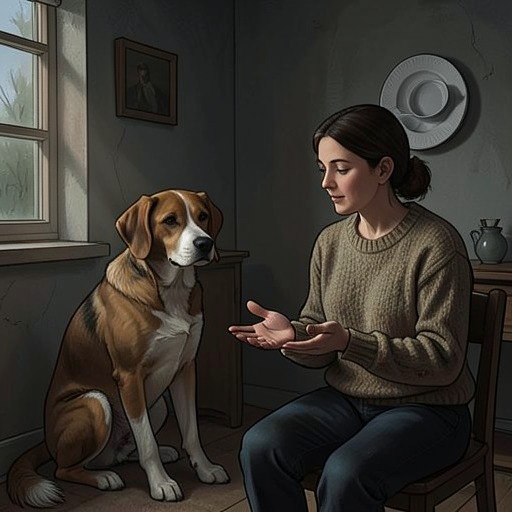
After Bella and the other puppies are gone, the narrator and a brother wake cold and hungry in the box. Jennifer comes to see them and recognizes that they miss their mother. Her voice soothes the brother, who rises against the side of the box to reach her as she bends toward him with a smile. The scene makes Jennifer’s comfort concrete: she attends to the puppies’ fear and answers it with closeness and reassurance.
Jennifer also takes the narrator upstairs and cradles the puppy on her back, telling her to stay still. The narrator squirms at the approach of an unfamiliar object, but Jennifer speaks gently and asks her not to fight it. The precise purpose of that moment is not stated; what is clear is Jennifer’s effort to handle the puppy calmly. From then on, she feeds the puppies in her lap several times a day. The narrator comes to anticipate the feedings and to love both the food and Jennifer’s voice as she cuddles her. Jennifer adjusts the order, too: because the brother becomes distressed when the narrator is fed first, she gives the narrator the second turn rather than feeding over his cries. Her care is practical and responsive, shaped by what each puppy appears to need.
Boundaries and Narrative Role
Jennifer’s tenderness exists alongside a deliberate boundary. When a woman takes Che, Jennifer explains that keeping every foster dog is called foster failure; she says it happened with Barney, her first foster. She had realized that if she adopted several dogs herself, she would no longer be able to help others. The admission gives her generosity a particular form: she can become attached, but she tries not to let attachment end the work of making room for the next animal.
That balance distinguishes Jennifer’s role in the puppy narrator’s early life. She provides temporary security after separation, and her lap becomes a place of repeated feeding and affection. At the same time, her account of fostering makes clear that care can include letting an animal go. The puppy’s gradual trust in her is not presented as a reason Jennifer should keep every dog; it is evidence of what attentive foster care can make possible while an animal waits for a new life with a person.