Luke
A Dog's JourneyLuke is Andi’s big brown male dog and the most conspicuous working example in her scent-based sessions with dogs and people. His focused sniffing and precise response show Molly a behavior she later copies, making him an unwitting teacher in her entry into Andi’s program.
Identity and Introduction
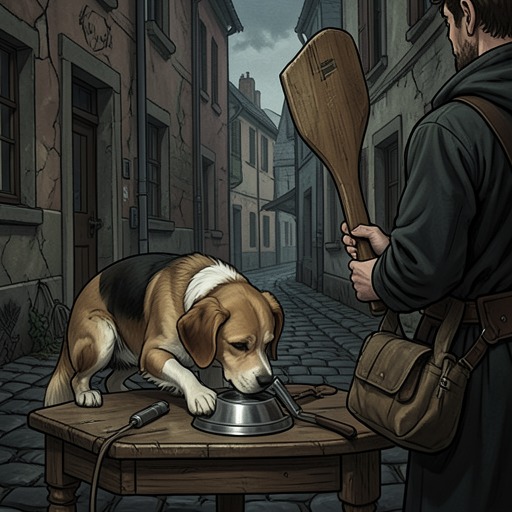
Luke first appears beside Andi as she works with a dog among several metal buckets. She leads him to sniff each bucket; at one, she gives the instruction “Smell that? Now drop!” and Luke lies down, earning a treat. When Molly edges close, the dogs sniff one another, and Andi introduces him by name. Molly recognizes that Luke is a serious dog, intent on the game, unlike Rocky, whose attention is chiefly directed toward having fun and loving Trent.
That contrast establishes Luke through what he does rather than through a history or explanation of his training. The narrative gives no account of how long he has worked with Andi or how he learned the task. It does, however, repeatedly show him attending carefully to a scent exercise and responding in a consistent, recognizable way.
Work with Andi
In a later session at Andi’s building, the dogs are kept indoors because they are not allowed to go out into the snow except for leash walks. While CJ cleans kennels, Molly plays in a fenced indoor area. Some dogs are too old to play; others, frightened and unsure how to play, snarl or snap and are moved one at a time to another pen. Molly spends much of this time watching Andi work with Luke and two female dogs, one yellow and one black.
The exercise involves older people seated far apart in metal chairs. Andi brings the dogs to them one at a time so they can sniff each person. The people remain seated and do not play with the dogs; after each round, the dogs return to their kennels while the people change seats. Luke’s response is particularly clear when Andi leads him to a bald man: he sniffs carefully, lies down, crosses his paws, and rests his head on them. Andi rewards him immediately and praises him. The repeated routine makes the change of seats part of the exercise, while Luke’s quiet, deliberate posture marks the response Andi values.
Luke is not presented as the only dog capable of participating: Andi praises all of them. But she becomes especially excited when Luke performs his signal. The account’s attention to his specific behavior gives Molly, and the reader, a visible example of how sniffing can be connected to a communicative action rather than remaining an unexpressed response.
Molly Learns by Watching
Molly first tries Luke’s posture without understanding that imitation alone will not earn the same result. After watching him, she approaches the bald man and bows down, crossing her front paws. Andi notices and asks whether Molly learned it from Luke. Molly receives no treat then; Andi instead leads her back to CJ. The difference matters: Luke’s behavior is already part of the exercise, while Molly has reproduced its outward form without yet being recognized as a participant.
The later explanation makes Luke’s role in Molly’s progress explicit. Andi says that dogs may detect an odor without connecting that detection to a signal for people. In her view, Molly has been watching Luke, and the matching crossed-paw gesture supports her conclusion that Molly learned by observing him. Andi describes this kind of learning as something she has never heard of a dog doing before, and says she can see no other explanation. Luke’s work thus supplies the pattern through which Molly’s own capacity becomes legible to the humans around her.
Narrative Significance
Luke’s importance lies less in a separately narrated personal arc than in the chain of attention and learning he makes possible. His consistent response gives Andi a reason to praise and reward him; Molly watches that response, attempts it herself, and is eventually invited into the program. Her imitation turns Luke from one working dog among several into a model whose behavior helps another dog cross from observing the activity to joining it.
The scenes also connect Luke’s scent work to the story’s larger interest in what dogs can perceive and communicate. In one encounter, Molly detects an odd metallic tang on the bald man’s breath, a smell she recognizes from her earlier life as Buddy. The account does not state a diagnosis for the man, and Luke’s response is not explained in those terms at that moment. What it does show is the man as the focus of Luke’s careful sniffing and characteristic signal, within a program in which Andi is evaluating dogs’ ability to connect odor with an alert. Luke’s demonstrated task, and Molly’s surprising observational learning, together establish the practical and relational setting in which her ability can be developed.