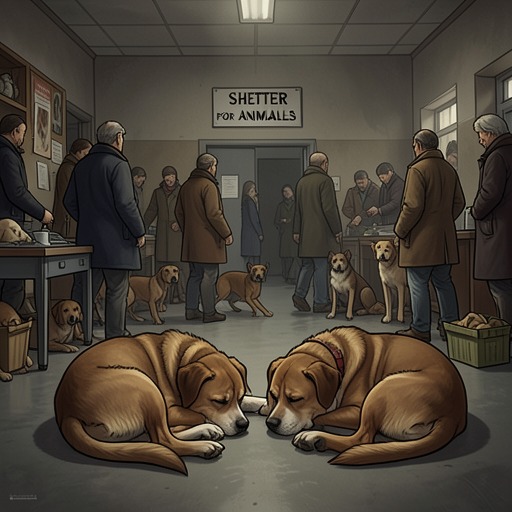
Max Listed for Euthanasia
A Dog's JourneyMax Listed for Euthanasia is the shelter’s final disposition for Max after his aggression and prolonged failure to find an adopter make him difficult to place. The deadline brings the shelter’s limited capacity into direct conflict with Max’s attachment to CJ: he has been judged unadoptable by ordinary measures, yet he responds to her as someone he already knows.
How the Deadline Develops
The threat first becomes explicit when a man checks whether anyone is interested in Max and Gail says that, after that day, he must be put on the list. Max is waiting in a pen, watching people rather than taking part in the decision. When neither person opens the gate, he lies down in the grass; from his perspective, the immediate obstacle is that he cannot get out and find CJ. The shelter’s timetable, however, is already closing around him.
His difficulty is not only a lack of interest from adopters. Gail reports that Max nipped a little girl that morning, and the man doubts that anyone would be able to handle him even if he could be adopted out. Max’s behavior has therefore become part of the official case against placing him, while his own account stresses how little he understands of the judgment being made. He is focused on CJ when the adults discuss his prospects, and his attention to her does not fit their picture of a dog who has failed to warm to people.
The man nevertheless grants him one more adoption fair, planned for Tuesday, while acknowledging that Max is already past the established time. The exception is temporary rather than a fresh start: one additional chance is offered against a deadline that has already been exceeded. When Max is taken to the open-air pen again, Gail tells him that it is his last day. She still thinks he is a wonderful dog, but cannot take him herself because her apartment does not allow dogs, even small ones. Her affection cannot change the practical limit that keeps her from becoming his adopter.
Shelter Limits and Risk
The later conversation makes the shelter’s policy and its pressures explicit. Max is scheduled to be euthanized the following morning. Gail explains that the shelter is not a no-kill facility; it tries to foster animals to no-kill shelters when possible, but those shelters are full, as is its own, and new dogs arrive every day. Puppies are usually easier to place, but Max has not warmed to other people and is overdue. The decision is presented not as an assessment of his worth, but as a consequence of limited space and competing animals in need.
That distinction does not soften the outcome for CJ. She recoils when she learns how soon Max may die, and Gail acknowledges that the policy is brutal even as she explains why it is used. The shelter’s image of rescue as a flow that must continue frames the dilemma as a contest between saving one dog now and preserving room for dogs still arriving. Max is the individual at the point of that trade-off: the shelter has tried to find alternatives, but its usual routes for extending his stay have run out.
Max and CJ
For Max, the approaching deadline is bound up with recognition. He remembers CJ from the time he was Molly and insists that he would know her despite the changes in her appearance. Though the shelter is filled with unfamiliar scents, he can still find hers. When he sees her walking past the pen alone with two bags, he yips; she turns and looks directly into his eyes, then continues walking. He scratches at the fence and cries after she moves on. The encounter gives him a brief sign of recognition without the reunion he is seeking.
CJ later holds Max while Gail observes that he plainly likes her. Gail says that Max has warmed to no one else—not even her, though she feeds him—and that he snapped at her that morning. Against the earlier report of the nip to a child, this detail sharpens the contrast between Max’s behavior around people generally and his response to CJ. Gail interprets their connection as a choice Max has made among all the people in New York City, and turns that bond into the basis of her plea for CJ to take him. She offers to waive the adoption fee and says he needs a chance.
The Unresolved Choice
CJ’s hesitation has a concrete reason: she has only just adopted a cat, two weeks earlier. Gail counters that dogs and cats raised together usually do well, and that adopting Max would save his life. The argument makes the stakes unusually immediate. This is not a general appeal to compassion; Gail has told CJ that Max is due to be euthanized tomorrow, and she asks her to decide while holding the dog who has singled her out.
The scene ends with the deadline still in force. CJ has not yet agreed, and Gail returns to the consequence of refusal: tomorrow Max dies. The episode thus leaves his placement suspended between an institutional decision already made and a personal bond that might still interrupt it. Max’s listing marks the point at which his record of aggression, the shelter’s overcrowding, and his recognition of CJ converge; none cancels the others, but together they make her response the last visible possibility of changing his fate.