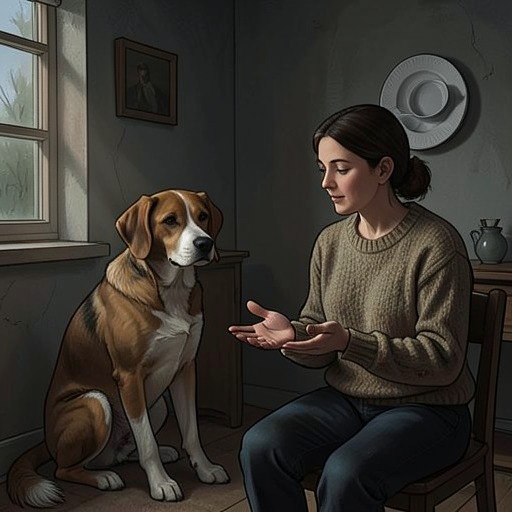
Spring in Molly’s Puppyhood
A Dog's JourneySpring in Molly’s Puppyhood marks Molly’s adjustment to life as a female puppy and her brother Rocky’s companion in Jennifer’s home, a place crowded with dogs and open to the uncertainty of fostering. Its decisive turn comes when Molly recognizes Clarity Mahoney among the people who arrive to meet the puppies: the encounter transforms an unexplained separation into a reunion across lives.
A foster home in spring
Molly and Rocky live with Jennifer after being separated from their mother and other siblings, whose fate Molly briefly wonders about before finding that she can scarcely remember them. For now, their household consists of two puppies and Barney, a lazy dog whose soft, floppy ears become irresistible targets for their tugging. Molly also has to adjust to being female and to the unfamiliar arrangement of her new life.
As the puppies grow stronger, Barney becomes less patient with their chewing. Other dogs bring new rhythms to the household. Che, a big gray dog, races around the backyard in the warming spring sun, inviting the puppies to chase him and darting back to bow when they give up. Mr. Churchill offers a pointed contrast: stocky, short-eared, wheezing and waddling, he seems almost incapable of running, though Rocky can sometimes goad him into chasing the puppies. Jennifer’s home feels to Molly like living full-time in a dog park, even as she sometimes misses The Farm.
Waiting for a home
The puppies’ days at Jennifer’s are shaped by the decisions of people who control where dogs live and what happens to them. When visitors come, Molly understands that they may be there to take either her or Rocky home. She wonders why she should have to leave—and privately thinks Mr. Churchill would be the more obvious dog to choose—but accepts that the decision is not hers.
On one visit, neither puppy is chosen. Molly feels relieved that she and Rocky will remain together and that she does not have to say goodbye to the other dogs, but cannot understand why people would come to play with her and then leave without taking her. The unanswered question gives the later arrival of Clarity its force: Molly’s future is not simply a matter of which strangers happen to choose her.
Recognition in the backyard
Before that recognition, Molly and Rocky play with Daisy, a new brown dog who is thin and timid around Jennifer. Daisy avoids Jennifer’s reaching hand and keeps close to the shelter of a place behind a picnic table, though she will wrestle with the puppies and let them pin her despite being much larger. The scene of ordinary backyard play changes when car doors slam and Jennifer comes outside with a boy and a girl.
The girl is about the age Ethan was when he began driving. She kneels and opens her arms; Molly and Rocky run to her, and she gathers them close. Molly recognizes Clarity by her scent. Her response is immediate and physical: she climbs over Clarity, kisses and smells her, then leaps and spins with joy. The recognition is not prompted by anything Clarity says or does to identify Molly; Molly knows her through the intimacy of scent and contact.
A bond carried across lives
Molly had not expected Clarity to come looking for her or to know that she had been reborn. The encounter gives Molly a new explanation for the people who had visited without taking her and Rocky: they had been searching for their own dogs, and the puppies were not the ones they sought. In Molly’s understanding, human power over dogs’ homes and daily lives now includes something more wondrous—the possibility of finding a beloved dog again.
The spring setting holds both change and continuity. Molly must learn to live as a female puppy in a household unlike The Farm, yet the bond she recognizes in Clarity has survived the change of body and circumstance. The season’s emotional movement is from waiting without understanding to recognition: Molly cannot choose where people send her, but she discovers that a connection from her former life can lead Clarity back to her.