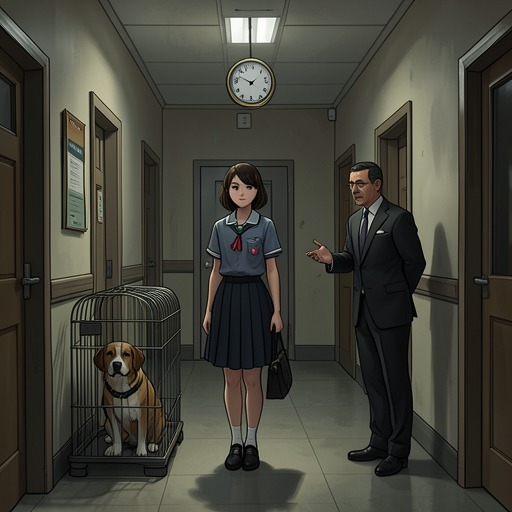
The Art Building
A Dog's JourneyThe Art Building is both a recurring refuge for CJ and Molly and the setting for a consequential encounter involving Shane and Kyle. In Molly’s account, it first appears as a quiet place where CJ can work while Molly chews a toy; its welcome contrasts sharply with the coldness Molly experiences at home. Later, a nighttime visit there draws CJ into the circumstances of a theft investigation, giving the familiar workspace a more troubling significance.
A Quiet Place to Make Art
CJ and Molly go to the Art Building regularly for what they call “art building.” CJ plays with papers and sticks that smell, while Molly settles with a chew toy. The routine is deliberately simple: the dog has something to do, and CJ has a place to concentrate on her work. The building is not described through its architecture or equipment; its character comes instead from what CJ and Molly do there together.
Molly’s perspective makes the space especially important by setting it against home. At the Art Building, people know her name, pet her, and sometimes feed her. At home, CJ welcomes and cuddles her, but Gloria pushes her away when she tries to greet her. Molly also observes that Gloria never touches CJ. The building’s public welcome therefore contrasts with a home in which affection is scarce, and the difference helps explain why Molly regards her companionship as a central comfort for CJ.
The refuge is not exclusively social. Sometimes other people are present to pet Molly; at other times, CJ is alone in the building with her. The repeated visits establish the place as part of their ordinary life rather than a one-time escape. In Molly’s telling, art-making, a chew toy, and quiet company form a small routine that can continue whether or not anyone else comes in.
A Familiar Space Against Home
The building’s significance is sharpened by the separation between CJ’s life there and Molly’s life at home. When CJ is away, Molly is kept downstairs, though Trent helps CJ install a dog door in the basement door so Molly can go into the backyard. The Art Building offers a different kind of freedom: Molly accompanies CJ, receives attention from others, and remains close to the person whose company matters most to her.
That contrast is emotional rather than architectural. The evidence does not present the building as an elaborate sanctuary; it becomes one because CJ brings Molly there and because other people accept her presence. For Molly, being held by CJ helps ease CJ’s loneliness, while their shared visits let the dog participate in CJ’s activity instead of waiting alone at home. The location thus gathers two strands of their bond: CJ’s need for companionship and Molly’s pleasure in being included.
Shane and Kyle’s Late-Night Visit
The Art Building’s routine changes one night when someone taps at the door. Molly growls and raises the fur on her neck, and CJ reassures her before going to answer it. Molly recognizes Shane’s scent but remains uneasy. Shane arrives with Kyle, who says they want to pass their art-history midterms and calls the test a joke; he proposes making a copy and leaving. CJ appears unhappy, but she hands Shane something, which he tosses to Kyle before Kyle walks away.
The scene leaves the object CJ gives them unnamed, so its precise identity cannot be established from the account. The next exchange adds another detail without resolving that uncertainty: Shane returns, drops something on CJ’s table with a metallic ring, and says they are leaving. CJ does not answer. The encounter is therefore presented through actions and objects—a knock, an exchange, a metallic sound—rather than an explanation of CJ’s intentions or knowledge.
The Break-In Investigation
A few days later, two police officers come to CJ’s house while she and Gloria are watching television. They say they are investigating a break-in at the high-school art department and list a laptop computer, cash, and a silver picture frame among the missing property. CJ reacts with surprise, asking about the break-in. The proximity of this investigation to the earlier visit at the Art Building gives that scene a new weight: Shane and Kyle had asked for access in connection with copying an exam, and the officers later bring news of theft from the art department.
The evidence links the Art Building to the investigation through the setting and sequence of events, but it does not, in these passages, establish exactly what CJ handed over or prove who committed the break-in. That distinction matters: the building is where CJ’s ordinary artistic routine and the suspicious request intersect, while the police visit carries the consequences into her home. The place’s narrative role rests on that contrast. A quiet refuge shared by a girl and her dog becomes the scene of an encounter whose possible connection to a crime is only made clear afterward.