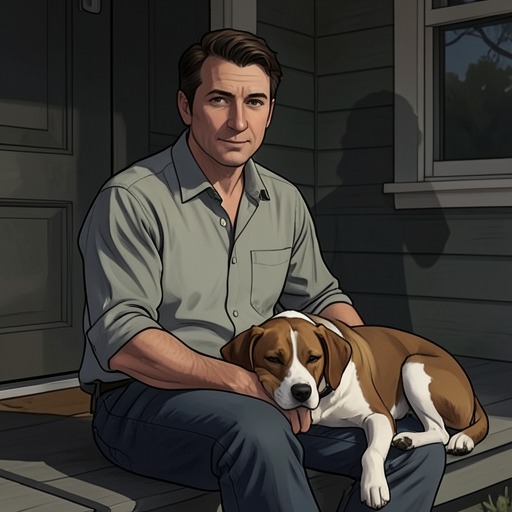
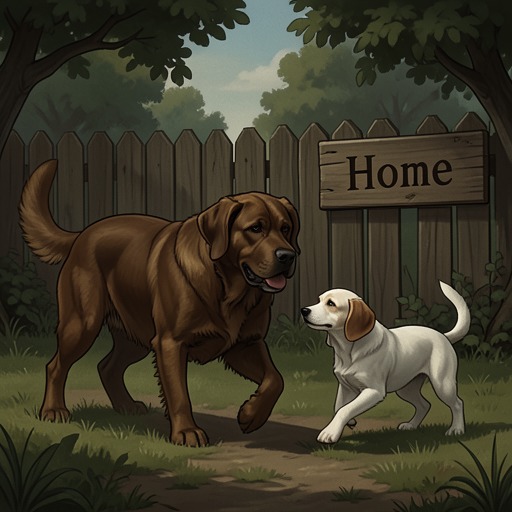
Trent and Rocky’s Owner-and-Dog Bond
A Dog's JourneyTrent and Rocky’s Owner-and-Dog Bond is defined less by explicit declarations than by the small actions through which they share space and by the grief that follows Rocky’s death. Rocky’s alertness when Trent is threatened gives the relationship a protective dimension; later, Trent’s sorrow over losing him reveals the depth of their attachment. In the aftermath, Max offers comfort without making Rocky’s place in Trent’s life seem replaceable.
Identity and Everyday Companionship
Rocky is Trent’s dog and is regarded by the narrator as his brother. Their bond appears within a larger circle of relationships in which dogs have particular people to love and care for. The narrator understands its own purpose as looking after CJ, and recognizes a corresponding purpose in Rocky: to love and protect Trent. This parallel makes Rocky’s connection to Trent more than simple proximity. It presents the dog as having a distinct attachment and a role within the human relationships around him.
A quieter glimpse comes when Trent and CJ prepare to leave with suitcases. The narrator claims the front seat of the car, and Rocky comes over to sniff the narrator but does not try to climb in beside it. The moment offers little direct information about Rocky and Trent’s private routines, but it places Rocky naturally in Trent’s company and shows the dogs sharing an ordinary departure. The narrator expects to see Trent and Rocky again in a day or two, treating them as a familiar pair rather than as separate presences.
Protection in a Moment of Conflict
Rocky’s protective instinct becomes unmistakable during a tense encounter with Shane. When Shane resists leaving, Trent grows angry, CJ puts a hand on his wrist, and Rocky raises his ears as the fur along his back rises. The dog does not need to speak or intervene physically for his response to register: his posture signals alertness at the moment tension gathers around Trent.
The narrator reads that bodily reaction as an expression of Rocky’s purpose, just as the narrator’s own purpose is to care for CJ. The comparison gives the scene a relational symmetry. Both dogs are attentive to a person they love, but their roles are particular rather than interchangeable: Rocky’s attention is directed toward Trent, while the narrator’s is directed toward CJ. The bond is therefore presented through action and orientation, not merely through ownership.
Rocky’s Death and Trent’s Grief
Later, when Trent and CJ speak again, Trent apologizes for Rocky’s death. The narrator pauses at the sound of the name, registering the significance of the loss before returning to explore. Trent explains that Rocky had been a very good dog and that stomach torsion had killed him, a condition the veterinarian said occurred often in larger dogs. The matter-of-fact medical explanation identifies the cause, but does not lessen the emotional weight carried by Trent’s apology and sadness.
The narrator senses that sadness and races across the room, leaping into Trent’s lap. Trent catches the dog and kisses its head. This exchange shows grief passing between human and dog through touch: Trent receives comfort, while the narrator responds to the sorrow it perceives. The moment also connects Rocky’s absence to the beginning of Trent’s relationship with Max. Trent explains that he found Max at a dog adoption in Central Park, but the scene does not present the new dog as erasing the old bond. Rocky remains the dog whose name brings Trent’s grief into view; Max’s presence creates another relationship alongside that memory.
Meaning of the Bond
The relationship’s most revealing moments are brief: Rocky’s bristling posture during conflict, his place beside Trent in the ordinary pattern of departure, and Trent’s sadness when speaking of his death. Together, they frame companionship as an ongoing attachment expressed through vigilance, shared life, and mourning. Rocky is not only a sign of Trent’s care for a dog; in the narrator’s understanding, he is also a caregiver in his own right, with a purpose centered on Trent.
The narrator’s response to Trent’s grief extends the book’s recurring portrayal of dogs as attentive to human feeling. Max does not know Rocky in the scene as a replacement or rival; the evidence instead shows him answering the sadness present before him with closeness. The bond between Trent and Rocky thus remains legible after Rocky’s death: it survives in Trent’s grief, in the narrator’s recognition of what Rocky meant to him, and in the distinction between losing one companion and forming another attachment.