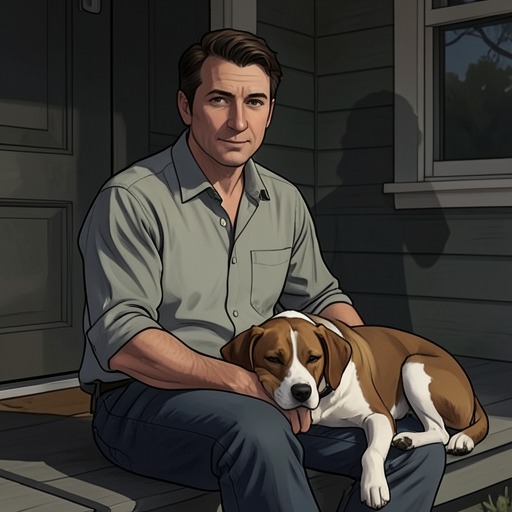
Trent’s Cancer
A Dog's JourneyTrent’s Cancer is the illness Max detects before CJ and Trent understand what his signal means. The warning begins in an ordinary command, “Pray!”, but its meaning changes when CJ recognizes that Max is responding to a scent rather than saying grace. Trent’s subsequent sickness makes the alert’s stakes painfully concrete; his later recovery confirms that the early warning mattered. The episode binds canine perception to human care without making the dog’s knowledge fully explainable, even to the people whose lives it changes.
Detection and the Misread Signal
When Trent bends down to Max, the odor is especially strong. CJ calls, “Pray!” and Max obediently signals, following the trained cue without knowing what his behavior signifies to the people around him. The command appears to be familiar and harmless, but Max’s response is carrying information about Trent’s health that neither person has yet interpreted. The danger is present before it has a name.
CJ’s sudden fear marks the moment the signal becomes intelligible to her. She puts a hand to her mouth, and Max immediately goes to her and nuzzles her, sensing the force of her reaction without understanding its cause. Trent asks why she looks frightened. CJ does not explain the odor or the alert; she asks him, “I want you to go to the doctor.” When he asks why, her voice breaks as she insists, “You have to do this for me!” Her plea converts an obscure sensory warning into a concrete request. The scene’s urgency comes partly from that gap: Max can detect something, but it is CJ who must persuade Trent to act on what the signal might mean.
Illness and the Strain of Care
Over the next year, Trent becomes very sick and vomits repeatedly in the bathroom. The sound and sight recall CJ’s former pattern of throwing up, although she no longer does so. The parallel does not make their illnesses the same: rather, Trent’s sickness reawakens a distressing memory for CJ, and his vomiting upsets her as much as her own once did. Max whimpers anxiously for both of them, registering distress across the household even when he cannot distinguish its causes or remedy it.
Trent’s illness also changes the shape of family visits. His mother and father come several times; his sister Carolina appears with a man and children, leading Max to infer that she now has a family. These gatherings feel unlike the reunions at the Farm. Only the children seem readily happy, ready to laugh, or interested in a good dog. The contrast places Trent’s illness within a quieter, more anxious domestic world rather than the lively family atmosphere Max remembers elsewhere.
The disease becomes visible in Trent’s body when all the hair on his head falls out. While Trent lies in bed, Max licks his scalp and makes him laugh; CJ laughs too, but her laughter has an underlying desperation, accompanied by constant worry. The gesture offers a small, immediate comfort, not a cure. Max’s attention to Trent’s changing appearance and his effort to draw laughter out of him show how care continues through simple physical contact while the illness remains serious.
Recovery and Recognition
Later, sitting with Max on a warm summer day, CJ explains what she believes his earlier signaling meant. She tells him, “You weren’t saying grace, were you? You were trying to tell us about Trent, trying to say you could smell his cancer. We just didn’t understand at first.” She wonders whether Molly told Max, whether Molly speaks to him, and whether either dog is an angel dog. These questions remain questions; CJ offers no proof of communication between the dogs. What she can state with certainty is that Max’s alert led her to urge Trent to seek medical attention.
CJ also tells Max, “We got it in time, Max. Because of you they got it and it hasn’t come back. You saved my husband.” Her thanks supplies the clearest account of the consequence: Trent’s cancer was caught in time and has not returned. The narration does not detail the medical diagnosis, treatment, or follow-up, so the episode’s emphasis falls on the warning, the decision to seek a doctor, and the reported outcome rather than on a clinical account. CJ asks Max to thank Molly if he talks to her, extending her gratitude beyond what she can verify to the dog she associates with his knowledge.
The Signal After the Danger Passes
Trent’s hair eventually grows back. Max is disappointed because licking Trent’s scalp had made him laugh, a small sign that recovery alters even the intimate routines formed during illness. CJ’s hair, too, is now longer than it has ever been, falling over Max when she bends down. The household has changed, though the narration does not claim that appearance alone measures recovery.
The scent provides a more direct marker. When Trent bends over, Max can no longer detect the metallic odor. Yet the old “Pray” command persists after its urgent purpose has passed. When Trent uses it, Max sits and stares at him in confusion; Trent and CJ laugh, clap, call him “Good dog!” and give him a treat, although he has done nothing. The joke depends on a gap between the signal’s former significance and its present use: the humans know that Max once alerted them, while Max cannot understand why the same command now earns praise without a meaningful odor to follow.
The episode therefore makes detection a relationship rather than a fully explained ability. Max senses before the humans understand; CJ interprets his response and acts; Trent’s illness gives the warning its meaning in retrospect. Recovery does not erase the episode but changes how its signs are read: the metallic odor disappears, the command becomes an affectionate ritual, and CJ remembers Max as the dog who saved her husband.