Under-stairs clubhouse
A Dog's JourneyThe Under-stairs clubhouse is the small basement enclosure where Clarity Mahoney tries to hide Molly and keep her quiet. Though Clarity gives the space a playful name and supplies a pillow and water, Molly experiences its boxes as barriers separating her from the person she wants to follow. The clubhouse’s meaning shifts with that divide: it is at once a refuge arranged by Clarity and a confinement Molly repeatedly resists.
A Secret Space Beneath the Stairs
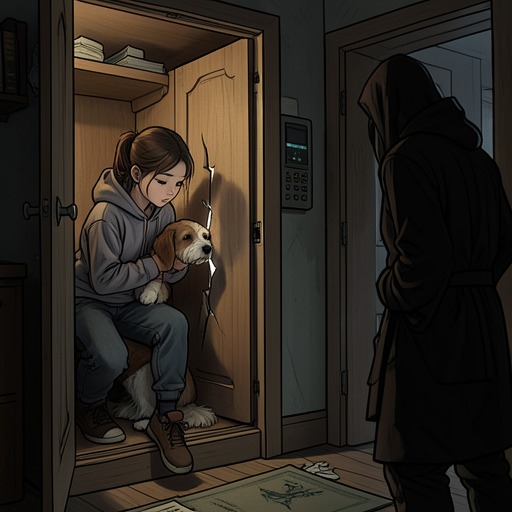
Clarity carries Molly down to the basement and shows her a space beneath the stairs, low enough that Clarity herself must squat inside it. She calls it her clubhouse, places a pillow there, and leaves water for Molly. The preparations make the enclosure look like a small, cared-for den, but Clarity’s instructions immediately complicate that impression: Molly must be quiet while Clarity leaves for a while. The arrangement’s comfort is real, yet it is conditional on Molly remaining unseen and unheard.
Food is part of the space’s makeshift provision. Clarity gives Molly cold, salty meat, and later promises to bring puppy food. But the clubhouse is not built around Molly’s needs in any lasting sense. When Molly has to relieve herself on the floor, the confined space becomes unpleasant; her small bladder, the basement, and the limited room make clear that the hideaway is not a suitable substitute for being outside. The contrast between the pillow and water on one hand and the corner where Molly squats on the other exposes the limits of its apparent domestic comfort.
Confinement, Barking, and Return
Clarity tries to secure Molly inside by sliding boxes across the opening. Molly darts out once, but Clarity picks her up and puts her back; this time the boxes block her exit. Left alone, Molly scratches at them, naps, chews a plastic toy, and eventually yips. The low enclosure throws her barking back at her, but does not make it sound powerful. Her voice seems tiny to her, yet barking becomes the action she can take when Clarity is gone.
The clubhouse therefore holds two conflicting lessons. Clarity insists on silence, but Molly’s experience teaches her that barking can bring Clarity back. After a later separation, Clarity pushes aside the boxes as soon as Molly yips. Molly takes the response to mean that barking is how to summon the person she wants. Clarity’s words and actions point in opposite directions: she asks for quiet, then answers the sound that breaks it. What is meant to conceal Molly becomes, through this repeated exchange, a place where Molly tests whether their connection can cross the barrier.
The same pattern becomes less straightforward when Clarity tries to teach quiet through rewards. On one occasion, Clarity leaves Molly in the space overnight; when Molly barks, Clarity comes down and says no, but after Molly gives up and lies down, Clarity wakes her and gives her a treat. Molly cannot make sense of the shifting response. Later, Clarity deliberately puts her in the clubhouse before Gloria returns. Molly stays quiet, receives a large treat, and is taken for a long walk. Clarity repeats the praise and affection before leaving again, making silence a behavior rewarded with food and time outdoors.
A Barrier That Does Not Hold
The concealment depends not only on Molly’s silence but also on the boxes across the opening. When Clarity leaves them short of fully blocking the space, Molly discovers that she can move the bottom box far enough to get her head through. She wriggles and pushes until she squeezes out. The boxes that previously stopped her have become an obstacle she can alter with her own body, and the small opening changes the clubhouse from a sealed hiding place into a route of escape.
Molly is large enough to climb the stairs, though reaching the top is difficult. The basement door stands open; as she reaches the highest step, the doorbell rings and Gloria crosses the floor to answer it. Molly trots into the living room and stops to sniff a suitcase that was not there before. The sequence leaves the clubhouse behind just as Gloria’s arrival becomes immediate. The enclosure has delayed Molly, but it has not kept her in place: her persistence carries her from the concealed space into the household above.
Shelter and Separation
The clubhouse’s central contradiction is its difference in meaning for Clarity and Molly. Clarity arranges a pillow, water, food, and rewards, and tries to manage when Molly is heard or seen. Molly measures the space instead by whether she can stay near Clarity, get outside, and answer separation with a bark. Even its name cannot make the enclosure feel like a game when boxes prevent her from leaving.
As a recurring setting, the space turns concealment into a physical problem rather than an abstract intention. Its low ceiling constrains Clarity as well as Molly; its boxes can be pushed aside or moved; its staircase connects the hidden basement to the rooms where Gloria may be. Each detail changes what the clubhouse can do. It begins as a privately named place furnished with care, becomes a test of quiet and obedience, and finally proves permeable to the puppy it was meant to contain.