Audrey
A Dog's Way HomeAudrey is an animal-rescue worker whose work joins hands-on care with organized advocacy. She helps Lucas respond to the threatened cat colony, arranges for rescued cats to find homes, and later offers a route to safety for Bella through a foster family in Durango. Her importance lies not in a detailed personal history—the story gives little of one—but in the way she repeatedly turns concern for animals into practical steps and coordinated help.
Identity and Work
Audrey is identified with Audrey's animal rescue organization. Her work takes place within a wider rescue community: Lucas is reassured that he did the right thing by contacting the organization, and that it will find good homes for any cats recovered from the house. The promise is specific and immediate. The cats are not treated simply as a problem to remove; their rescue is linked to the prospect of care after they are found.
The scale of the colony is a source of concern. A rescuer observes that the animal-rescue community is closely connected and that a group of twenty cats would ordinarily have become known through those channels. Since nobody had reported a large colony entering the system, the absence of news leaves open the fear that something has gone wrong. Audrey’s part in this exchange places her inside a network where information, calls for help, and the search for suitable homes are all part of animal rescue. The account does not establish that she personally conducted every search or placement, but it shows her representing a group prepared to take responsibility for the animals.
Intervention to Protect the Cat Colony
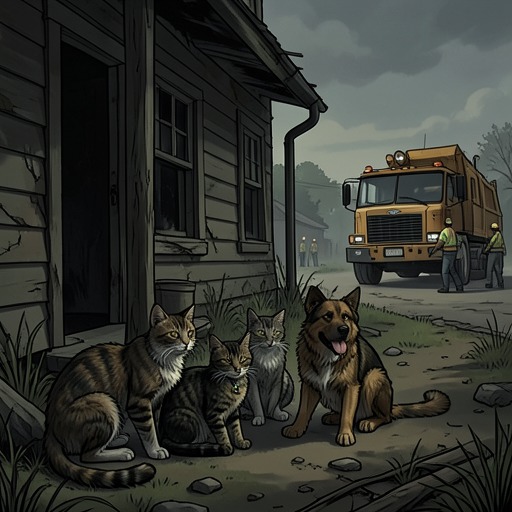
Audrey’s advocacy becomes decisive when Gunter’s demolition plans threaten the house sheltering the cats. At the site, she identifies herself as working in animal rescue and reports that the building commission has been contacted. The presence of feral cats has led the commission to pull the demolition permit; if Gunter proceeds with the demolition, she warns, the act will be illegal. Her intervention brings a threatened group of animals into a dispute over whether work on the building can lawfully continue.
The speed of the response is challenged by Gunter, who dismisses the idea that the building commission could act so quickly. Audrey answers that one of the rescue organization’s board members is a county commissioner. The detail explains the organization’s leverage in this instance: it has access to a person with public authority, and that connection can make an urgent call consequential. Audrey does not claim the commissioner’s position as her own. Instead, she describes the network that allows the organization to intervene before the shelter is demolished.
The initial halt is followed by further work. Audrey later tells Lucas that the cats will be all right: the permits have been stalled, and Gunter is allowing the rescuers to enter and conduct a proper roundup of the remaining animals. The progression matters. Blocking demolition protects the colony from an immediate threat, while permission to enter makes a more complete rescue possible. Audrey’s account thus links official delay to a concrete next step, rather than presenting the permit dispute as a resolution by itself.
Direct Care and Contact with Bella
Audrey’s work also appears in an ordinary domestic visit. When she comes to Lucas’s home, Bella recognizes her and responds warmly. Audrey is pleased to see the dog, tells her she is good and big, and carries away a box of cats. Bella assumes the cats are being returned to the den, an interpretation shaped by her own earlier experience of the animals. The scene makes Audrey’s work visible from Bella’s limited perspective: a familiar rescuer arrives, gives the dog attention, and takes the cats away for purposes Bella does not fully understand.
That brief encounter complements the larger rescue effort. Audrey’s attention to Bella is friendly, but her immediate task is the cats in the box. The story does not specify their final destination in this scene; elsewhere, however, the organization’s stated aim is to find good homes for cats it recovers. Her role therefore combines personal kindness with the practical movement of animals toward further care, without making the two forms of responsibility interchangeable.
A Foster Route for Bella
Audrey later offers help with Bella, whose presence in Denver has become dangerous under the city’s treatment of condemned pit bulls. She says a foster family in Durango regularly takes dogs facing that fate. This is presented as a concrete plan for getting Bella out of Denver, where she would be safer, rather than as a final adoption or a permanent arrangement. Lucas says he will retrieve her once he finds a place outside the city limits, and Audrey asks how long that might take. The exchange shows both the resource she can offer and the uncertainty that remains for Lucas.
Across the colony crisis and Bella’s proposed placement, Audrey’s recurring function is to connect urgent need with available systems of support. For the cats, that means calls, a commission’s intervention, and a proper roundup; for Bella, it means access to foster care beyond Denver. The means differ, but both efforts resist the idea that an animal’s danger makes its fate inevitable. Audrey’s significance is grounded in this practical work: she helps create time, routes, and care where the animals would otherwise be left exposed.