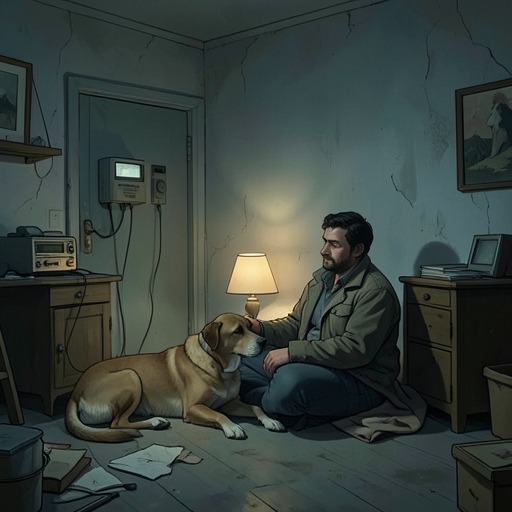
Axel’s homelessness
A Dog's Way HomeAxel’s homelessness is not a brief interruption in his life but the precarious setting that shapes his days with Bella, from sleeping outdoors in the cold to accepting practical help on uncertain terms. The narrative presents both the material hardship of his life and the fragile support around him, culminating in Bella remaining beside him after his death.
Living without a home
Axel and Bella spend time in town on blankets laid on the sidewalk, where passersby stop to talk, give Bella treats, or leave bags of dog food for Axel. Their shelter is described as a house with no walls; the open structure offers little privacy or protection, and Bella feels lonely there when the two of them are alone. Their routine depends partly on returning to town and partly on whatever shelter and provisions Axel can maintain.
Winter turns that instability into a physical danger. The air burns Bella’s throat and stings her paws, and she seeks the warmth of the tent and the heat Axel can produce by adjusting a metal box inside it. She presses against him at night to keep him warm, while also alerting him when two police officers approach. Their presence frightens her because she associates police with the truck that once took her away from Lucas; Axel tells them that he found her abandoned.
Aid, mistrust, and daily routine
People in town try to help. One man urges Axel to go to a church where he could shower, appealing to the approaching cold and Bella’s needs, but Axel rejects the offer because he does not regard the place as a true church. Tom also explains that no one can live outside through the winter in Gunnison, Colorado, that the town lacks suitable facilities, and that Axel will not accept help from charities. Axel’s mistrust is expressed in his conviction that everyone wants something from him, even as Tom insists that people care about him because he served the country and helped others.
Tom and the police eventually show Axel a winter shelter set up beneath the roof of his existing open-sided home. It includes an arctic tent, a propane stove, a mountaineering sleeping bag, food in coolers, and a cookstove with an electric lighter. Bella investigates the tent, while Axel questions why it is being offered. The scene makes assistance concrete: warmth, food, and a place to sleep are available, but accepting them requires Axel to face people and institutions he does not trust.
Help remains intermittent rather than resolving his circumstances. Tom visits every few days with food for the plastic boxes; sometimes Axel is glad to see him and talks, while at other times he is hostile, and Tom leaves after giving Bella a small treat. Axel and Bella continue going into town. At times Axel leaves Bella tied to a fence for what feels to her like a long stretch, then returns and takes her directly back to the tent. His routine also includes episodes in which he carries a pencil over his arm before climbing into the tent and sleeping for a long time. The account does not present the shelter as ending his hardship: the cold, dependence on others, and instability persist.
Relocation and final days
After a confrontation at the park, Axel packs his belongings into a cart and leaves with Bella. They travel along the road beside the river, then follow a path to a flat, sandy bank, where Axel rebuilds his tent and settles as if they will stay. The move changes their location but not the basic conditions of their life: they remain outdoors, apart from settled housing and reliant on a makeshift shelter.
Over time, Axel’s suffering worsens. He cries out more in his sleep and speaks loudly to Bella during the day, gesturing toward the sky. At times he pants and twitches anxiously, leaves Bella tied to a stump while he goes toward town, and returns with a pencil before sleeping deeply. Bella remains tethered to him and must stretch to the limit of her leash to relieve herself. The description makes their dependence visible in small daily constraints as well as in the larger fact that neither has a stable home.
Axel is later found dead by the river, still connected to Bella by the leash. A boy who has heard that the homeless veteran moved there comes to see what happened. After Bella has eaten, he apologizes to her and strokes her head, but she is still thirsty and attached to Axel’s heavy, unmoving body. As the sun lowers, Bella senses the boy’s growing fear and leans against him; he relaxes slightly and calls her a good dog. Responders arrive in vehicles with flashing lights, loosen Bella’s leash, and hand it to the boy, who takes her to the river to drink.
Narrative significance
Bella understands her care for Axel as part of the same work that led her to comfort other people and animals: being a good dog means staying with someone who needs her. Their companionship offers warmth and attention, but it cannot replace secure housing or prevent Axel’s decline. The narrative also places his isolation beside broader scenes of veterans seeking a place to be: Ty observes that many men at the hospital come not only to spend time with people like themselves but because they have nowhere else to go. Axel’s story gives that absence of refuge a stark endpoint, while Bella’s comfort of the frightened boy briefly carries their bond outward to another person.