Axel’s substance dependence
A Dog's Way HomeAxel’s substance dependence emerges as a recurring pattern of distress, brief relief, and physical collapse, witnessed by Bella as she stays beside him through the winter. The narrative offers no diagnosis and does not name what he uses: instead, it follows his changing moods, absences, bodily gestures, and returns. At the pattern’s final and most intimate turn, Axel becomes calm after doing something to his arm, calls Bella a good dog, and stops breathing while she lies beside him. The sequence connects his dependence to his death without establishing a medical cause.
Pattern and Observable Signs
The account first presents Axel’s changing moods in ordinary encounters. Tom visits every few days with food in plastic boxes. Sometimes Axel is happy and talks with him; at other times he is hostile and angry, and Tom leaves after giving Bella a small treat. These visits show that Axel’s state can shape even a modest exchange, while Bella’s attention remains fixed on how he behaves toward the people around him.
In town, Axel sometimes leaves Bella tied to a fence for what seems to her an extremely long time. He returns with a bottle whose smell reminds her of Sylvia, then takes Bella straight back to the tent. There he holds a plastic pencil over his arm before climbing inside and sleeping for a long time. The sequence places the pencil, his arm, and his sleep together as repeated details, but does not explain the object’s function or identify the substance involved. Bella records what she can perceive, not a human account of the episode.
Winter makes the tent a source of physical shelter for Bella: the cold burns her throat and stings her paw pads, while Axel can warm the space by adjusting the knobs on a metal box inside. Her comfort there gives the episodes a domestic setting. She hopes that summer will let her resume going home, but the warmth Axel provides is reason enough, for now, to stay close to him. Dependence is thus embedded in a shared routine that offers Bella security even as Axel’s condition worsens.
Escalation and Disruption
Over time, Axel suffers more visibly. He yells out more often in his sleep and talks loudly to Bella during the day, gesturing toward the sky. At times he pants and twitches anxiously, then leaves Bella tied to a stump while he walks toward town. He returns with one of his pencils and seems happy, but only briefly, before collapsing into deep sleep. The recurring movement from agitation to apparent relief and then collapse gives the pattern its structure; Bella’s tethered waiting makes the cost of his absences part of the same routine.
His behavior by the river becomes more disruptive. Axel paces and yells along the banks for an entire day, tears down the tent, and once forgets to feed Bella, then does so again. Later he pours a whole bag of food on the ground within her reach, ties her to a stump, and marches away while kicking at rocks. These are distinct failures of care: first Bella is left without food, then supplied with more than she can readily eat while still being abandoned. She does not interpret the cause, but experiences the instability through hunger, confinement, and separation.
Axel is gone for two days. Bella eats the food and drinks from the river, growing sad and anxious and wondering whether she has been a bad dog. When Axel returns, he is stumbling and talking, and does not acknowledge how frantically happy she is to see him. His breath again reminds her of Sylvia. The remembered smell links this return to the earlier town routine, but the narrative leaves the smell itself unexplained. Bella’s question about whether she has misbehaved also shows how she understands the separation through the language of her own conduct, rather than through any knowledge of Axel’s condition.
Relief, Relationship, and Death
On the riverbank, Axel sits hunched on a rock and begins doing something to his arm. Bella recognizes the motions and anticipates what follows. He becomes very relaxed, laughs, and calls her a good dog; the fear and anger leave his face. The episode supplies the clearest contrast in the account between his preceding distress and his temporary ease. It also remains limited to Bella’s observation: the action is not named, and her recognition does not give the reader a substance, dose, or medical explanation.
Axel’s tenderness toward Bella is present within this precarious pattern. In the same episode that follows his return after two days away, he calls her his best friend and tells her she is a good dog. She answers to her name and stays beside him. Their attachment is not an alternative to the dependence or its consequences; it is the bond through which Bella witnesses them. She comforts Axel by curling up next to him, understanding her closeness as being a good dog and providing comfort.
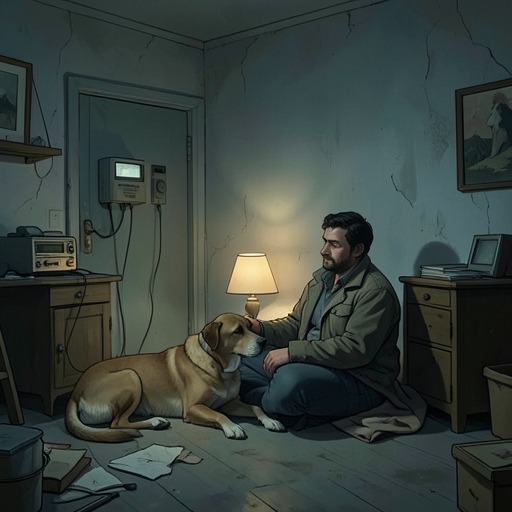
After Axel slumps into the dirt and breathes slowly, Bella remains curled against him. His breathing stops. She lies through the night with her head on his cooling chest and observes his scent changing. The narration does not label his death as an overdose or state that the arm gesture caused it. Instead, it places the cessation of breathing immediately after the episode of relief, making the juxtaposition stark while preserving the limits of what Bella can know.
Narrative Perspective and Significance
Bella’s first-person account makes Axel’s dependence legible through repeated sensory and behavioral details rather than explanation: the plastic boxes, bottle, pencil, arm, anxious movements, long sleep, and changing breath. The recurrence matters. What might otherwise appear as isolated episodes becomes a cycle because Bella sees Axel leave, return altered, and briefly settle, while her own waiting and care continue around him.
That perspective also prevents the pattern from becoming only a description of Axel’s condition. Bella faces concrete consequences, including being tied up, left without food, and separated from him for two days; she also receives shelter and companionship in the tent and remains beside him at the end. The account holds those facts together without resolving them into a simple judgment. Axel’s dependence is presented as a worsening disruption of daily life and care, but the final image is also one of their closeness: Bella stays with the man who called her his best friend, even after he can no longer respond.