Bella escapes Loretta’s yard
A Dog's Way HomeBella escapes Loretta’s yard when waiting for Lucas no longer seems bearable. The decisive act is both practical and emotional: after hearing that Lucas is expected to come for her, Bella recognizes that he has not arrived and chooses the command she understands as a route back to him, Go Home. A slide temporarily moved beside the fence becomes the means by which that resolve turns into action.
The decision to leave
The day before the escape, Jose tells Loretta and Bella that he plans to replace the rotten wood chips in the play area because summer is approaching and his grandchildren will want to play there. After Loretta returns to the house, Jose tells Bella that Lucas is coming to get her the next day and that he will miss her. Bella responds by yawning and scratching behind her ear; she does not appear to grasp the significance of the preparations around her.
Jose moves the swing, slide, and other play structures off the wood chips and sets them beside the fence, then brings Bella indoors. Resting on a pillow by the fireplace, she thinks of Lucas, Olivia, and the familiar instructions Go to Work and Go Home. The contrast between Jose’s assurance and Bella’s experience sharpens as she confronts the possibility that Lucas may not come. Though she understands herself to be a good dog, she cannot make his absence fit the promise she has heard. She considers whether she must perform Go Home herself.
The slide and the fence
That night Jose lets Bella into the backyard alone. She cannot smell Lucas there, but she senses the direction in which he is and feels drawn toward him, more faintly than when he used to approach at the end of the day. The distinction matters: she has no immediate trail of scent to follow, yet her sense of where Lucas belongs gives her a heading.
The fence blocks her. Bella knows it is too high to jump, and that the walks Jose and Loretta take her on are always on a leash. She studies the yard’s arrangement through a remembered pattern of play: Lucas would throw a ball, and she would chase it as it bounced up the slide. Now the slide stands beside the fence, where its incline provides a way to gain height. Bella realizes that the ball is unnecessary. She runs up the slide, clears the fence, and lands on soft dirt outside the yard. Jose’s rearrangement of the play area, made for routine maintenance, has unintentionally placed an exit within reach.
Beginning the journey
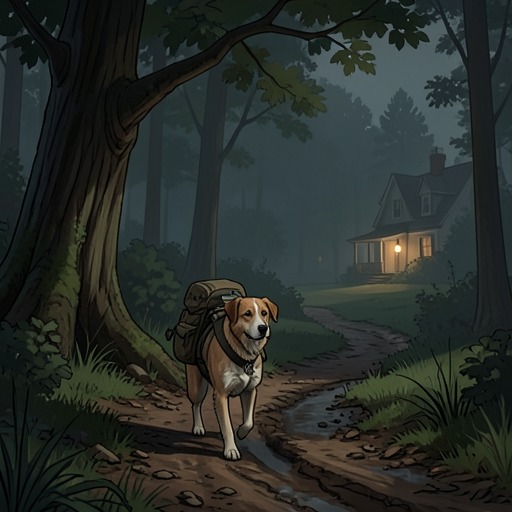
Once outside, Bella leaves the houses and dogs behind and heads toward the trees, guided by the smells of rocks, dirt, and water. The escape changes her from a dog waiting in someone else’s care into a traveler acting on her own purpose. She feels strong and alive, and the decision to seek Lucas gives her direction even when she cannot smell him.
Bella does not sleep that night or the following day. She finds a trail used by people, but turns away and moves well clear whenever she hears someone approaching. A nearby stream gives her water. These first choices establish the pattern of her journey: she keeps moving toward home while avoiding human contact and using what the landscape offers. The journey is not simply a straight path to Lucas; it requires Bella to navigate without him, relying on her senses and judgment.
Companionship and the cost of continuing
Later, Bella’s journey becomes entangled with her care for Big Kitten. The two spend several days near a kill, sharing food and play. Big Kitten pounces on Bella; Bella knocks her onto her back and mouths her head until she twists away. Big Kitten also sleeps through much of the day, but becomes alert as evening approaches. Once she returns with a small rodent, which they share. When Bella’s urge to move returns, Big Kitten follows, often keeping to cover because she dislikes the human smells on the trail. Bella sometimes loses track of her precisely, waits, and lets her catch up. She knows she could cover more ground alone, but feels responsible for Big Kitten’s safety.
That responsibility complicates the urgency that began with the escape. The trails are crooked, and when Bella hears people, she and Big Kitten hide. Bella often smells dogs and longs to greet them, but they are with their people, as she hopes one day to be with Lucas. When she detects dogs without humans, however, their scent alarms her: they are tracking the pair. Bella recognizes four Coyotes—a female and three young males—and understands that they are hunting, not approaching out of curiosity. The homeward journey thus exposes her to dangers that cannot be solved by determination alone.
Winter makes the cost of traveling with Big Kitten still clearer. Deep snow slows Bella and obscures the landscape, while Big Kitten moves across it with striking ease. When Bella cannot keep up, Big Kitten returns and eventually leads her through the snow to a young Elk she has taken down. They eat and return to their temporary den; afterward, Big Kitten continues finding prey, including deer, Elk, rabbits, and smaller mammals. The escape from the yard therefore begins a larger passage in which Bella’s attachment to Lucas remains her compass, but care for a companion repeatedly shapes how quickly and by what means she can continue.