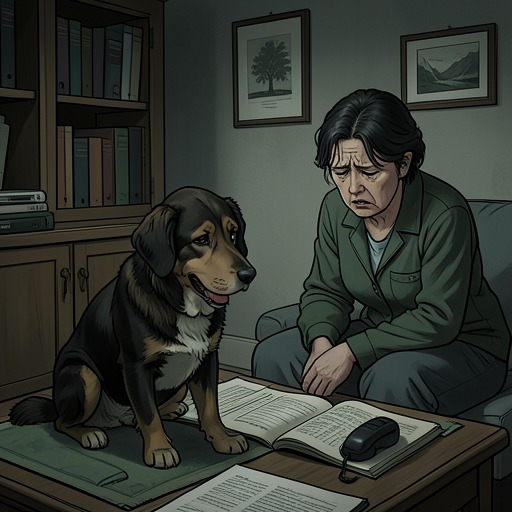
Bella’s emotional-support-animal status
A Dog's Way HomeBella’s emotional-support-animal status gives formal recognition to a role she had already taken on through her bond with Terri: offering comfort and companionship, and responding to Terri’s distress. The recognition came through a doctor’s letter intended to support a housing accommodation, not through training or certification as a seizure-alert dog. The distinction matters throughout Bella’s story, where her help is evident to the people around her even as institutions require it to fit defined categories.
Identity and practical meaning
Bella’s connection to the emotional-support-animal designation begins with her relationship with Terri. Lucas tells the hospital doctor that Bella helps his mother with depression, and confirms that this support is substantial. Ty has also heard Terri describe Bella as more effective for her than the antidepressants she takes. That is Terri’s reported experience, rather than a clinical finding in the narrative, but it explains why the request for formal recognition carries immediate importance to the family.
The letter is discussed in the context of housing. The doctor explains that, under his understanding of the Fair Housing Act, an emotional support animal can qualify for an exception to a no-pets rule when the treating doctor provides a letter. Lucas asks whether that document would allow them to remain in their building. The doctor says he is not an attorney, but that what he has read appears to require the building to make an exception. His qualification leaves the legal outcome less than certain; what he can offer is a medical letter, not a guarantee about how the building will respond.
A role formed through care
Before that conversation, Bella’s presence at the hospital has already shown how her companionship affects people beyond Terri. Ty brings her to rooms where people are seated together. Although Bella dislikes being separated from Lucas, the people welcome her, pet her, and call her by name. Ty gives her food, and some patients offer her their own attention and affection. The encounter presents her not simply as a private comfort to one person but as a focus of connection in a shared space.
Ty explains to Lucas and Terri that many of the people who come there have few other places to go. His observation places Bella’s visit within a social setting: the comfort she provides matters partly because people are gathering where companionship is scarce. He also tells the doctor that Bella eases stress on the ward and encourages newcomers in the twelve-step group. In his account, people approach her before speaking, and her presence helps them feel more confident. Those are Ty’s observations, not a formal assessment, but they give concrete reasons for his insistence that her good work should count.
Bella’s response to Mack makes the support personal and immediate. Recognizing sadness that reminds her of Terri’s difficult moments, she climbs into his chair and stays with him. Mack hugs her. The scene does not depend on a command or specialized training: Bella interprets the emotional situation through her experience of comforting Terri and acts on it. Her ability to offer reassurance is shown as relational and practical, expressed through closeness rather than an official designation.
Recognition and its limits
The family’s request first raises the possibility of identifying Bella as a seizure dog. Lucas says she has barked before Terri’s seizures and that recognizing the signal could let them prepare. The doctor explains that seizure dogs are commonly trained to signal, and that Bella’s behavior appears to come naturally rather than from training. He cannot state that she is a trained seizure-alert animal, and he says a letter on that basis would not resolve the matter. Bella’s seizure-warning behavior and her emotional-support role are therefore related in the family’s experience, but they are not interchangeable categories in the doctor’s explanation.
The obstacle is procedural as well as definitional. The doctor says Bella would have to be certified to be treated as a seizure dog and that the hospital does not handle that process. Lucas has only three days before proceedings are due to begin, which sharpens the difference between a potentially helpful ability and a qualification that can be documented in time. Ty asks whether the doctor can at least write a letter. After asking Lucas about Terri’s depression and hearing his confirmation that Bella helps, the doctor agrees to provide a letter identifying Bella as an emotional support animal. He presents this as the available route under his understanding of the housing law, not as seizure-dog certification.
Beyond the designation
Bella’s later actions show that comfort is not confined to the home or to a legally recognized status. During a rescue, she stays beside a distressed man and the injured man he is helping, understanding her continued presence as something she is supposed to do. Later, after Axel has died, she leans against the frightened young man who has been left with her, and he relaxes slightly as he strokes her. These episodes do not establish any additional formal role for Bella. They do, however, echo the instinctive care that first made her important to Terri and that persuaded Ty her presence mattered to others as well.
The emotional-support designation consequently marks both recognition and limitation. A doctor’s letter can translate Bella’s relationship with Terri into documentation relevant to a no-pets rule, but it does not capture every way Bella helps, nor does it certify her natural warning behavior as trained work. The narrative keeps those distinctions visible: Bella’s support is first encountered in the ordinary acts of staying close, noticing distress, and offering companionship; the institution can acknowledge only the part that fits its available process.