Bella’s seizure-alert ability
A Dog's Way HomeBella’s seizure-alert ability is the spontaneous warning behavior through which she detects signs of Terri’s approaching seizures and barks, even when told not to. It gives Lucas an early indication that something is wrong, but its importance is never simply a matter of recognition: the behavior is useful in the household and at the hospital ward, while the people who might formally authorize it insist that an innate ability is not the same as a trained, certified seizure-alert dog.
The Warning Before the Seizure
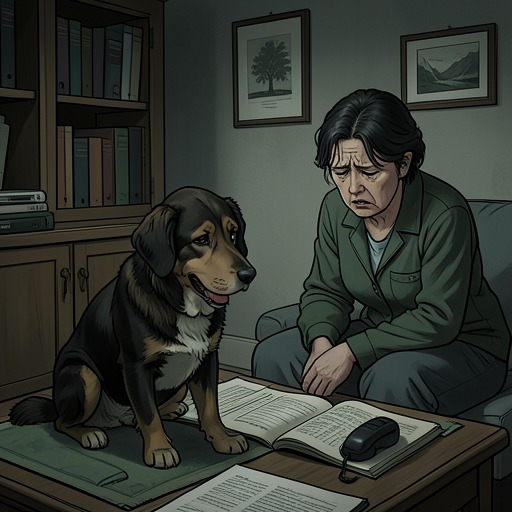
Bella’s warning begins with smell. While she and Terri are alone at home, Bella notices a sharp, sour scent that she recognizes from an earlier occasion when Terri became ill and Bella was left alone in the house all night. Terri does not respond to Bella’s anxious whining, so Bella barks instead. The account presents the scent as Bella’s first sign that the situation is changing; her response comes before she can know, in human terms, what is happening.
When Lucas is present, the same sequence becomes more difficult to dismiss. The tang grows sharper, and Bella barks again. Lucas tells her No Barks and even swats her rear, interpreting the barking as misbehavior rather than a warning. Bella persists. Only when Terri begins making small peeping sounds and her hands curl and bat at the air does Lucas recognize the emergency: he runs to her, calls for help, and says that his mother is having a seizure. The contrast is central to the ability’s portrayal. Bella’s alarm precedes the visible signs that make the crisis legible to Lucas, and her repeated barking continues through his attempt to stop it.
After emergency responders take Terri from the house, Lucas keeps Bella crated and reassures her that she is a good dog and should stay. The episode thus shows the warning operating amid ordinary demands for obedience: Bella has just been scolded for barking, yet the same behavior is what calls attention to a danger that Lucas has not yet recognized. Her persistence does not replace human care or emergency assistance, but it helps mark the moment when the household understands that Terri needs them.
Recognition and Evidence
The family’s understanding of Bella’s behavior develops after the immediate crisis. Lucas looks at information on his phone and tells Terri that it says fifteen percent of dogs can sense seizures. Terri agrees that Bella seemed to know what was happening, and Lucas praises her. The figure is presented as information Lucas has found, not as a formal assessment of Bella. What the scene establishes directly is that Terri and Lucas reinterpret the barking in light of the seizure: what had sounded like disobedience now appears to have been a response to the onset of an emergency.
A later discussion makes the distinction between ability and training explicit. A doctor says that seizure dogs exist and that many are trained to signal in the way Bella does naturally. He also notes that some people claim such dogs have saved lives, while others are skeptical. Bella’s particular capacity, as Lucas describes it, is based on two recent occasions when she barked as Terri was going into a seizure. Lucas argues that advance recognition could have allowed the family to prepare. The evidence for the ability in this conversation is therefore personal and repeated: two warnings linked, in retrospect, to Terri’s seizures, rather than a course of training or a certification process.
The doctor does not deny that Bella may possess the ability. He instead separates that possibility from what he can officially attest to. He says that having an innate ability is far from obtaining legal certification, and refuses to state that Bella is a trained seizure-alert animal because she is not trained. The distinction leaves the practical observation intact while limiting what the family can claim through official channels. Bella may signal naturally; that does not make her, in the doctor’s terms, a certified working animal.
Institutional Recognition and Its Limits
The conversation about certification unfolds under pressure: Lucas says that only three days remain before proceedings begin. The doctor explains that a dog prescribed for seizure-alert work must be allowed even in a no-pet building, but that a procedure must be followed and Bella would have to be certified. He invokes the Fair Housing Act accommodation for emotional support animals as a legal route requiring an exception to a building’s no-pet rule. The available evidence does not show that Bella receives certification or that this process is completed; at this point, the doctor’s answer is that the legal possibility exists but cannot be secured merely by describing what Bella has already done.
Ty presses the case beyond the seizures. He says Bella eases stress on the ward, gives newcomers in twelve-step meetings confidence, and sits at the front, where people who want to speak often pet her first. He also reports that Terri considers Bella more effective than the antidepressants she is taking. These are presented as Ty’s observations and as Terri’s reported view, not as a clinical finding about Bella. They broaden the account of her value: her usefulness is not confined to predicting seizures, and the people around her point to forms of comfort and support that do not fit neatly into the doctor’s question of whether she is trained.
Ty’s appeal meets another institutional limit. The doctor asks whether Ty knows that having a dog in the Veterans Affairs hospital is against the rules. Thus Bella’s presence can be experienced as helpful by people on the ward and still conflict with the hospital’s policy. The contrast parallels the problem of certification: in both settings, observed benefit and formal permission are not interchangeable. The narrative leaves that disagreement unresolved in these scenes, rather than treating Bella’s evident role in people’s lives as automatic authorization.
Narrative Significance
Bella’s ability is conveyed through a sequence of sensory recognition, repeated barking, and belated human understanding. The reader first shares her awareness of a familiar smell; Lucas initially hears only a dog violating No Barks. The seizure makes the significance of the barking clear, and the later conversation gives that recognition a name and a possible institutional framework. This progression lets the same action change meaning without changing its form: the bark is first reprimanded, then understood as a warning, and finally examined as evidence that may or may not satisfy formal standards.
The episodes also distinguish care from classification. Bella’s warning matters because it alerts people to Terri’s condition, while the doctor’s concern is what can be certified and what rules permit. Ty adds the ward’s everyday experience of Bella’s calming presence, but that testimony does not erase the requirements or restrictions he is discussing. The resulting tension is not that Bella’s natural behavior is shown to be false; it is that its practical meaning does not automatically translate into recognized status. Her seizure-alert ability is therefore both an intimate, repeated bond of attention between Bella and Terri and a test of how far institutions can recognize care that has not been formally trained or certified.