Cats
A Dog's Way HomeCats are part of Bella’s world before she can identify them: first as nearby lives she senses in a shared den, then as playmates and a colony whose safety becomes a concern for Lucas. Their story links Bella’s early family bonds to the human effort to protect the cats’ shelter, while Mother Cat’s eventual move to a cared-for home gives that connection a quieter continuation. The narrative also sets the colony apart from Big Kitten, a cougar whose companionship with Bella unfolds in the wilderness rather than among domestic cats.
Early Life and the Den
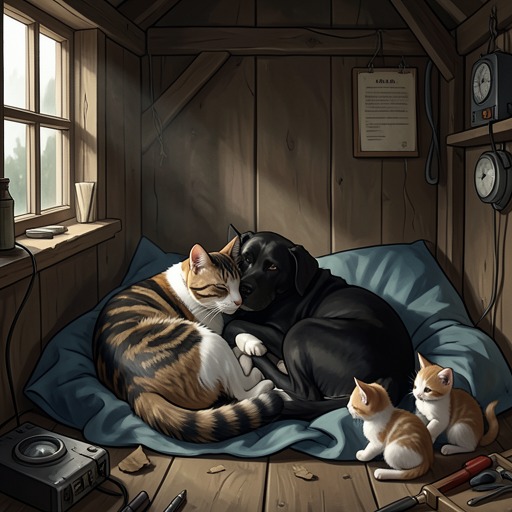
Bella first registers the cats through presence rather than sight. Her eyes are open, but she cannot make out more than shifting forms when cats are nearby; she can distinguish their smell from that of her mother and littermates. At first, she understands them only as creatures unlike herself, living in the same den but not trying to nurse. As her vision improves, she recognizes them as small, quick animals of their own kind.
The den is a shared home, but not a place where the young animals have identical access to one another. Bella plays with kittens in the deeper recesses, particularly with a friendly pair whose mother sometimes licks her. Bella comes to regard that adult as Mother Cat. When Bella’s own mother finds her in the kitten pile, she carries her back by the scruff. Bella’s siblings then sniff her with suspicion, registering the cat smell she has brought back with her. This early exchange makes the cats part of Bella’s formative experience of family: she moves between two groups, welcomed by the kittens and cared for by their mother, but returned to her own litter by her mother.
Bella’s access to the outside remains limited. A square opening in the den brings in light and the scents of the larger world, and cats pass through it, but Bella’s mother pushes her back when she tries to approach it. The den is therefore both a place of shared life and a boundary: Bella can observe the cats and play among their young, yet she does not control when she leaves or returns.
The Colony and Human Intervention
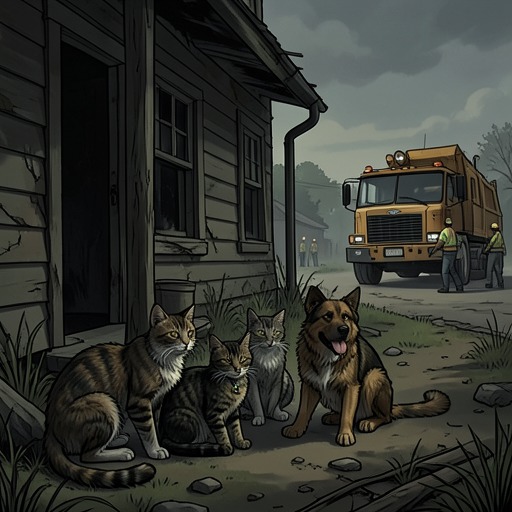
The cats’ shelter later becomes a practical and political concern. People discussing demolition recognize that the colony is too large simply to remove without consequences for the animals, while a deadline to finish the demolition by the end of June creates pressure to act. Their conversation frames the cats not as a single pet or two, but as a colony whose fate is bound up with the work planned at the site.
Lucas takes Bella to the den at least once a day. Several houses stand in a row without residents, but only one contains cats. A mesh fence blocks entry; Lucas pulls at the wire where it is fastened to a pole so that they can get inside. He leaves food and water for the cats, though Bella is not allowed to eat it or enter the den to see Mother Cat. He points out that she is watching from the shadows. The visits maintain a link between Bella and her first feline family, but also show that the cats’ protected space is precarious and managed through human decisions.
On a later feeding visit, Bella detects another female cat hidden among the others. The cat stays out of sight, reinforcing Bella’s conclusion that cats are wary of people. The colony’s survival depends in part on human willingness to provide food and seek a safe outcome, yet the cats do not necessarily respond by approaching or accepting human contact. When Lucas tells his mother that Audrey’s rescue organization cannot act because Gunter Beckenbauer has put up no-trespassing signs, the obstruction is procedural as well as physical. The cats remain under the shelter, while the possibility of helping them is constrained by access to the site.
Mother Cat and Continuing Care
Mother Cat remains important to Bella after the original den changes. In the course of Lucas’s visits, the signs of the kittens fade, while the smell of Mother Cat remains. Later, Bella finds her under a deck at a house on a hill. Mother Cat is alive and responds to Bella by purring and rubbing against her. Bella is comforted by meeting the animal who first cared for her, especially because Lucas is absent and she has lost the human family she is trying to find.
The reunion does not lead Mother Cat back to Lucas. Bella observes that Mother Cat moves stiffly and has patches of missing fur. Cat food on her breath, and the absence of signs that she has recently been hunting or near Lucas, suggest that she now depends on human-provided food. When Mother Cat climbs onto the deck, Bella follows and finds food and water by the windows, along with evidence that people live there and care for her. The change from the old den to this new place is therefore not a return to the former colony; it is a new arrangement that sustains Mother Cat while leaving Bella’s search unresolved.
A woman identifies the dog as a stray and tells her to leave, while Mother Cat keeps her distance from the woman. The contrast clarifies that accepting food does not mean seeking human touch: Mother Cat can live near people and receive their care while remaining wary of direct contact. Bella, by contrast, is eager for the woman to pet her. Mother Cat’s new home thus preserves her independent habits even as it provides for her needs.
A Different Feline Companion
The book distinguishes the den’s cats from Big Kitten, an orphaned cougar who travels with Bella in the wilderness. Their relationship offers a parallel form of feline companionship, but not a continuation of the domestic colony. Big Kitten follows Bella, avoids human smells, and keeps to cover. Bella adjusts her own movement around the younger animal, waiting when she falls behind rather than pressing ahead at full speed. Their bond entails practical responsibility as well as affection.
Their ways of finding food also change over time. They spend several days sharing a kill and playing; Big Kitten later returns from a hunt with a small rodent to share. When snow makes travel difficult for Bella, Big Kitten moves across it with greater ease and leads her to an elk she has killed. Bella follows her tracks to reach the food, and the usual arrangement shifts: Big Kitten becomes the more capable hunter, bringing back or locating prey often enough to keep them fed. This wild partnership differs from Lucas’s provision of food for the cats at the den, but both relationships show care taking material form in food, shelter, and continued presence.
After Bella is attacked by coyotes, the grown Big Kitten returns and drives them away. She tends Bella’s neck wound by licking it, then hunts while Bella rests. Their renewed companionship does not end with a shared journey home. Big Kitten eventually will not travel farther with Bella, and Bella understands that the cougar has a place of her own to go. She leaves despite the safety and food their partnership has provided. The separation echoes her earlier departure from Mother Cat: a feline bond can be lasting without requiring the animals to remain together.
Narrative Significance
Cats are introduced through Bella’s sensory limits. At first she cannot visually distinguish them, but she knows that they are present and unlike her; understanding follows as her senses develop. The narrative gives the animals an existence beyond Bella’s immediate needs: the colony has its own vulnerable shelter, Mother Cat maintains her distance from people, and the hidden female does not emerge merely because humans have arrived with food.
The cats also connect different forms of care without making them interchangeable. Bella receives early nurture from Mother Cat, Lucas later feeds the colony while trying to preserve access to it, and people provide food and water at Mother Cat’s new home. Big Kitten, meanwhile, becomes a companion whose hunting and protection are part of a distinct life in the wild. Across these settings, cats and other felines are not simply background to Bella’s longing for Lucas; their own habits, needs, and separations shape what family and belonging mean in her journey.