Crawl space beneath the abandoned house
A Dog's Way HomeThe Crawl space beneath the abandoned house is both Bella’s first home and a refuge shared with a colony of cats. Its darkness, low roof, and narrow opening shape her earliest understanding of safety and the world beyond; later, Lucas’s visits make it a place of care, while a demolition notice threatens the animals who depend on it.
Physical Form and Early Life
The den lies beneath one of several houses standing empty in a row. Bella’s earliest memories place her there with her mother and littermates, in a packed depression in the dirt that serves as their bed. The space is cool and dark, with dry earth under Bella’s nose and a ceiling of parched wood so low that her mother’s raised tail reaches halfway to the beams. When the mother leaves, the puppies squeak and huddle together until she returns. The den is shelter, but it is also a place where separation is felt sharply.
A single square hole at the far end provides the only light and the den’s connection to the outdoors. Through it come smells of cold, wet, living places that Bella cannot yet reach. Cats occasionally pass through the opening, but her mother pushes her back whenever she crawls toward it. The entrance therefore marks a boundary before Bella understands what lies beyond it: enticing scents and movement on one side, the reassurance of her mother on the other.
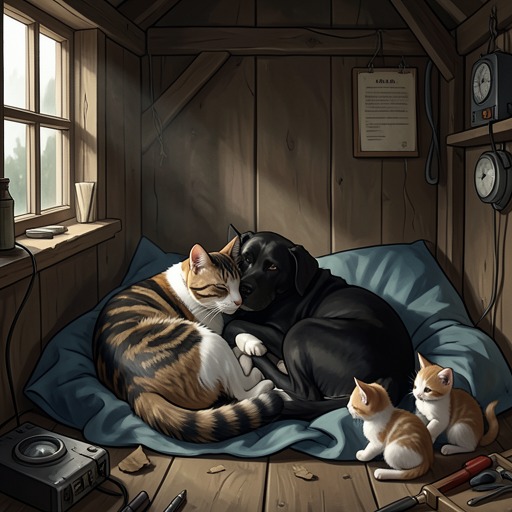
The cats are part of the den’s life from the beginning. At first Bella knows them only as creatures unlike herself, present in the shared space but not nursing with her. As her legs strengthen and her sight improves, she plays with the kittens, especially two friendly young cats in a recess farther back. Their mother sometimes licks her. Bella comes to know this cat as Mother Cat, and the rear recess becomes associated with a relationship that crosses the apparent divide between dogs and cats.
A Shared Refuge Under Threat
The den’s fragile sense of enclosure is broken when a sudden blaze of light floods the space. Bella is playing with Mother Cat’s kittens when the cats scatter and she freezes. Human voices call for nets, anticipating that the animals will bolt together. The abrupt transformation from a dim, familiar home to a bright scene of capture shows how exposed the colony is when people enter its refuge.
After Lucas adopts Bella, he takes her back to the den regularly. Several vacant houses stand in a row, but only one contains cats; a mesh fence surrounds their area. Lucas pulls at the wire where it is fixed to a pole so they can get inside. Bella recognizes Mother Cat’s scent, though traces of the kittens are fading, and senses that male cats have returned. Lucas leaves food and water, but does not let Bella eat the cats’ provisions or enter the den to see her mother. From outside, he points out Mother Cat watching in the shadows. The visit gives Bella a view of the place she came from, while preserving a separation between her new life with Lucas and the cats’ continuing refuge.
As Lucas begins working, visits to feed the colony remain among Bella’s favorite outings. He crosses the street and pushes through the fence flap; Bella, eager to follow, is tied to a tree on the street side. She can smell three felines inside, while Mother Cat stays too far from the hole to be seen and two other cats sometimes appear in the light. Lucas sometimes wriggles into the den himself. Bella whimpers until he comes back. The den is thus both a destination in their routine and a threshold Bella is repeatedly prevented from crossing.
Feeding, Access, and Demolition
Lucas understands that he cannot be at the den all the time. He tells the cats he will try to protect them but warns that they will have to run if machinery arrives. Bella cannot understand the warning, yet the threat belongs to the place: the colony’s shelter depends on a structure that may be demolished. The boundary also changes over time. On a later visit, Lucas finds a rut beneath the base of the fence, and the smells there tell Bella that more cats are living in the den. Mother Cat is still inside. Unable to get closer, Lucas pushes a bowl of food under the fence instead of opening it and going in.
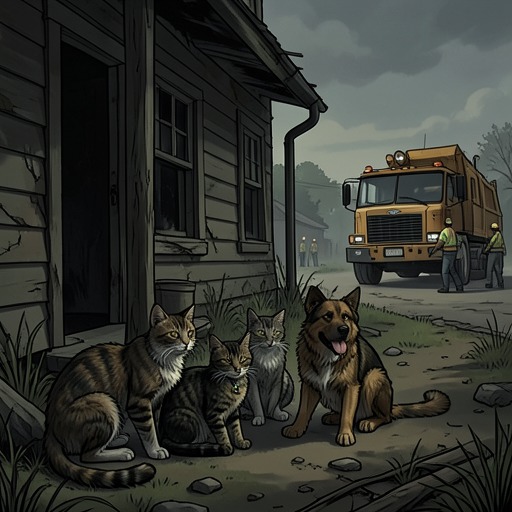
After feeding the cats, Lucas stares at a white notice on the dark fabric covering the fence. It announces demolition and confirms that the permit has been obtained. The notice makes the danger previously described to the cats immediate and official. Lucas returns home, distressed, and takes out thin blankets with wood blocks in their corners, along with his phone and Bella’s leash. His preparations connect the threatened den to the practical possibility of catching or moving the animals; the refuge can no longer be treated as a stable home.
Meaning and Limits of the Place
The den’s significance comes from its repeated combination of intimacy and exclusion. Bella begins life in its low, enclosed shelter, among siblings and cats, but as she grows she encounters the outside chiefly through a single hole that her mother guards. Later, she returns with Lucas and can smell her former home without being allowed inside. The space remains familiar through scent even as her place in it changes.
For Lucas, the den is a site of responsibility: he brings food, tries to protect the cats, and eventually faces the consequences of demolition. For the colony, it is a shared home whose mesh fence and low entrance offer no guarantee against human intervention. The den’s recurring boundaries—its small opening, the fence, the rut beneath it, and finally the posted notice—turn a modest shelter into a measure of how precarious that protection is. It is not simply where Bella’s life begins; it is the place that continues to bind her memories to Mother Cat and to Lucas’s efforts on behalf of the animals left behind.