Denver pit bull ban and consequences for a second violation
A Dog's Way HomeThe Denver pit bull ban and consequences for a second violation make an animal-control breed label more than a description: it can determine whether a dog is seized, fined, and ultimately destroyed. In Bella’s case, an officer’s judgment overrides Lucas’s account of her role in the household and her emotional-support letter; a treat used as a behavioral test becomes part of the basis for rejecting her status as a therapy dog. The rule’s force lies not only in its penalties but in how little room its described enforcement system leaves for a family to challenge the label.
Background and Scope
The ban is presented through an explanation of its origins and its contested premise. The animal-control officer says that there is no specific American Kennel Club breed called a pit bull, but that the term is used for a class of dogs. He connects the city council’s decision to a child’s death that had been reported as involving a pit bull. He also recounts testimony that these dogs were no more dangerous than other dogs, and observes that dachshunds bite people more often than any other breed. These points appear as part of his explanation of the policy, not as a change to its legal operation: despite the disputed category and arguments about comparative risk, the ban remains enforceable.
The officer offers a further, qualified explanation for the dogs’ reputation, suggesting that their protectiveness toward their owners may have helped produce it. He also notes the irony that pit bulls became more popular in Denver after the ban, interpreting that increase as a response to prohibition. The account thus places the rule within a tension between a broad public label, disagreement over what that label means, and a policy that still gives it concrete consequences.
Classification and Enforcement
The rule’s first decisive act is classification. The officer tells Lucas that animal control can pick Bella up on the word of a single officer; if two more officers agree that she is a pit bull, the designation is established for purposes of the law. The explanation makes the process strikingly different from a determination based on an uncontested breed identity. Bella’s classification is presented as an institutional decision that can be assembled through officers’ judgments, even while the officer himself calls the system irrational.
Bella’s encounter with the officer demonstrates how an assessment can proceed. Lucas says that Bella is his mother’s therapy dog and that the family has a letter. The officer places a treat on the ground, and Bella lunges for it. He treats this response as failure of one test used to establish whether a dog qualifies as a therapy dog. He says it is one of several tests and that failing any one is enough; in the shelter system, there is no appeal. The test therefore has consequences beyond the single observed behavior: it allows the officer to set aside Lucas’s letter and to maintain that Bella falls within the prohibited category.
The episode also distinguishes Bella’s actual relationships from the official classification. At the hospital, people welcome her, pet her, and call her by name; she climbs onto Mack’s chair when she senses his sadness and stays close as he hugs her. Later, Lucas reads that some dogs can sense seizures, and his mother agrees that Bella seemed to know what was happening. These moments establish why the family regards her as a support animal, but they do not displace the animal-control assessment. The rule makes the category—and the procedures that enforce it—more decisive than the fuller account of Bella’s behavior.
Penalties and Limited Review
The officer describes an escalating penalty. After an initial impoundment, Lucas would have to pay a fine, and Bella would be microchipped. If she were caught again, she would be destroyed. The consequence is not left as a distant possibility: when Lucas later signs release forms, a shelter worker reiterates that a dog picked up again for any reason within Denver city limits will be held for three days and then destroyed. The two-strike structure makes a later seizure potentially final, even if it occurs for a reason other than a new demonstration of dangerous behavior.
The stated route for challenging the classification is through the courts, not through an appeal in the animal-shelter system. The officer tells Lucas and Olivia that court action would be expensive and could take months, during which Bella would remain in the shelter. The shelter worker adds that judges generally defer to animal-control officers. She describes the arrangement as stacked against the family and identifies Chuck as the officer who picked Bella up, while making clear that her criticism concerns the way the system operates rather than the conduct of every animal-control employee. As she explains, most officers are concerned with animal welfare, but she distrusts Chuck and says he is protected by fellow officers. The family’s difficulty is consequently both substantive and procedural: they contest the label, but also face a costly, prolonged, and uncertain means of review.
Application to Bella and Its Consequences
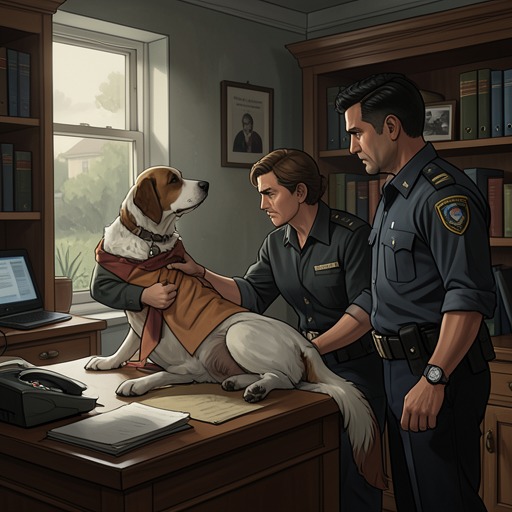
The rule shapes the family’s choices before any final resolution of the dispute. When the officer says that he cannot enter a residence to take Bella, Lucas summons her to his side rather than letting her approach the man. The officer nonetheless warns that he will impound her if he catches her outside the apartment. Later, when Lucas is walking Bella and the officer’s truck arrives, the officer announces that he is seizing her under the city’s authority. Lucas pleads for time, explaining that the family is moving and needs a few days to find a place. The officer refuses, reasoning that granting extensions to owners of pit bulls would prevent animal control from carrying out its work. Police arrive as the confrontation continues, underscoring that the threat of seizure has become an immediate contest over enforcement, not merely a disagreement about breed terminology.
The rule therefore makes location and timing consequential. Lucas is advised that Bella has to leave Denver; continuing to live with her within city limits exposes her to the specified second-strike penalty if animal control picks her up again. The family’s emotional-support letter and their account of her care for Lucas’s mother do not, on the evidence presented, remove that risk. In the story, the ban’s central contradiction is that Bella can be welcomed as a comfort to hospital patients and recognized by her family as responsive to human distress, yet remain vulnerable to a legal process that treats an officer’s breed determination as controlling. The rule turns the name applied to her into a condition of belonging: to keep Bella safe, Lucas must consider leaving the city that has made the classification enforceable.