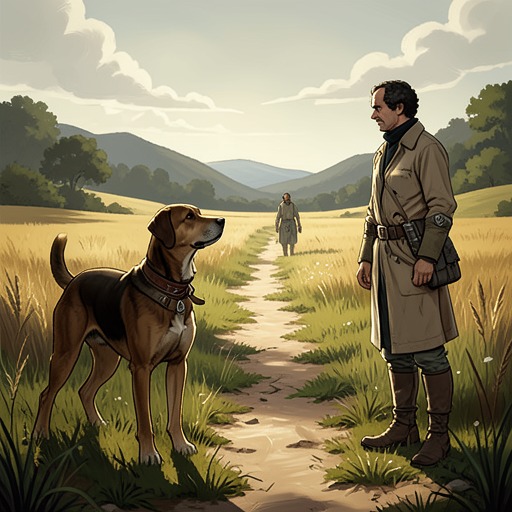
Go Home
A Dog's Way HomeGo Home is both a specific command Lucas teaches Bella and the idea that sustains her search for him after they are separated. At first it has a clear routine: she runs to their house, lies in a designated hidden spot, and receives a treat. As the journey carries her far beyond that house, the command changes from a learned action into a personal compass. Its final fulfillment is not simply reaching a familiar place, but being back with Lucas and his family.
Meaning and Initial Training
Lucas teaches Bella that Go Home means running back to their house and curling up beside the front door. He is particular about the exact location: she must lie against the wall, under the hedge, where people on the street cannot see her. He pats the cement until she settles into place, then gives her a treat. The lesson joins a physical route to a precise destination, posture, and reward.
The concealment is part of the command, not an incidental detail. Lucas wants Bella in a spot hidden from view, and he tells his mother that Bella has learned to return there and lie down if needed. The routine therefore gives Lucas a dependable way to send her home and keep her out of sight. For Bella, it also creates a direct association between following the instruction, occupying the correct place, and being praised and fed.
Bella distinguishes this exercise from No Barks. Although Lucas may give her a treat after either command, Go Home makes her feel like a good dog, whereas No Barks does not. The difference reveals that the command means more to her than the food at the end: doing it successfully offers a sense of approval and belonging. Later, when she longs for Lucas, she remembers the treat she calls a Tiny Piece of Cheese but recognizes that what she misses is the love and attention attached to it.
Practice, Interruption, and Confusion
The command is rehearsed as an action Bella can perform on cue. When Lucas decides that another approach will not work because he cannot safely get her up and down the obstacle, he unsnaps her leash and calls, “Go Home, Bella!” Bella knows what to do: she dashes across the street and curls up in the right place. She enjoys the exercise, and Lucas treats the successful return as practice.
The routine is not always straightforward. Mother Cat suddenly runs down the street during one rehearsal, and Bella understands this new event as a reason the exercise no longer applies. The interruption shows that even a well-learned command operates alongside Bella’s attention to other animals and immediate circumstances; her understanding is not simply a mechanical response to a phrase.
On another occasion, Bella carries out Go Home and curls up in her special spot. Lucas opens the door, but instead of welcoming her as she expects, he is stern and calls her a bad dog. Bella cannot tell what she has done wrong, though she can tell that Lucas is angry. The moment unsettles the command’s reassuring pattern: the action is correct by the rule she has learned, yet the response she receives does not confirm that she is good.
Later, Lucas’s mother unsnaps Bella’s collar and sends her home from farther away than she has ever traveled from her usual spot. Bella runs and reaches the porch, panting, then curls up by the bushes, convinced she has done well. A man tosses meat onto the sidewalk, and Bella interprets it as a reward for obeying Go Home. The episode echoes the command’s original reward structure while placing it in a situation where the person rewarding her is not Lucas. Bella’s learned expectation helps explain why an apparent reward can draw her away from the home she is trying to reach.
From Command to Compass
After separation from Lucas, Go Home begins to name an intention rather than a practiced trip to a known door. At a temporary home, Bella thinks about Lucas, Olivia, and the commands associated with daily life, then wonders whether she needs to do Go Home. When she is let into the backyard, she cannot smell Lucas, but she senses the direction in which he is and decides to follow it. She resolves that she will now do Go Home to Lucas. The destination has shifted from a particular house understood through routine to the person who makes that place home.
The phrase follows Bella even when other people use it differently. A man tells a group of dogs to go home, and the dogs leave. Bella understands that each has a house and people waiting for it; the group is temporary and will dwindle as the dogs depart. She cannot do Go Home and remain with the group in town. Nor can she be with her person and stay with the small male. She turns away and continues to look for Lucas. In this scene, the command marks a choice: companionship in the present cannot replace the bond she is seeking.
Helpful people also complicate the journey. Bella recognizes that people who feed her and seem kind may nevertheless be leading her away from Lucas. She has walked with them because she wants company and dinner, but decides that she must leave and continue toward home. Go Home becomes the test by which she measures competing comforts: food and welcome matter, but they do not resolve her longing for Lucas.
The same distinction shapes her response when Dutch is distressed after Gavin and Taylor drive away. Bella understands that crying and scratching at the gate will not bring them back; if Dutch wants to be with them, he will have to go find them, as she is trying to find Lucas. She cannot feel Lucas at that point, but has a sense of the direction Gavin and Taylor took and plans to follow it until she reaches the town she knows, then rely on her nose. The command is now a sustained undertaking, dependent on direction, scent, and persistence rather than a short practiced run.
The Cost and Direction of the Journey
Bella’s progress is not always direct. During the days she spends with Big Kitten, the younger animal’s hunting leads them toward prey and often away from the route Bella wants to take. They follow deer trails that are easier to travel through the snow but meander off course. Bella misses Lucas and longs for his touch, his praise, and the Tiny Piece of Cheese associated with their life together. The distance between the original lesson and the actual journey is stark: she knows what Go Home means emotionally, but the landscape and the needs of another animal repeatedly complicate getting there.
The command also gives meaning to departure from otherwise generous company. Bella can feel an urge to stay with people who have fed her, yet she understands that remaining with them would take her farther from Lucas. Likewise, when Dutch is left behind, Bella does not treat abandonment as something a dog can reverse by waiting at a gate. Her own search supplies a model for what he would have to do: go after the people he wants. In these episodes, Go Home is bound to action and choice, not merely a wish to be rescued.
At one point, the thought of Go Home becomes a pain and a hunger. Bella is tired of where she is and takes Gavin’s return as a sign that she may soon be able to continue toward Lucas. After a long car ride, the smell of the place where she and Lucas lived gives her her bearings. She knows where she needs to go. The shift is important: for much of the journey, she has followed an uncertain pull or a direction borrowed from others; now the familiar combination of home’s odors makes the destination recognizable again.
Return and Fulfillment
When Bella finally reaches the place where Lucas is, she does not perform the original routine exactly. She does not curl up against the wall. Instead, she scratches at the door, wags, and barks for Lucas. The trained response has given way to an urgent attempt to reach the person inside. Go Home has brought her back to the threshold, but the old rule about remaining quiet and hidden no longer expresses what she needs.
The search is not immediately over. Bella thinks she knows where to go, then decides to return and check whether Lucas is there this time. She crosses a stream, climbs the bank, and passes the slide she remembers from earlier visits, which now seems much smaller to her. The repeated attempt shows how the command persists even when a particular return does not produce reunion: she tries again rather than treating arrival at a familiar landmark as enough.
At last Bella is with Lucas. She cannot stop yipping or dancing in circles, and Lucas’s mother explains that Bella has just appeared there. Lucas says Go Home, and Bella wags. Now the phrase can connect the learned response, the long search, and the presence of her person without contradiction. She lies between Lucas and Olivia, understands that the journey has been so she could do Go Home, and regards herself as a good dog. The ending completes the command by changing its measure of success: the essential destination is not the concealed patch beside the door, but life again with Lucas and his family.
As a recurring expression, Go Home holds together training, reward, separation, and reunion. Its meaning expands because Bella carries the words beyond the circumstances in which she learned them. A command once measured by whether she reached the right patch of cement becomes her account of what she wants, her reason to leave substitutes for Lucas, and finally the name for being with him again.