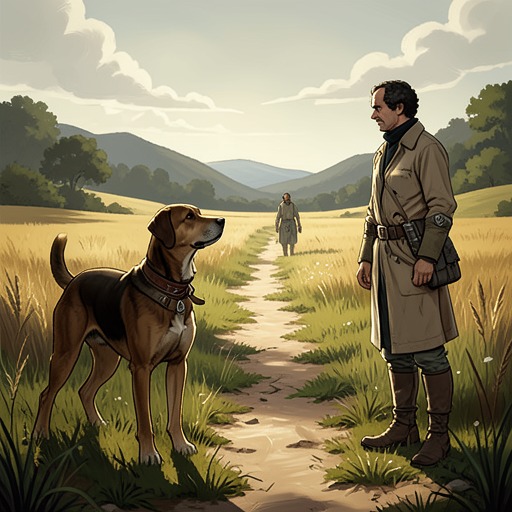
Good dog
A Dog's Way Home“Good dog” is both an affirmation Bella receives and a standard she gradually makes her own. At first, its meaning is closely bound to Lucas’s affection: his praise assures her that she belongs with him. Separation and setbacks unsettle that assurance, but the phrase continues to organize how she understands her actions. By the time she responds to Sylvia’s abuse, goodness has become more than pleasing a person; it includes defending someone who needs help.
A phrase built from affection
Lucas repeatedly tells Bella that she is the best puppy in the world. His words make goodness feel secure because they come from the person she most wants to remain beside. Bella does not treat praise as abstract approval: it tells her that her bond with Lucas is real and that she is doing well within it.
Terri offers a related affirmation when she strokes Bella’s fur and calls her “a good dog” and “A good, good dog.” The praise comes from a different relationship, but Bella recognizes the same reassurance in it. The phrase gives her a way to understand herself through the care she receives from people, not only through the tasks she performs.
That care also becomes something Bella can give. At a room where people sit in soft chairs, many of them old, she dislikes being away from Lucas, yet the people welcome and pet her. She is drawn to Mack when she recognizes his sadness as resembling Terri’s. Remembering that lying beside Terri had helped, Bella climbs onto Mack’s chair to be with him. The scene links being a good dog to attention and comfort: Bella notices distress and acts on what she has learned from an earlier relationship.
Approval, work, and self-doubt
Bella also connects praise to specific, repeatable behavior. Lucas’s Tiny Piece of Cheese has taught her that performing Sit can be rewarded. At Jose’s chair, she repeats the behavior in hopes of receiving a salty treat, much as she had learned to associate Lucas’s cheese with being good. With Warren, she performs Sit and shifts her weight to draw attention to the last piece of dog snack in his crinkly package. These moments show how Bella reads human responses: a treat can confirm that her behavior has pleased someone.
But that measure is vulnerable to separation. After she is sent away, Bella feels like a bad dog. She is too miserable to eat for the first two days. Then she decides that Lucas has sent her somewhere to wait for him, and begins eating when the other dogs do. Her resolve to be the best dog she can is not simply a wish to earn approval from whoever is nearby; she hopes that being good will bring Lucas back. The belief sustains her, even as it reveals how much her sense of worth depends on reunion.
When Lucas finally comes for her, Bella’s relief resolves that uncertainty. She presses herself against him and understands his return as proof that he loves her and has come to take her home. Her declaration that she was a good dog is inseparable from that recognition. The phrase does not merely mark success at a task; it confirms, for Bella, that she has not lost her place with her person.
Goodness beyond praise
Bella’s work in the world increasingly takes forms that are not measured by treats or verbal approval. When Lucas reads that fifteen percent of dogs can sense seizures, the information gives context to Bella’s alert behavior, but her identity as a good dog does not depend on a trained role. She has already learned to respond to sadness by staying close, and later she remains with a man who is moaning, another man, and a dog. Even when loud machines approach from below, she feels that she has to stay. She understands being there as her job, as she understood helping people who were sad as something a dog ought to do.
Her life with Big Kitten adds a different kind of companionship. The two share a kill, play together, and share a small rodent Big Kitten brings back from the trees. When Bella senses that feral dogs are tracking them, she becomes alert; Big Kitten follows because they are a pack. In deep snow, Big Kitten later leads Bella to a young elk she has taken down. These events do not present praise or obedience as the measure of Bella’s conduct. Instead, they show care and cooperation across a bond that is not organized around human approval.
A revised moral standard
The clearest change in the phrase’s meaning comes with Sylvia. After Bella and Dutch respond to Mike, Sylvia praises them as “Good dogs” and gives them meat. She then throws Mike’s belongings outside and, later, falls asleep on the living-room floor. Bella stays pressed against her, hoping to provide comfort. From the repeated instructions Lucas taught her, Bella has learned that dogs learn through repetition; now she draws a broader lesson from what has happened. When a man is bad to a woman, she understands, he has to leave, and a good dog should growl and snap when a bad man is hurting a woman.
That conclusion revises rather than abandons Bella’s earlier understanding. Praise still matters, and her bond with Lucas remains central, but goodness can require action that is not simply compliant. The phrase now encompasses a protective response to another person’s need. Across the episodes of reunion, comfort, waiting, and defense, “good dog” becomes Bella’s evolving account of what she is for: not only to be wanted, but to remain present and help.