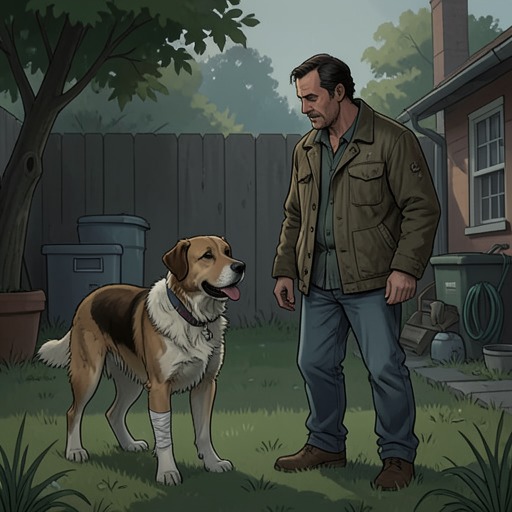
Kurch refuses to take Dutch back
A Dog's Way HomeKurch refuses to take Dutch back, turning a return meant to restore a dog to his former owner into a second abandonment. Kurch’s avalanche injuries leave him unable to care for Dutch, but the refusal is also shaped by anger and guilt. Gavin responds by taking Dutch with him and promising that he, Taylor, and Bella will become the dog’s family; when Dutch tries to return to Kurch, Gavin meets him on the road and gives him a new sense of home.
An Intended Return
Gavin arrives believing he is bringing Kurch his dogs. The misunderstanding becomes plain when Kurch says that Bella is not his and claims never to have seen her before. Gavin is shocked: he had assumed both dogs belonged to the injured man. The exchange establishes that the return is not a simple reunion. Dutch is the dog Kurch recognizes as his, but Gavin has also brought Bella, whose presence exposes how little either man understands about the other’s expectations.
Kurch’s condition supplies the immediate reason he gives for refusing Dutch. He says that half his body is in a cast after the avalanche, that he cannot feed himself, and that even getting to the bathroom takes an hour. The details make his incapacity specific: accepting Dutch would mean taking responsibility for a large dog while struggling with basic tasks himself. His injury is not incidental background but the circumstance that turns a familiar bond into a practical burden he says he cannot manage.
Refusal and Conflict
Gavin asks whether Kurch is saying he does not want Dutch back. Kurch answers that there is no way he can have the dog right now. Gavin insists that Dutch is his dog, but the dispute sharpens when Kurch brings up Gavin’s own earlier reluctance to take a dog because of China. He accuses Gavin of hypocrisy, suggesting that Gavin could do for Dutch what he is doing for Bella, with Taylor as his husband.
The accusation stops Gavin. His stillness marks a change in the encounter: rather than continue arguing over what Kurch ought to do, he recognizes the hostility beneath the exchange and decides to leave with Bella and Dutch. Kurch then tells Dutch to get out, saying that the dog makes him feel guilty and that the situation is not his fault. The words separate inability from rejection. Kurch has described a real physical limitation, but he also directs his anger at Dutch, who cannot understand the argument that has made his return unwelcome.
Dutch Leaves, Then Turns Back
Bella follows Gavin down the hallway and out the door, while Dutch trails behind. He repeatedly looks back toward the room and its angry occupant. Through Bella’s perception, the scene is defined by the dog’s divided attachment: the man in the bed is still Dutch’s person, even though Dutch is being told to leave. In the car, Gavin puts his arms around him, apologizes, and promises that he and Taylor will love and care for him. Gavin wipes his tears with a cloth from his pocket; Bella licks the hand he reaches back to her.
That promise does not immediately erase Dutch’s bond with Kurch. Later, Bella sees Dutch trotting ahead with his leash dragging, head low and tail down. She understands his movement as his own version of going home: he is heading back toward the place with the sandwich and the man in the heavy pants. Gavin stops the car and calls him over. Dutch sinks to the ground, blinks rapidly, and nearly crawls toward Gavin, appearing to Bella as though he feels he is the worst of the dogs for wanting to return.
A New Home Through Comfort
Gavin kneels, puts his arms around Dutch, and tells him that Gavin is his daddy now. He explains that Kurch’s place is no longer Dutch’s home: home is with Gavin, Taylor, Bella, and their family. He holds and rocks Dutch until Bella recognizes what he is doing—providing comfort. The scene does not make Dutch’s attachment to Kurch disappear; instead, it answers the rejection with a new offer of care while allowing the dog’s confusion and grief to remain visible.
Bella’s recognition draws on an established pattern in her own actions. At the hospital, she climbed into Mack’s chair because she sensed his sadness and remembered comforting someone who felt similarly; she also stayed beside distressed men after an avalanche rescue because she felt she had to be there for people who needed a dog. Here, she watches Gavin offer Dutch the same kind of bodily reassurance she has learned to give others. The event therefore changes more than Dutch’s living arrangement: it makes comfort a shared practice among the three dogs and their human caregivers, and gives Gavin’s promise of family its first concrete test.