Lucas stops the demolition of the cats’ shelter
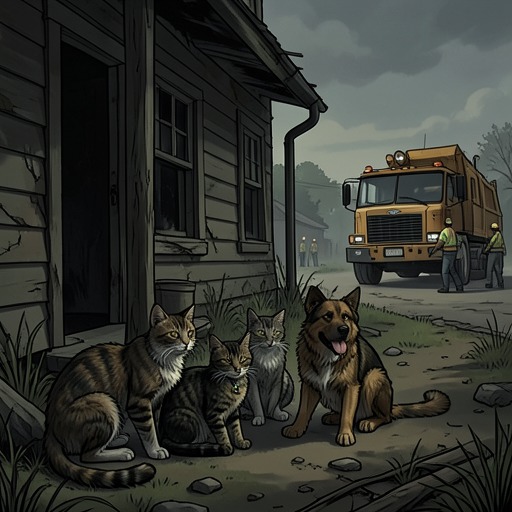
A Dog's Way HomeLucas stops the demolition of the cats’ shelter when a backhoe arrives at a house where feral cats are still living. He places himself and Bella in front of the machine, while Audrey films the confrontation and alerts the authorities to the cats’ presence. The intervention becomes decisive when Mother Cat runs from the den into view, contradicting the developer’s claim that the building is empty; Audrey then announces that the demolition permit is being withdrawn. The episode turns a threatened destruction into a contest over who has the authority to recognize and protect the animals living there.
Warning and Immediate Response
The crisis begins when Lucas sees a backhoe being unloaded. The threatened demolition is not merely a dispute about a building: cats remain inside, and Lucas understands that the work could kill them. He tells his mother what is happening, sends her to call the animal rescue organization, and asks her to request Audrey. His instructions connect the approaching machinery to a specific, urgent danger: the rescue workers need to know both that the developer intends to tear the house down and that cats are still inside.
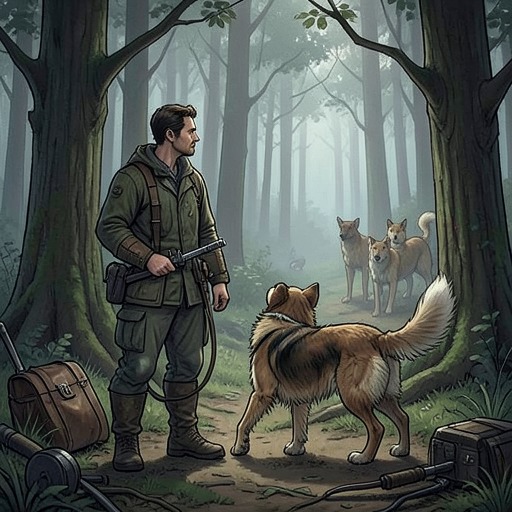
Lucas does not wait for the call to produce help. He gets Bella’s leash and clips it on; Bella feels his fear and wakes fully. When the demolition crew insists it cannot wait for the rescuers, Lucas walks in front of the backhoe and tells them they cannot proceed. Bella follows, with the leash slack between them. Their position makes the danger visible without suggesting that Bella understands the machine or the dispute as Lucas does: she sees something enormous, while he deliberately places himself in its path. The scene’s immediate stakes are life and death for the cats, set against the crew’s determination to continue the work.
Confrontation at the House
Audrey arrives with another person and begins filming the confrontation. The developer’s representative objects to being recorded and claims there are no cats at the site anymore. Audrey answers by identifying the house as a dwelling for feral cats. Her camera gives the dispute a record beyond the competing statements at the scene, while her presence connects Lucas’s individual obstruction to organized animal rescue.
The claim that the house is empty is overturned in a brief, visible action. Bella recognizes Mother Cat at the edge of the den’s hole. Mother Cat pauses, assesses the situation, then darts into the open and disappears into bushes by the back fence. Bella tries to follow but is held by the leash, and sits yelping in frustration. The attempted chase underscores the difference between Bella’s immediate attachment to Mother Cat and the humans’ effort to make the cat’s presence legible as evidence. Audrey asks whether her companion recorded the escape and is told that he did. The animal the developer says is absent has appeared on camera.
Permit and Authority
Audrey says that she is with the animal rescue organization and that the building commission has been called. More consequentially, she reports that the commission is withdrawing the demolition permit because feral cats are present; if the representative tears the house down, she warns, the act will be illegal. The intervention thus moves from physical resistance in front of the backhoe to a challenge grounded in the permit governing the work. The cat’s appearance supplies an observable reason for that challenge, and the recorded footage preserves it.
The developer’s representative dismisses the speed of the commission’s response as impossible. Audrey explains that one of the rescue organization’s board members is a county commissioner. That detail reveals how the rescue group can bring institutional influence to bear where an ordinary call might not have produced an immediate response. The two officers at the scene do not take control of the dispute: one observes that the rescuers are standing on the sidewalk and are not breaking the law by filming; the other notes that the representative had said there were no cats. They describe the matter as outside their department, while Audrey insists that animal welfare falls within their concern. The scene leaves the officers’ jurisdictional hesitation in tension with the clear evidence of Mother Cat’s presence.
Outcome and Significance
Lucas’s intervention and Audrey’s organizing perform different but complementary work. Lucas makes it harder for the machinery to proceed at once; Audrey documents the confrontation, identifies the remaining cats as the reason the permit is being pulled, and invokes the building commission’s authority. The episode’s immediate reversal depends not on a general appeal to compassion alone but on the specific fact that cats still use the house as shelter. The developer’s assertion of absence cannot withstand Mother Cat’s emergence from the den.
The intervention also gives Bella a partial view of a human conflict whose rules she cannot fully comprehend. She senses Lucas’s fear, follows him, recognizes Mother Cat, and is physically stopped from chasing her. Her limited understanding does not make her irrelevant to the event: the leash links her to Lucas’s stand, and her recognition marks Mother Cat’s appearance as significant. The episode presents protection as both an act of physical refusal and a process of making vulnerable lives visible to institutions. The permit’s withdrawal interrupts the threatened demolition; the evidence here establishes that immediate halt, not the cats’ permanent future in the house.