Pit bulls
A Dog's Way HomePit bulls are a consequential but uncertain classification in Bella’s story: people infer it from her appearance, yet the label becomes decisive in conflicts over whether she may remain in Denver. The novel sets that institutional judgment against scenes of Bella’s sociability and caregiving, making the distinction between an individual dog and a category imposed on her central to the term’s significance.
Appearance and Uncertain Classification
When Bella is found near the cat colony, people try to guess what kind of dog she is. One observer thinks she may grow large, pointing to her paws; another considers mastiff ancestry but sees features associated with Staffordshire dogs or rottweilers, and concludes that her ancestry may be mixed. The exchange offers possibilities rather than a confirmed pedigree. Bella is also described as healthy, but the people present do not agree on how she came to be in the underground space.
That uncertainty persists when Gunter Beckenbauer challenges the presence of a dog at the building. He asks whether Bella is a Pit bull and raises the apartment lease as a separate problem. His question turns a visual impression into a practical threat: the label is not merely descriptive when it can be used to support objections to her being there.
Animal Control and the Force of the Label
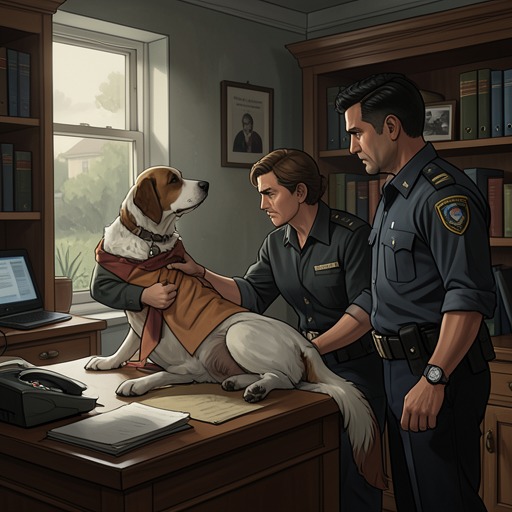
The classification becomes more consequential in Lucas’s encounter with an animal-control officer. The officer opens by asking whether a Pit bull lives in the home. Lucas answers that Bella’s breed is unknown: she was abandoned at birth and found in the crawl space, where someone from the office had said there were no animals, despite the continued presence of cats. His response contests both the certainty of the label and the account of the animals’ presence.
The officer later identifies Bella as one of the Pit bulls after seeing her. Lucas answers that they have the letter, referring to the documentation that supports Bella’s status with the household. In this exchange, visual judgment and paperwork occupy different roles: the officer’s assessment names a category, while Lucas relies on a document to protect Bella. The scene does not resolve the biological uncertainty that accompanied her earlier description.
After Bella is returned, the warning about the rules makes the stakes explicit. If she is picked up again within Denver city limits, she will be held for three days and then destroyed; the policy is described as allowing two strikes for Pit bulls. The person explaining the forms says that an appeal must go through the courts and that judges generally defer to animal-control officers. She also identifies Chuck, the officer who picked Bella up, as someone whose colleagues cover for him. Lucas is left unsure what to do, and the advice is to get Bella out of Denver. The label therefore shapes not only the risk of another seizure but the family’s options for where Bella can live.
Bella Beyond the Category
The novel gives readers evidence of Bella’s conduct that is not reducible to a breed designation. At the hospital, Ty takes her into rooms where people welcome and pet her. Bella is uncomfortable at being separated from Lucas, but accepts attention from the visitors. When Ty brings her to Mack, she recognizes his sadness and climbs beside him; he embraces her. The episode presents her as responsive to an individual person, not as an illustration of a classification.
Bella’s contact with Mack belongs to a wider pattern of comfort-giving in the story. Lucas later discusses the possibility that dogs can sense seizures, and Terri agrees that Bella seemed to know what was happening. During a separate emergency, Bella remains with an injured man, another man, and a dog until help approaches, understanding her presence as a responsibility. These scenes do not establish a general claim about Pit bulls; they show the particular conduct of Bella, the dog whom other people have placed within that category.
Narrative Significance
The novel places two kinds of judgment beside one another. People make uncertain guesses from Bella’s appearance, while animal-control rules attach a severe consequence to the resulting classification. By contrast, the narrative follows her actions in specific relationships: she stays near distressed people, responds to Mack, and remains devoted to Lucas. The distinction is not that the book supplies a definitive pedigree or a general verdict about Pit bulls. Rather, it shows how a contested label can acquire institutional force even when the individual dog’s identity is unclear.
The contrast also shapes the plot. Bella’s size and perceived breed become grounds for conflict over housing and animal control, while her demonstrated capacity to comfort others contributes to the case for keeping her with the people who care for her. The category is therefore both a description under dispute and a rule-bearing label: it changes the risks Bella faces without displacing the more intimate knowledge of her built through daily companionship.