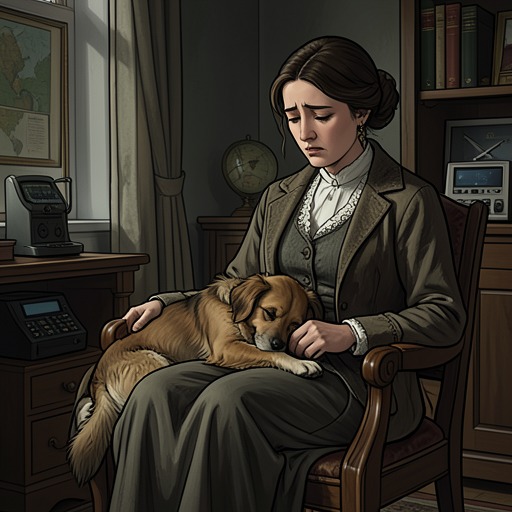
Terri’s depression
A Dog's Way HomeTerri’s depression is a recurring condition within her family life, at once a source of fear and guilt and something the household learns to meet through ordinary care. It has not simply disappeared: Lucas describes substantial improvement with Bella’s companionship, but also remembers how severe Terri’s low periods could become. The narrative sets those difficult episodes beside walks, a dog’s head in a lap, and Terri’s insistence that her son must still have a future.
A recurring condition, not a single crisis
Lucas tells his mother that his concern for abandoned animals comes from seeing them as alone in the world. Terri hears a family history inside that explanation: she suggests that his urge to protect the abandoned reflects his own earlier need for protection. The exchange makes the connection between Lucas’s care for vulnerable animals and the family’s experience of abandonment explicit, without reducing Terri’s depression to a simple explanation for his actions.
Terri’s distress appears in moments of lowered confidence as well as in the more serious history she later recounts. After a man leaves the house, she remains at the door for a long time, crying; Bella approaches her, and Terri wonders why she can never do even one thing right. Bella then settles beside her on the couch, and Terri strokes her. The scene gives the downturn a domestic scale: the visible signs are wet eyes, a self-reproachful question, and the need not to be left alone with the feeling.
Lucas describes more severe periods to a hospital clinician. Before Bella, he says, he could return home to find Terri still in her pajamas and without having eaten. He also says that this has not happened for a long time. His account therefore holds change and vulnerability together: Terri is doing better, but the earlier episodes remain the measure against which he recognizes improvement.
Abandonment, guilt, and a future for Lucas
Terri’s fear of becoming a burden shapes how she speaks about her condition. She tells Lucas that he cannot watch over her constantly and that she would hate for him to put his own life on hold. In her view, being a burden to her child would be the worst thing for a mother; her request is not that Lucas deny her difficulties, but that he believe her when she says his future matters.
That insistence is bound to regret. Terri recalls having abandoned Lucas when she joined the army and nearly abandoning him when she tried to take her own life. She says that she is past that point now and will not leave him. The exchange places a past suicidal crisis beside her present reassurance, rather than presenting her as either permanently defined by that crisis or untouched by it. Her depression is part of a relationship in which she recognizes the harm Lucas has experienced and tries to prevent care for her from becoming another form of loss for him.
The conversation also complicates the roles of caregiver and cared-for person. Lucas wants to protect Terri; Terri, in turn, worries about the cost of that protection to him. Her recovery is not described as a clean reversal in which all risk vanishes. Instead, she asserts both her need for support and her wish for Lucas to live beyond the demands of looking after her.
Bella’s everyday support
Bella’s help is shown through repeated, simple actions rather than formal instruction. When Terri is deeply sad after the man’s departure, Bella nuzzles her hand and lies with her on the couch. Bella understands sitting with Terri as a job more important than walks or helping feed the cats. The account makes comfort active: Bella stays, offers physical closeness, and remains there for as long as Terri needs.
Lucas describes a broader daily pattern. Terri stays with Bella during the day, takes her for walks, and gets energy from them. He says Bella seems to notice when Terri is beginning to enter a dark period and puts her head in Terri’s lap. The change Lucas observes is concrete: Terri is more often up and eating when he comes home, and she has not for a long time been as low as she was before Bella. The narrative presents these routines as meaningful support, not as proof that the depression has been cured.
The care also flows outward. During a visit to hospital rooms, Bella is welcomed by patients and gently petted; Ty gives her food, and one woman with trembling hands strokes her fur. Ty then brings Bella to Mack, whom she recognizes as sad in a way that recalls Terri’s sadness. Remembering how she stays with Terri, Bella climbs into Mack’s chair, and he hugs her. This encounter extends the pattern learned at home: the same closeness that helps Terri becomes a way Bella responds to another person’s visible distress.
Depression alongside other concerns
Terri’s improvement does not settle every worry in the household. Lucas reports that she has not been as depressed lately, while saying that her seizures are a real concern and that the family had thought they were over. These are presented as distinct problems: the seizures add uncertainty to Terri’s health, but they are not treated as another name for her depression.
After a seizure, Lucas reads that some dogs can sense seizures, and Terri agrees that Bella seemed to know what was happening. That moment brings Bella’s observed attentiveness into a new context, while the account of depression remains grounded in daily companionship, walks, eating, and moments of emotional withdrawal. Across the two concerns, Bella’s presence matters because she notices and stays; the story does not claim that her care removes the need for human attention or guarantees that Terri will not suffer another low period.