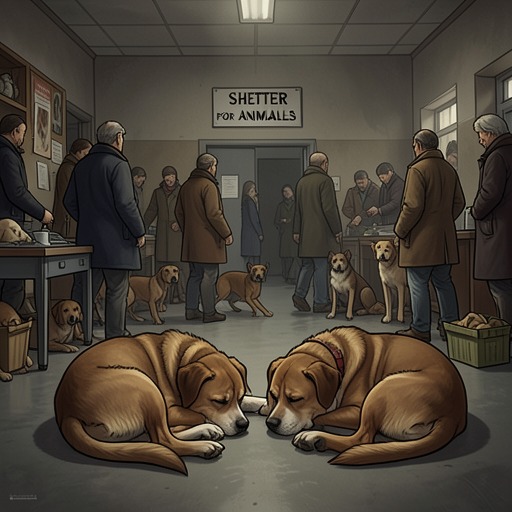
After Police Take CJ Away, She Retrieves Molly from the Shelter in Time
A Dog's JourneyAfter police take CJ away, Molly is sent to a crowded shelter and placed on a short euthanasia timetable after a fear response is read as aggression. CJ returns for her before that deadline, turning a promised reunion into a rescue from a system whose test mistakes fear for danger.
The Police Encounter and Separation
The encounter changes from an ordinary conversation into a separation when a police officer recognizes that CJ is already in the system. CJ has handed over identification; the officers are walking around the car when one says, “She’s in the system.” CJ runs, and Molly gallops beside her, not understanding why but eager to follow. The policeman catches up and asks how long she wants to keep running. He tells CJ that running away from home will not send her to jail, but that she is a minor and must come with them. CJ answers that she cannot go.
The officers’ distinction between jail and being taken into their care does not reassure CJ. When the policeman says he will have to cuff her because she ran, she immediately asks what will happen to Molly. The answer, “We’ll call Animal Control,” makes the separation concrete. The officer promises that Molly will be held until CJ can pick her up, but that assurance cannot remove the uncertainty of being handed to strangers. CJ’s fear of what will happen to her dog becomes the scene’s central stake: the police can take CJ, while Molly’s fate depends on the shelter process and on whether CJ is able to return.
A Promise at the Shelter Door
When a truck arrives with a cage on its back, Molly shrinks away from the man carrying a catch pole. CJ calls her over instead. She kneels, holds Molly’s head in her hands, and explains that Molly will have to stay at the shelter for a few days. She promises to come back and calls her a good dog. At CJ’s instruction, Molly climbs into the cage; before the truck leaves, she licks the tears on CJ’s face. The parting is therefore neither a voluntary surrender nor an unexplained disappearance: CJ tells Molly what is happening and gives her a specific promise to return.
That promise becomes painful as the days pass. Molly is confined among barking dogs, grows anxious and sick, and cannot become accustomed to being without her girl even as she grows used to the shelter’s noise and smells. On the third day, she feels as if CJ has forgotten her and needs her to come immediately. The account gives this waiting the shape of an animal’s separation: time is measured not by paperwork or a scheduled pickup, but by the growing fear that the person who matters will not come back.
The Aggression Test and Its Consequences
The shelter’s aggression assessment determines how little time Molly may have. A staff member explains that dogs who fail are short-tracked, receiving only four days before they are put down; dogs may be given longer when the shelter is not crowded. When another worker asks whether it is ever uncrowded, the answer acknowledges that the facility is usually packed. The test is presented as a practical procedure within that pressure: Molly is given food to smell, then a plastic hand will pull it away. Snapping or growling at the hand is defined as aggression.
Molly does not understand the test. Hungry and frightened, she lowers her nose toward the food, then sees a man approach with a large stick. Her experience with CJ in the car has taught her that sticks can mean danger, so she growls because she is too frightened to do anything else. The assessor calls the result: “Aggressive. Short track.” The other man objects that Molly’s owner said she would come back. His colleague dismisses such promises as something owners say when leaving dogs, insisting they never return. The exchange makes the test’s consequences especially stark: Molly’s defensive response is treated as evidence against her, and the very possibility that an owner might reclaim her is discounted. The four-day policy and the crowded shelter leave little margin for that error.
Reunion Before the Deadline
After three days, a woman opens Molly’s cage and leads her through the rows of dogs. When a door opens, CJ is waiting. Molly jumps up, sobbing in the language of the scene, trying to lick CJ’s face; CJ asks whether she is all right and apologizes repeatedly. They embrace and kiss for several minutes. Molly understands the reunion as proof that CJ had not forgotten her after all: the promise made beside the truck has survived the days of barking and the failed assessment.
CJ leads Molly to a car, and Molly follows joyfully. She enters through the back door and sees Gloria in her usual front-seat place. Even so, she wags at Gloria, glad to be leaving the shelter. CJ praises her as she gets behind the wheel. The return does not erase the fear or the danger of the short track, but it reverses the separation before the four-day limit described by the staff. Molly’s rescue depends on CJ’s return, while the scene’s earlier promise and Molly’s mistaken classification show how precarious that reunion was.