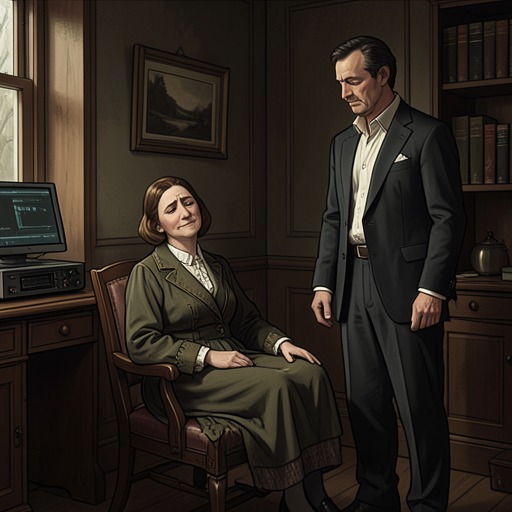
CJ—Gloria
A Dog's JourneyCJ—Gloria is the strained, enduring bond between CJ and her mother. Across their shared life, care and injury coexist: Gloria participates in the practical work of raising and feeding her daughter, yet also shames and controls her; CJ resists that control, eventually distances herself, and later remains present as Gloria grows old and loses her lucidity. Their relationship does not resolve into an uncomplicated reconciliation. Its final expression is more modest and more powerful: CJ sits with her mother as she dies and says goodbye with love.
Early Dependence and Uneasy Care
In Clarity Mahoney’s childhood, Gloria’s role includes intimate, necessary care. Clarity sits in a special chair with a tray while Gloria tries to spoon food into her mouth. Clarity spits much of it back out; she has tasted the food herself and understands the refusal. Some food Clarity is allowed to handle and put into her own mouth, but Gloria and Hannah still have to feed her the especially unpleasant portions. The scene makes care concrete and bodily, while also showing that the care does not always follow the child’s preferences.
The family circumstances around Clarity’s home life are unsettled. Hannah tells Gloria that, although she and Henry are no longer together and never married, Gloria is the mother of Hannah’s grandchild and will always be considered family. Hannah then raises the possibility that Clarity could stay with her. Gloria’s response turns quickly to financial insecurity: she fears Henry may end child support and leave her with nothing. When she sees the family’s kindness as a sign that something is being arranged behind her back, she stands abruptly and says she knew it was something like this. The exchange places material dependence alongside family belonging: an offer involving Clarity is heard by Gloria not simply as help, but as a possible threat to her security.
As Clarity grows older, Gloria’s words can wound in ways that make the household feel emotionally unsafe. When Clarity is leaving, Gloria criticizes the shorts she is wearing and says they make her thighs look heavy. Later, Clarity sleeps in the crook of Molly’s arm while Molly strokes her; Clarity whispers that she loves Molly. The contrast is telling without making the dog a substitute for every human bond: the scene records a tenderness Clarity seeks and gives, set against the preceding body-shaming remark from her mother.
Molly and the Fight for Autonomy
The dispute over Molly becomes the clearest arena in which mother and daughter contest who has authority over CJ’s life. Gloria connects the family’s trouble to CJ’s supposed lack of respect and to the day she brought the dog home, then demands that CJ get rid of Molly. She insists that the house operates by her rules and forbids CJ from speaking to her in what she calls a smart-mouthed way. Molly is therefore more than a pet in the argument: keeping her is bound up with CJ’s ability to make a decision for herself inside a home where Gloria claims final authority.
CJ’s resistance rests partly on a history of neglect and abuse she says Gloria would rather leave unspoken. During one confrontation, CJ points to the trips on which Gloria left her without adults in the house, including when CJ was twelve. She also raises allegations that Gloria beat her with garden tools and broke her arm when she was eight. These are CJ’s accusations in the confrontation, not a neutral reconstruction of every event; their force in the scene lies in the history she invokes to challenge Gloria’s authority and credibility. CJ then makes keeping Molly the condition for her silence, warning that she will tell the judge what happened if Gloria tries to make her give the dog up.
The conflict later takes on an explicit legal dimension. Gloria says she has consulted a family-law attorney and threatens to ask a court to force CJ to move home and to free Gloria from having to accommodate a dog. She presents the cost and likely outcome of court as reasons CJ should yield, suggesting that the money could instead be spent on a trip. CJ refuses that framing and says she is willing to go to court. She plans to hire a lawyer, use provisions in Henry’s trust for her welfare, and ask the judge to find Gloria unfit to be a mother. Her answer turns the threat back toward the relationship’s central history: the question is no longer only whether Molly can stay, but whether Gloria can continue to define their conflict as a child’s disrespect rather than a mother’s conduct.
Separation and the Cost of Contact
The struggle does not produce a settled closeness. Much later, CJ admits that she does not know whether she wants to see Gloria. The reason she gives is personal and immediate: whenever she sees her mother, she ends up feeling bad about herself, and she wonders whether that response is terrible because Gloria is still her mother. The statement captures the contradiction at the center of the bond. Kinship remains real, but it does not make contact feel safe or restorative.
CJ compares Gloria’s disappearance from her life to parents moving without leaving a forwarding address and decides to take it as a sign to go. The comparison is wry, but its implication is serious: CJ experiences the separation as something Gloria has done to her, not as a clean decision that erases attachment. When CJ later receives a message from Gloria, the news enters a life in which that distance has already become part of their relationship. The evidence does not make the message itself a full repair; it shows that contact resumes against a substantial history of estrangement.
Care in Old Age
In Gloria’s later years, the balance between mother and daughter changes. Gloria is described as having good and bad days and, most of the time, not being lucid. On a comparatively good day, she accuses CJ of stealing her money and asks to go home, calling for Jeffrey. CJ sighs but keeps stroking Toby’s head while Gloria speaks. The accusation is a painful reversal of the earlier financial anxiety: the old fear of losing money remains present, but Gloria now directs it at the daughter who is beside her.
CJ gives a different account of the money. She says Gloria tells people that CJ stole her fortune and house, while the truth, as CJ understands it, is that she has supported her mother for the past fifteen years. She adds that whatever she sent was never enough. The disagreement exposes how care can remain materially demanding without being recognized as care by its recipient. Gloria’s impaired understanding shapes their present exchanges, but it does not erase CJ’s memory of the years of support or the accumulated strain of trying to provide it.
CJ’s own health is fragile during this period. She explains that a kidney transplant from a deceased donor, received in her thirties, gave her more than two decades before chronic rejection caused it to fail; she had restarted dialysis seventeen years earlier. This does not make her support of Gloria effortless or resolve the history between them. Instead, it places CJ’s continuing presence beside her mother within a life marked by long-term illness and ongoing treatment.
Final Goodbye and the Relationship’s Meaning
About a week after the scene of Gloria’s accusations, Toby senses a change while sitting at CJ’s feet in Gloria’s room. Gloria’s breathing grows lighter, stops, and resumes in weaker breaths. CJ remains there and, at last, says goodbye to her mother and tells her she loves her. The ending offers no retrospective claim that the wounds between them have disappeared. It gives the relationship a final act of recognition: despite the hurt, the separation, and the difficult work of supporting an increasingly confused parent, CJ is present at Gloria’s death and addresses her as her mother.
That ending brings the relationship’s recurring tension into focus. Care passes unevenly between them, shaped by dependence, control, money, illness, and memories that cannot be made harmless by family ties alone. CJ’s final words acknowledge love without converting the past into an uncomplicated story of forgiveness. Their bond remains strained, but it is not reduced to estrangement: at the moment of parting, CJ stays.