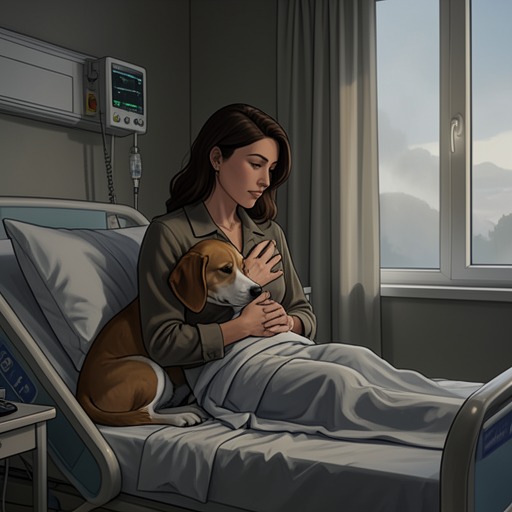
Molly’s Warning Helps Sheryl Discover a Lump in Time
A Dog's JourneyMolly’s warning helps Sheryl discover a lump in time, transforming an uncertain moment in Andi’s group-scent research into a consequential alert. Molly detects an unusual metallic smell on a woman’s breath and signals; only later does Sheryl explain that the warning led her to act on a small lump she might otherwise have postponed checking. The episode gives practical force to Molly’s sensitivity to scent: what first appears to her as a puzzling game becomes, in retrospect, an intervention with life-saving consequences.
Research and the New Group Exercise
Molly and CJ had once visited Andi every day, but the routine changed, and their visits became occasional. Molly welcomes each return: after the familiar greetings of hugs and kisses, she and the people there play a chair-based game, as well as a newer exercise in which participants form a long line, sometimes seated and sometimes standing. That shift in format matters. Andi explains that her grant is intended to test whether a dog can signal positively on people in a group. Luke is the only dog who has already figured out what the exercise requires, leaving Molly to learn the task through her own uncertain encounter with it.
As Molly and CJ move along the line, Molly can tell that Andi and CJ want her to do something, but she does not yet understand what. Then one woman’s scent stands apart. The woman has no hair, her hands smell of harsh soap, and Molly catches an unmistakable metallic odor on her breath. Molly signals and receives a biscuit. Her response is grounded in immediate sensory perception rather than any explanation of illness: she recognizes a particular smell, acts on it, and is rewarded.
The exercise remains confusing because Andi continues guiding Molly toward other people who do not have the same scent. When Molly signals for them, Andi crosses her arms and gives her no biscuit. From Molly’s perspective, the differing responses do not yet make the rule clear. The sequence preserves the uncertainty of training rather than presenting Molly as already knowing the medical meaning of her alert. She has noticed a scent and performed the behavior that earns a reward; the importance of this particular signal is not yet explained to her.
Sheryl’s Later Confirmation
The connection emerges much later, when CJ and Trent are speaking with Sheryl. They had met at the Christmas party, where Molly signaled, but CJ now raises the unanswered question of what happened after that alert. Sheryl confirms that there had been a lump. It was small, and she was busy; without Molly’s signal, she says, she would have kept putting it off. The discovery therefore does not rest on an abstract claim about a dog’s ability. Sheryl identifies a concrete change in her own behavior: the alert interrupted a pattern of delay and brought the lump to attention.
Sheryl adds that her doctor said they caught it in plenty of time. The scene does not specify a diagnosis or describe treatment, so its emphasis stays on the early discovery and the importance of acting before the lump could be ignored further. Sheryl also reveals that she called Gloria and told her about it. CJ had not heard the news and says she had been traveling. The information had reached her mother, but not CJ, leaving CJ to learn the result directly from Sheryl during this later conversation.
Molly’s response to the confirmation is physical and immediate: she wags as Sheryl acknowledges what the earlier signal accomplished. Sheryl leans over to kiss her and thanks her for saving her life. Rocky pushes his head into the moment, while Molly continues wagging. The exchange turns the earlier biscuit reward into only the first, limited recognition of what happened. Now Sheryl herself names the consequence, and gratitude becomes the human confirmation of a warning whose significance Molly could not have understood.
From Ambiguous Signal to Consequence
The event is arranged as a delayed recognition. At Andi’s visits, Molly experiences the line exercise as a set of inconsistent expectations: one signal earns a biscuit, while signals for other people do not. The later conversation supplies the missing consequence without changing the original scene. The metallic breath, the woman’s distinctive appearance, and Molly’s successful signal acquire new meaning when Sheryl identifies the lump and explains that she would have put off dealing with it. What was initially legible only as scent and response becomes legible to the people around Molly as an effective warning.
The episode also makes the difference between an animal’s perception and a person’s interpretation central to the event. Molly does not diagnose Sheryl or explain why the odor matters; her contribution is to detect, signal, and persist in a task whose purpose remains unclear to her. Andi’s group exercise provides a setting in which such a signal can be noticed, while Sheryl’s later account reveals the personal consequence. The narrative joins those stages across time: training first, confirmation afterward.
Sheryl’s words give the event its decisive stakes, but the account preserves the small practical steps between warning and outcome. Molly responds to the scent; the signal draws attention; Sheryl discovers a lump; and her doctor says it was caught in time. Her admission that she would have continued postponing it makes the alert’s value specific rather than merely symbolic. Molly’s ability to notice what other people had not acted on changes the course of Sheryl’s attention, and the later thanks recognize that change as a life-saving intervention.