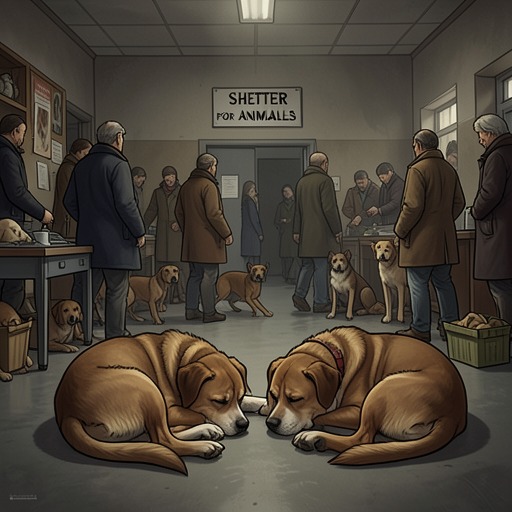
Shelter Aggression Assessment and Euthanasia Policy
A Dog's JourneyShelter Aggression Assessment and Euthanasia Policy governs how a dog’s behavior is assessed and how long it may remain available for adoption. In Max’s case, a growl during a frightening food test marks him as aggressive and short-tracks his stay; the shelter’s overcrowding then turns that judgment into an urgent question of whether he can be placed before euthanasia. The policy is presented not as an abstract rule alone, but as a decision made under pressure, with the shelter’s need to make room set against the possibility that a dog judged difficult might still thrive with different care.
Assessment and Time Limits
A shelter worker explains that a dog who fails the aggression test is short-tracked: the dog receives only four days before being put down. Dogs who do not fail may be given longer, but that additional time depends on whether the shelter is crowded. The distinction makes the assessment consequential beyond its immediate label. A failed test narrows the time available for adoption, while passing does not guarantee a fixed period of safety; capacity remains part of the decision.
The policy is described in a setting where crowding is usual rather than exceptional. When a newer worker asks whether the shelter is ever not crowded, the experienced worker says that it is sometimes not completely full, but that the usual condition is being packed. Dogs arrive every day, and the shelter cannot treat every animal’s stay as open-ended. The four-day limit thus operates within a larger system in which an individual assessment can quickly become a deadline.
How Max’s Test Works
The test is explained as a food-guarding exercise. A bowl is placed before the dog so she can smell the food and understand that it is hers; the tester then tries to pull the food away with a plastic hand. Snapping at the hand or growling counts as aggression. The procedure focuses on the dog’s response to an apparent threat to food, and the tester describes the hand by its shape and flesh color. The newer worker’s question about whether a dog would recognize it as a hand draws laughter, but the test proceeds.
Max is hungry and begins to salivate when the food is set down. Instead of the described plastic-hand maneuver, however, a man approaches him with a large stick. Max has learned from his time with CJ in the car that sticks can signal danger. As the stick is pushed toward his nose, he growls because he is frightened. The tester immediately calls the result aggression and assigns him to the short track. The sequence matters: Max’s reaction is interpreted as evidence about his temperament, although the threatening object in the moment is a stick, not the food-removing hand the procedure had just described. The narrative shows the rule being applied, while also making visible how the circumstances of the test shape what it records.
Crowding, Judgment, and Exceptions
The staff do not all regard Max’s prospects in the same way. One worker objects that Max’s owner said she was coming back. The tester dismisses such promises as something owners say when they leave a dog, asserting that they do not return. His response reveals a workplace expectation formed around repeated abandonment, but it also closes off the possibility that this particular owner might keep her word. The newer worker hesitates; the experienced worker insists that he must adjust quickly if he is to last, because the shelter cannot retain an aggressive dog indefinitely.
Max’s later behavior gives the staff further reason for concern: he nips at a little girl. A worker argues that even if Max could be adopted, a new owner might not be able to handle him. Gail counters that better socialization than the shelter can provide might help him. She insists that he has not bitten anyone and describes him as sweet beneath his difficult behavior. The disagreement is not simply about whether Max has shown risk; it is also about whether his conduct in the shelter predicts what he could become in a different environment.
The worker defending euthanasia frames it as a condition of rescue itself. If the shelter never euthanized dogs, he argues, it could fill with animals considered unadoptable and lose the ability to save others. Foster placements with no-kill shelters are used when possible, but those organizations are full, as is the shelter, and new dogs continue to arrive. Within that constraint, the staff agree to give Max one more adoption fair, although he is already past the established time. That additional opportunity is a limited exception, not a removal of the deadline: during a later visit Gail tells Max that it is his last day, and the shelter subsequently says he is scheduled for euthanasia the next morning.
Max’s Deadline and the Policy’s Stakes
Max’s case shows how the assessment and the capacity rule reinforce one another. He has growled during the test, nipped at a child, and failed to warm to most people at the shelter. Gail acknowledges that he has snapped at her, even though she is the person who feeds him, and says she cannot keep him in her apartment because dogs are not allowed there. In the shelter’s view, his difficulty connecting with prospective caregivers makes him harder to place; in Gail’s view, it does not erase his underlying sweetness or the possibility that more suitable socialization could help.
The deadline becomes immediate when CJ learns that Max is due to be euthanized the following morning. The shelter worker explains that the building is full, incoming dogs need space, and Max has not warmed to anyone there except CJ. CJ has only recently taken in a cat and is reluctant to add a dog, but the worker offers to waive the adoption fee and argues that dogs and cats raised together can do well. The appeal links Max’s individual chance of survival to the same circulation of animals that underlies the policy: for the shelter to keep helping dogs, space must be made, yet this particular dog can still be saved if someone takes responsibility for him.
Significance
The policy balances two kinds of judgment. The aggression test reduces a complicated animal’s behavior to observable responses such as snapping or growling; the short track translates that classification into a sharply limited period for adoption. At the same time, the shelter’s staff recognize that behavior may change with socialization and that a dog’s chances depend on who is able to care for him. Max’s fear-driven response to the stick, his nip at a child, Gail’s defense of his character, and his unusual attachment to CJ all complicate any single verdict about whether he is adoptable.
The shelter does not present euthanasia as an easy or consequence-free solution. Its workers explain the policy through overcrowding, unavailable foster placements, and the arrival of new dogs, while their debate over Max makes clear what those pressures demand of individual animals. The extra adoption fair briefly opens time that the short track would otherwise restrict, but the scheduled euthanasia remains close. The policy’s governing tension is therefore practical and moral at once: sustaining rescue for the many depends on limiting the time and resources available to each dog, even when a specific dog may yet find the person who can take him home.