Bella leaves the town dog pack
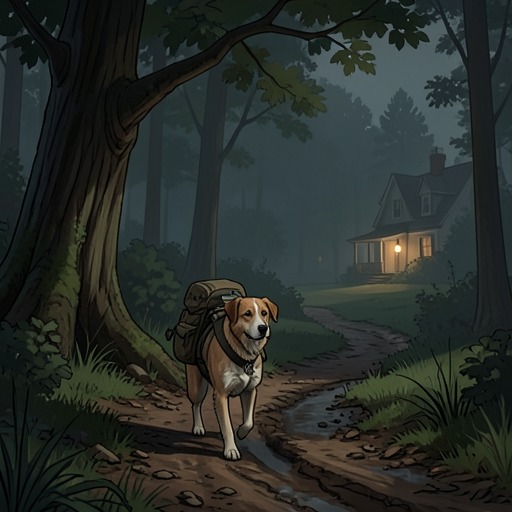
A Dog's Way HomeBella leaves the town dog pack when she understands that its members are only traveling together temporarily: unlike them, she has no home in town to return to, because her person is Lucas. Her choice turns a moment of apparent refuge into a solitary journey, making clear that comfort and safety cannot replace the particular bond she is trying to recover.
The Town and the Command to Go Home
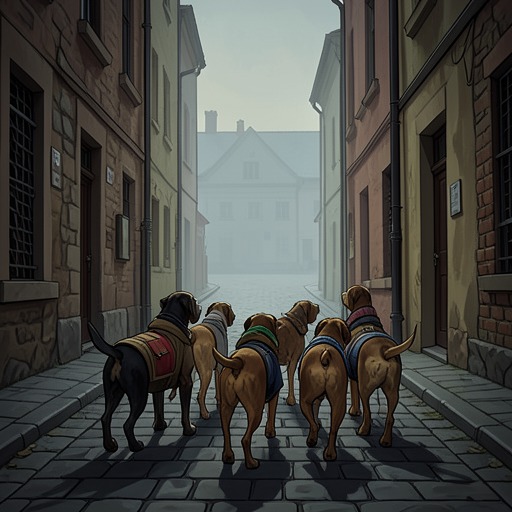
The pack’s departure begins with an ordinary human gesture. A man hands out food to the dogs and then shuts the door, telling them, “Go on home, now. Go Home.” Bella recognizes the words as a command she already associates with Lucas. Although she is far from him, the command makes her wonder whether she might at last be going home simply by following the other dogs.
The dogs move through a neighborhood of houses, with lights, food, people, and other animals around them. Their companions peel away one at a time. A female dog turns up a walkway toward a porch; a larger male scratches at a metal door until a boy lets him inside. The smaller male stays with Bella and signals for her to follow him toward another house. What first looks like a continuing pack journey is instead a series of separate returns to familiar people.
Recognizing the Pack’s Limits
Watching the dogs leave changes Bella’s understanding of the group. They had been traveling together, but their togetherness was temporary: each had a household waiting for it. She imagines how a park pack dwindles as people call their dogs by name and take them away, until only a dog without a person remains. Her realization is blunt: “One dog does not make a pack.”
The smaller male offers the possibility of belonging. Bella can smell that more than one person has handled him, and she longs for the ease his life seems to promise: a soft bed, food, and affection from his family. She does not mistake that welcome for a threat or reject the kindness of people. Earlier, in the hospital, she had enjoyed being petted and fed by patients, and she had climbed onto Mack’s chair when she recognized his sadness, staying close as he hugged her. Those experiences make the town’s warmth familiar; they do not make it her home.
Nor is Lucas’s importance abstract. Before Bella’s journey, Lucas had noticed her apparent awareness of a seizure, and Terri agreed that she seemed to know what was happening. His praise affirmed a relationship grounded in close attention and care. In the town, another dog may offer a household and immediate protection, but Bella understands that she cannot be with her person and also belong to the small male’s family. Her refusal is a choice between two attachments, not a denial that companionship matters.
Choosing the Road Alone
Bella turns her nose toward the direction she believes will lead to Lucas. The contrast is stark: the town offers people, buildings, food, and the safety of a dog among other dogs; the route ahead leads toward hills, streams, and trees, with snow in the air and no nearby people. Her days on the trail have already taught her that food may be uncertain and that the wild presents dangers she does not know. The small male watches from partway up the yard, still offering the comfort of a home, but Bella turns away and sets out to find Lucas.
This is not a confident departure. The town has made the risk of leaving newly legible. When Bella first escaped, she believed she would be home very soon; now she understands that she may walk for many days without reaching her hometown. Once the lights and smells fade, the moon gives her some light, but she feels vulnerable without a pack. The company of the town dogs had shown her how much safer travel can feel when others are present, so going alone means knowingly relinquishing that security.
Consequences and Narrative Significance
The decision sets the terms for the next part of Bella’s journey. She continues through the landscape with no human household to shelter her and no settled pack to protect her. Later, she forms a different kind of traveling companionship with Big Kitten: they share food and play, and Bella waits when the younger animal falls behind because she feels responsible for her safety. Their companionship does not end Bella’s search for Lucas; it accompanies it.
The wilderness also tests the choice directly. Bella senses feral dogs tracking her and recognizes four coyotes hunting the pair, while Big Kitten initially appears unaware of the danger. In winter, deep snow slows Bella dramatically, whereas Big Kitten can move across it with far greater ease and hunt prey that sustains them. These later hardships do not make the town’s offer unreal or foolish. They show what Bella accepts when she chooses Lucas: uncertainty, exposure, and dependence on her own judgment rather than the ready-made safety of another dog’s home.
The episode gives “Go Home” a meaning that exceeds the human command. For the town dogs, it means returning to separate houses and people; for Bella, it means continuing toward the one person she identifies as hers, even when the route offers no pack and no assurance of arrival. Her choice establishes the journey’s central tension: she can receive kindness and find temporary companions along the way, but she will not confuse either with being home.