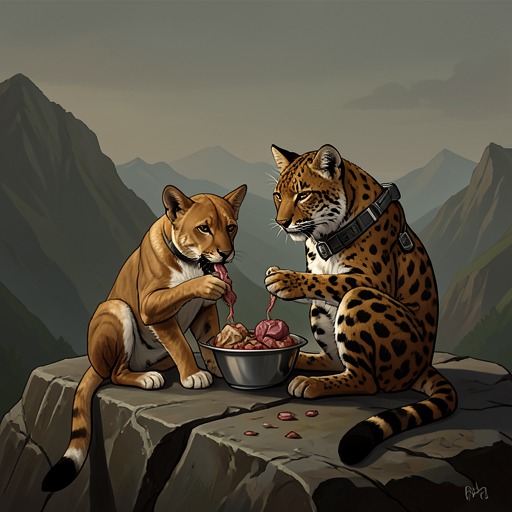
Bella takes in the orphaned cougar cub
A Dog's Way HomeBella takes in the orphaned cougar cub when her search for Lucas brings her upon the cub’s dead mother and two men nearby. The encounter changes Bella’s journey: rather than continuing alone toward home, she follows the frightened Big Kitten and assumes a protective role shaped by the care she received from Mother Cat. Their companionship becomes a practical partnership, sustained by shared food, play, shelter, and the cub’s growing ability to find prey.
Discovery near the dead mother
Bella is tired and hungry as she travels uphill. A loud report draws her attention, and she approaches a ridge where two men are moving down steep ground carrying pipes associated with the sound. They are not the people she expects to encounter. Their excited conversation suggests that the animal they have found has monetary value, but Bella’s attention shifts when she detects the smell of blood and discovers a large, motionless feline among the rocks.
The animal resembles a cat but is far larger than any Bella has seen. Its female sex and the milk scent at its teats remind her of Mother Cat. Bella also notices the men coming closer, but before she leaves, movement in the bushes catches her eye. There, partly concealed, is another immense cat, watching her. Its tense posture and retreat when one of the men shouts mark it as frightened. When it runs, Bella recognizes the movement as that of a kitten, although the animal is already as large as a medium-sized dog.
Bella cannot know for certain what has happened to the adult animal or what the men intend. She can, however, recognize the cub’s fear and the danger of remaining near the men. As she slips away into the brush, the Big Kitten follows. That first act of following turns a chance encounter into a shared journey.
Choosing to protect the cub
At first Bella continues along a route away from the men, following the animals’ trail. The Big Kitten stays quiet behind her and hides when Bella turns to look. After they have gone some distance, Bella tries to continue toward Lucas. The cub stops, moves briefly in another direction, and looks back at Bella. Bella reads this hesitation as a request to go elsewhere, and then understands the cub as an animal in need of help.
That recognition draws directly on Bella’s own early experience. Mother Cat protected her when she was vulnerable; now Bella feels compelled to protect the kitten. She follows the cub through rocks and other obstacles to a place beneath trees where the dead mother’s scent remains. There they find the nearly intact remains of a deer. Bella eats first, driven by hunger, and the Big Kitten eventually joins her. Food gives them an immediate reason to remain near one another, but it is not the only basis for the bond.
That night, the cub approaches Bella and examines her cautiously. Bella stays still while the kitten sniffs her, then licks her. When the Big Kitten begins to relax, Bella recognizes a familiar gesture from her own kittenhood: the cub rubs her head against Bella before curling up beside her. Bella understands the moment as an exchange of comfort, recalling how she rested against Mack. The vulnerable animal beside her is not a person, but a young kitten whose mother is dead.
Bella’s decision also follows a model she associates with Lucas. Lucas cared for cats and fed them; Bella concludes that looking after this kitten is something he would want her to do. Her continuing wish to reach him remains, but it no longer determines every choice. The responsibility she accepts slows her progress and changes the purpose of her travels for a time.
A shared routine on the trail
Bella and the Big Kitten spend several days near the deer remains, eating what they can. Their relationship develops through ordinary repeated actions as well as care. The cub pounces on Bella; Bella knocks her onto her back and mouths her head, and the kitten twists away to play again. The Big Kitten sleeps through much of the day but becomes active as evening approaches. On one occasion she leaves the resting place and returns with a small rodent, which the two share. The cub is not only a dependent companion: she can locate food and contribute to their survival.
When Bella’s urge to move toward Lucas returns, the Big Kitten follows. She avoids human smells and stays under cover, sometimes out of Bella’s sight for much of the day. Bella can still detect her nearby. If she loses track of the cub’s position, she waits until the kitten catches up. Bella recognizes that she could cover more ground without worrying about the Big Kitten, yet continues to make sure she is safe. Protection is therefore not a single rescue but a recurring decision that shapes their pace and route.
The same partnership influences how they respond to other animals. When Bella detects dogs without people nearby, their scent alarms her; she recognizes that they are feral and tracking the pair. The Big Kitten appears unaware of the danger and follows Bella because they are moving as a pack. Bella’s alertness becomes a form of protection, while the cub’s continued attachment keeps them together. Their different strengths matter: the young cougar can forage and negotiate difficult terrain, while Bella notices the approaching threat and leads them away from it.
Winter and a changing partnership
Snow transforms both the landscape and the pair’s routine. Bella finds that the deep snow makes forward movement slow and difficult, while her sense of the direction of home becomes more pronounced. The Big Kitten reaches her with little apparent difficulty, placing her hind paws in the impressions left by her front paws. The difference between their movement is striking: the same snow that impedes Bella barely slows the cub.
They shelter together and share warmth as snowfall covers their resting place. Later, Bella attempts to follow the Big Kitten at night but cannot keep pace, even when she walks in the cub’s tracks. When the cub returns from a successful hunt, she leads Bella to a young elk buried in the snow. The two eat, then return to their temporary den. Bella would prefer to stay with the food, but follows the cub away from it. As winter continues, the Big Kitten finds prey often enough to sustain them, including deer and elk cached in snow and smaller animals brought back to the den.
The relationship thus shifts without ending its mutual care. Bella first responds to the cub’s vulnerability by taking responsibility for her; in winter, the cub’s hunting and movement help sustain them both. Bella remains oriented toward Lucas, but their shared survival depends increasingly on the Big Kitten’s abilities. The care begun in response to loss becomes a working companionship between animals with different needs and capacities.
Significance
The episode makes Bella’s care for the Big Kitten an active choice rather than a detour that erases her own goal. She remains committed to finding Lucas, yet delays that journey when she encounters an animal who needs protection. Her decision carries forward the care she received from Mother Cat and connects it to the kind of care Bella associates with Lucas, while also extending that care beyond the human household.
The Big Kitten is not only someone Bella protects. Her play, preference for cover, ability to travel over snow, and hunting all give her an independent role in the pair’s life. Bella’s protection and the cub’s practical contributions change over time, allowing the relationship to become reciprocal without making their differences disappear. Their companionship is formed through repeated choices—waiting, following, sharing food, and resting together—and it alters the course of Bella’s journey home.