Demolition permit and site notice
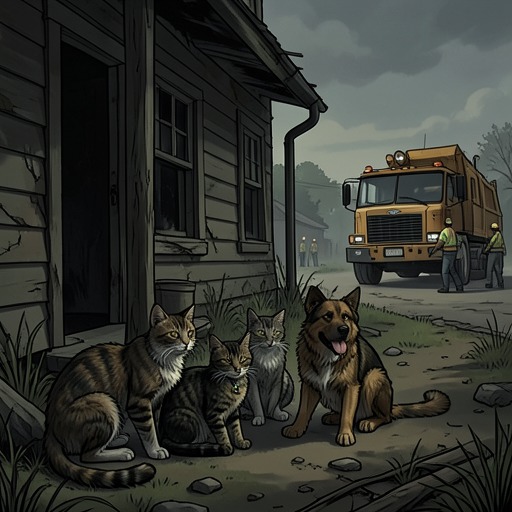
A Dog's Way HomeThe Demolition permit and site notice is the paper record at the center of the campaign to protect the feral cats living beneath a house marked for demolition. Its importance lies not simply in authorizing work: the displayed permit becomes a disputed claim about legality, a focus for gathering evidence, and a public object around which Lucas and Audrey organize resistance. As the cats remain hidden in the Crawl space beneath the abandoned house, the permit makes their shelter’s destruction look both imminent and, potentially, contestable.
The permit and the dispute
Lucas first explains that Bella was rescued from the crawl space beneath the house and that many cats are still there. His point is that the rescue is incomplete: the animals not yet caught remain inside the threatened site, so the house cannot legally be torn down while they are living beneath it. The dispute therefore turns on a concrete condition at the property, not simply on whether the building owner has paperwork.
The man preparing to demolish the house answers by pointing to the posted permit. He treats it as proof that the work is legal and insists that carrying out the job is not personal. Lucas rejects that separation between procedure and consequence. To him, the cats are abandoned and depend on people to protect them; the demolition is personal precisely because it threatens their only refuge. The same sheet of paper thus carries opposing meanings: the man presents it as settled authority, while Lucas sees its claim to legality as answerable to the cats’ presence.
A challenge through official channels
Audrey brings the dispute to the building commission. She says that the commission is pulling the demolition permit because feral cats are present and warns that tearing down the house would then be illegal. The speed of that intervention surprises the man, who doubts that the commission could respond so quickly. Audrey explains that one of her organization’s board members is a county commissioner. The permit’s status, as presented in this confrontation, is therefore not fixed merely because a copy has been posted: an official challenge can change what the authorization allows.
The competing statements leave a distinction between possession of a permit and the right to proceed under its terms. The demolition crew’s paperwork does not erase the cats from the site; conversely, Lucas’s account of the animals needs to be made visible to the officials deciding whether work can go forward. The argument is about authority, but also about what counts as evidence of the condition that should limit that authority.
The notice at the fence
After Lucas’s mother leaves, Lucas takes Bella to feed the cats. He does not approach their entrance. Instead, he finds a rut beneath the fence, recognizes from the scent that several felines are using it, and pushes food under the barrier. He cannot get closer. On the dark fabric covering the fence, he sees a white notice of demolition and tells Bella that he supposes the man has obtained his permit. The posted notice turns an abstract dispute into a visible sign that the threat may be advancing again; Lucas’s resigned response conveys how little control he feels he has over the process.
Lucas returns home and takes out the thin blankets with wooden blocks in their corners, along with his phone and Bella’s leash. The blankets are intended for catching cats, and their retrieval follows directly from the notice: if demolition is moving closer, protecting the animals may require action beyond arguing over the paperwork. Later, Lucas tells Terri that he caught no cats except on video, but that he photographed the demolition permit and sent the image to Audrey. The document becomes something that can be preserved and passed to the rescue organization, rather than merely read at the fence.
From posted paper to public evidence
Lucas’s recording brings the permit into a wider campaign. He films both the cats and the posted document, and the material circulates online. In the video, Terri includes footage of a backhoe being pulled up on a trailer alongside Lucas’s footage from the crawl space, then tags animal activists across the city. The juxtaposition places the machinery associated with demolition beside evidence of the animals who would be affected. The permit is no longer only the demolition crew’s displayed authority; its image becomes part of a public account challenging the work.
The footage accompanies a sidewalk protest in front of the den, where people hold large sheets of paper on sticks. Lucas identifies Gunter Beckenbauer as the man seeking to demolish the place and tells Olivia that Gunter had threatened to bribe an animal-control officer to certify that no cats were present. That is Lucas’s report of a threat, not evidence that a bribe took place. In the context of the dispute, however, it sharpens the conflict over whether the cats will be acknowledged in the official record. The video and photograph help make their presence harder to dismiss as an unsupported claim.
Legal boundaries and significance
The book also distinguishes the permit dispute from the separate question of where animal control may enter. When Lucas and Olivia ask about enforcement, they are told that animal-control officers need a court order to enter Lucas and Terri’s property, including its porch, or a driveway or garage that is part of their lease. Lucas turns that information into an instruction for Bella to go home and stay in her place if the threatening man appears. Those rules concern entry onto residential property, not the demolition permit itself, but they show how the story’s conflicts depend on precise boundaries and legal procedures.
The permit and notice matter because a posted authorization can appear conclusive while remaining vulnerable to facts about the site, official review, and public evidence. The cats are not visible in the notice; their presence must be established through Lucas’s visits, recordings, and photographs. By following the document from the fence to Audrey and the protest, the narrative makes paperwork part of the struggle over whether vulnerable animals count in decisions about a place—and whether a claim of legality settles the matter.