Dogs
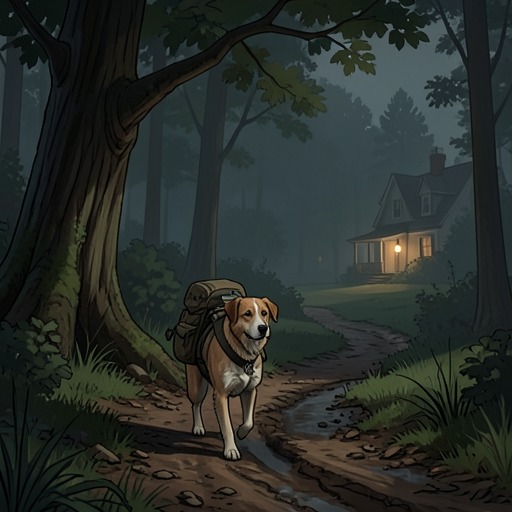
A Dog's Way HomeDogs are both companions and active participants in the novel’s world: they attach, communicate, seek safety, and sometimes care for others. Bella’s journey moves among domestic homes, a hospital, foster care, and the wilderness, where her encounters with other dogs reveal different forms of dependence and belonging. The story makes a dog’s life consequential without reducing every animal to a simple instrument of human comfort: dogs have their own needs, relationships, and ways of navigating danger.
Identity and Introduction
The category first appears in a moment of confusion during an animal roundup, when a human voice identifies a litter of puppies among the cats. Later, a puppy is found in the den itself: Bella, separated from Mother Cat and her kittens when people enter. This beginning places her between kinds of animals and kinds of shelter. The cats have hidden her with their young, while the humans recognize her as a dog; from the outset, her safety depends on bonds that cross species boundaries.
After Lucas takes Bella home, the routines of dog and person become a shared language. Bella learns that a treat is something given by hand, and the word becomes a favorite because it is joined to the immediate pleasure of food. She also learns commands and the ordinary pattern of a person leaving and returning. When Lucas goes to work and she is left in a crate, she barks in frustration and uncertainty; when he and Mom return together, she rushes to Mom and licks her face. Domestic life is conveyed not as abstract ownership but as repeated contact, separation, reunion, and care.
Dogs as Companions and Caregivers
Bella’s time at a hospital extends the idea of companionship beyond the household. Ty leads her into rooms where people sit in chairs, and they welcome her, pet her, and call her by name. Ty shares food with her, while a woman named Layla strokes her head and calls her a good dog. These encounters show the hospital patients receiving comfort from contact with an animal, while Bella is also welcomed and cared for. She is not simply present as a symbol: she responds to people, accepts their attention, and forms particular connections within the room.
That role becomes especially clear when Ty introduces Bella to Mack. She recognizes in him a sadness that reminds her of Mom’s, and climbs into his chair to be close. Mack embraces her. The episode presents comfort as something conveyed through bodily presence rather than explanation: Bella does not need to know the cause of Mack’s distress to answer it with companionship. Later, after Lucas reads that some dogs can sense seizures, he and Mom consider Bella’s behavior in light of Terri’s condition. Their conversation treats her apparent warning as remarkable, while the story grounds the discovery in Lucas’s observation and Bella’s repeated attentiveness, not in any claim that the ability was trained or medically established.
Packs, Difference, and Survival
The novel distinguishes dogs living with people from animals encountered on the road. During her journey, Bella stays for a time with Loretta and Jose, whose household includes two dogs, Rascal and Grump, as well as cats and a bird. Rascal has not learned not to bark; Grump is old, slow, and quiet. Their contrasting temperaments make a household of animals feel individual rather than interchangeable. Bella initially refuses food, then begins eating when the others do, understanding the foster home as a temporary place to wait for Lucas. She keeps the Lucas blanket with her, carrying a familiar connection into an unfamiliar canine household.
Later, Bella encounters Warren and Dude, whose company is temporary and whose car contains food she hopes to receive. She understands the arrangement as another short stay with people rather than a new home. Such episodes show how strongly her decisions remain oriented toward returning to Lucas, even as she accepts help along the way. Her desire to approach dogs she smells on the trail is tempered by the fact that they are with their people; she imagines that she too will someday be with Lucas again.
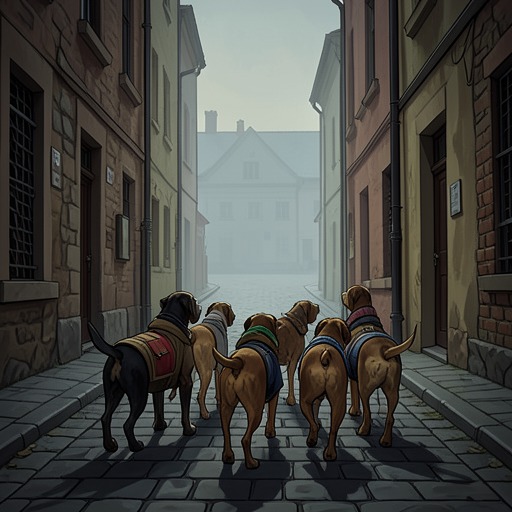
Not every dog-like encounter offers the safety of a domestic pack. Bella distinguishes the scent of coyotes from that of dogs who live with people, recognizes that the coyotes are tracking her and Big Kitten, and identifies a group of four as hunters rather than potential companions. The contrast matters: physical resemblance does not make every canid part of the same social world. Bella’s assessment of danger is tied to circumstance, and her protective attention to Big Kitten shapes how she responds. In the snow, the balance between companions changes: Big Kitten’s ability to move through deep snow and find prey makes her the more capable hunter, and Bella follows her tracks to food. Their interspecies partnership resembles a pack, but it is sustained by practical dependence as well as affection.
Dutch and Shared Responsibility
Dutch’s story further complicates the idea of a dog as a possession. Bella recognizes his distress while he is with an injured man and another person who offers the dogs bread. She stays with them even as machines approach, understanding her presence as a responsibility akin to her earlier efforts to comfort people at the hospital. The scene gives dogs a place within a crisis: Dutch remains attached to his person, while Bella stays beside both the human and canine companions who need her.
Afterward, Dutch joins Bella and Gavin. He is eager to leave for a walk, and when Gavin puts leashes on their collars, Dutch leads the way outside. Their relationship develops through shared movement and routine, not merely through a label of ownership. Bella’s account of their life together includes her concern for his welfare and their participation in a household that also includes Taylor. When she later reflects on the people and animals who helped her, she remembers Gavin, Taylor, Dutch, and Big Kitten as distinct sources of care. The novel’s idea of belonging can therefore extend beyond one permanent home without erasing Bella’s wish to return to hers.
Narrative Significance
Dogs in the novel occupy several positions at once: they depend on human shelter and food, make attachments to particular people, and offer companionship in moments when words are insufficient. Their actions also exceed the needs of humans. Bella is hungry, frightened by separation, and committed to finding Lucas; Dutch longs to follow his person; other dogs have their own temperaments and responses. The story’s dog-centered perspective lets those motives matter in their own right, even when human characters interpret or respond to them.
At the end of her journey, Bella remembers the care she received from Big Kitten, Axel, Gavin, Taylor, Dutch, and others. She understands this help as part of how she was able to keep going, and returns to Lucas and Olivia with a renewed sense of home. A hand-fed piece of cheese recalls earlier hunger and the intimacy of ordinary domestic life. In this way, the novel links the varied lives of dogs to its broader account of attachment: a dog may give comfort, need protection, join a temporary pack, or continue searching for one particular person. Bella’s return does not cancel the other bonds; it makes visible how much those encounters sustained her on the way.