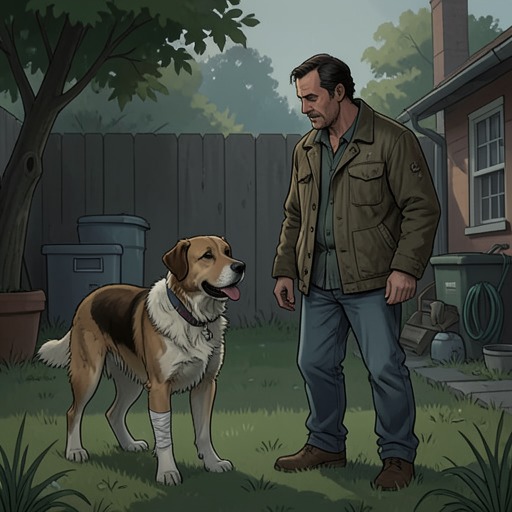
Dutch returns to Kurch’s home, then chooses to follow Gavin
A Dog's Way HomeDutch’s attempted return to Kurch’s home becomes a turning point in his relationship with Gavin: when Gavin finds him heading back, he does not punish or abandon him, but kneels to claim him as family. Seen through Bella’s narration, the scene makes belonging less a matter of where a dog instinctively goes than of who will meet him there and offer comfort.
Background and the Morning Walk
The episode follows a tense moment in which Gavin, after wiping his wet eyes with a cloth, tells the dogs that they have a real problem. The next morning Dutch jumps from the bed with unusual enthusiasm. He holds still while Gavin attaches leashes to the dogs’ collars, then pushes through the door and drags them toward the car. His eagerness is directed toward a ride, but Gavin tells him that they are going for a walk, not returning to “that place.” The correction establishes that Dutch’s past home remains present in the family’s movements: even a morning outing carries the possibility of going back.
As they walk along the sidewalk, Dutch marks over the scents left by other male dogs. Bella spots a heavy black female cat crossing a front yard and pulls at her leash to approach. That small diversion draws Dutch’s attention, but the walk does not hold him. He turns away from Gavin and runs, ignoring Gavin’s calls to come back. Bella calls him a bad dog, interpreting his disobedience through the rules she knows, but his flight soon acquires a different meaning. The episode places a familiar dog behavior—running off—against a more difficult question: where Dutch believes he belongs.
Dutch’s Attempt to Go Home
Gavin takes Bella back to the house at a trot, puts her in the car, and drives through the streets searching for Dutch. Bella cannot understand the search as a game: sometimes the car follows Dutch’s scent, and sometimes it seems to be going the wrong way. Gavin tells Bella that he knows she would never run away like this. When they draw close to Dutch’s trail, Bella breaks her No Barks behavior and barks from the car window. Gavin stops after spotting Dutch cutting between houses, then turns the car toward him.
Dutch is trotting ahead with his leash dragging behind him, his head low and tail down. Bella recognizes the purpose of his movement as his own version of Go Home. He is trying to return to the dark place associated with a sandwich and a man in heavy pants. The contrast is stark: Gavin has been leading Dutch away from that place, but Dutch’s course suggests that the old destination still exerts a pull. The scene does not present this as a calculated rejection of Gavin. Bella reads it as an attempt to go where Dutch believes home is, even though that home is no longer available to him.
Gavin’s Response
When the car stops, Dutch sinks to the ground. The tip of his tail flicks, and he blinks rapidly. Gavin gets out and quietly commands him to come. Dutch nearly crawls toward him, looking as though he believes himself to be the worst dog of all. His posture turns the encounter from a chase into a moment of vulnerability: he has been found, but seems to expect that his flight has made him bad.
Gavin answers that shame with physical closeness and a new definition of home. He kneels, puts his arms around Dutch, and tells him, “I’m your daddy now, Dutch. Do you understand?” He explains that the former place is no longer Dutch’s home and names the household—Gavin, Taylor, Bella, and Dutch—as a family. Rather than treating the runaway as an offense that must be punished, Gavin makes belonging the answer to it. Bella recognizes what Gavin is doing as providing comfort. In that recognition, the embrace becomes more than reassurance: it gives Dutch a reason to turn from the place he was trying to reach and accept the family waiting beside him.
Aftermath and Significance
Gavin’s declaration is followed by sustained, ordinary care. For several days he gives the dogs special attention, treats, and hugs. Dutch’s sadness does not disappear at once; Bella describes it as seeming to seep out of him a little at a time. The gradual change matters because the family’s promise is enacted repeatedly rather than settled by a single dramatic reunion. The scene moves from Dutch’s solitary flight to shared routines of attention, showing how Gavin’s claim of parenthood is made tangible.
The episode also complicates the idea of obedience. Dutch’s flight looks like misbehavior to Bella at first, but she comes to understand it as an effort to return to a former home. Gavin’s response does not depend on denying that effort or demanding immediate understanding. He retrieves Dutch, meets his apparent fear with an embrace, and tells him where home is now. The decisive shift is from a dog running toward an unavailable past to a dog being held within a present family; Bella’s final emphasis on comfort makes care, rather than punishment, the scene’s answer to separation.