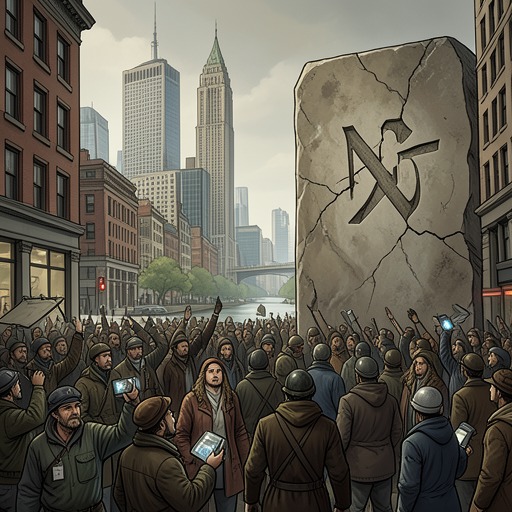
1941 Revolution Day Parade in Red Square
A Gentleman in MoscowThe 1941 Revolution Day Parade in Red Square took place amid the German advance on Moscow, after Joseph Stalin declared that he would remain in the capital rather than evacuate to Kuybyshev. The annual commemoration became a public display of defiance: for many Muscovites, the sound of The Internationale and the sight of Stalin on the rostrum marked a turning point in their confidence and resolve.
Crisis and decision
By late October, Moscow was under severe strain. Refugees and deserters crowded the streets, bridges had been mined for possible demolition, and classified files burned above the Kremlin walls as the government prepared to relocate to Kuybyshev. Against this uncertainty, a small cadre of laborers carried chairs from the Bolshoi to the Mayakovsky Metro Station, where the full Politburo assembled underground, a hundred feet below the city and beyond the reach of German artillery.
At nine o’clock, the assembled leaders sat at a long table set with food and wine. Joseph Stalin arrived by train in full military dress and took the place at the head of the table. He told the leadership that they were free to go to Kuybyshev, but that he had no intention of leaving Moscow; he would stay until the last drop of Russian blood had been spilled. He also announced that the Revolution’s annual commemoration would be held on Red Square on November 7, as usual. The parade was therefore not simply a scheduled observance: it followed a decision to maintain the public ritual in a city preparing for the possibility of evacuation and destruction.
The parade
On November 7, the commemoration brought the ceremony back to Red Square. Muscovites later remembered the heart-swelling sound of The Internationale accompanied by fifty thousand marching boots, while their leader stood defiant on the rostrum. The scale and familiar form of the parade gave a public shape to Stalin’s earlier declaration: the city would continue to mark the anniversary despite the danger at its gates.
For many who witnessed it, that combination of music, marching troops, and leadership presence made the day feel like a decisive change in the course of the crisis. Their recollection was not merely of a ceremony but of a moment when resolve seemed to become visible and collective. The narrative presents the parade as a powerful source of confidence without making it the sole explanation for Moscow’s survival.
Memory and military outcome
The parade’s status as a turning point is set beside other explanations. Some observers emphasized that Stalin had kept seven hundred thousand soldiers in reserve in the Far East and that these troops were being moved west to aid Moscow even as the celebration took place. Others pointed to the weather: snow fell on twenty-eight of December’s thirty-one days, grounding the Luftwaffe, while the average temperature dropped to minus twenty degrees, a climate as unfamiliar to the German forces as it had been to Napoleon’s.
The German army had taken five months to advance from the Russian frontier to the outskirts of Moscow, but it never entered the city. After taking more than a million prisoners and causing a million deaths, the troops began their retreat in January 1942, leaving Moscow surprisingly intact. The narrative thus preserves both the parade’s emotional importance and the difference between a remembered symbol of reversal and the several material factors behind the military outcome.