1954 Combined Dinner of the Presidium and Council of Ministers
A Gentleman in MoscowOn June 11, 1954, Count Alexander Ilyich Rostov presided over a joint dinner of the Presidium and Council of Ministers in Suite 417 of the Metropol. What began as a meticulously managed state occasion also became a display of political rank: the guests received no seating plan, yet settled into positions that made the hierarchy visible. As the evening drew toward eleven, Nikita Khrushchev turned the gathering’s attention to an announcement about the Obninsk power plant and its imminent delivery of electricity to Moscow.
Return to the headwaiter’s post
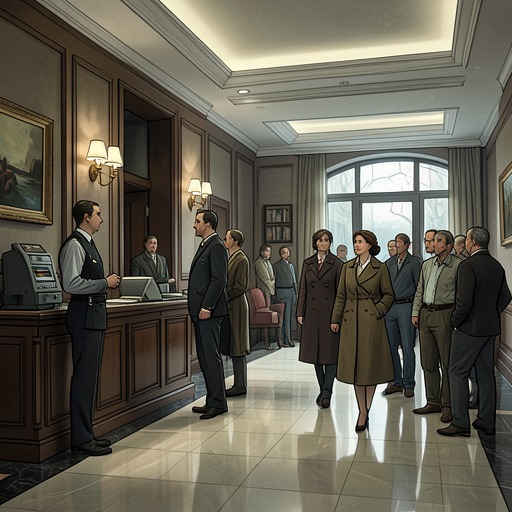
At 6:45 in the evening, Rostov stood in Suite 417 in the white jacket of the Boyarsky, checking the place settings and the appearance of his staff before the doors opened. His return to this responsibility followed an abrupt change in circumstances. Eleven days earlier he had been excused from the duty; on the afternoon of June 10, Maître d’ Andrey Duras came to the restaurant’s daily meeting with a tremor in his hands. Duras said the condition seemed consistent with the onset of palsy, and demonstrated how severely his right hand shook. The ability that had distinguished him in his work was now compromised, and the dinner required a replacement.
The young liaison Comrade Propp was relieved to have Rostov in charge. Propp did not know that the headwaiter was under house arrest at the Metropol or that he was a Former Person. He knew him instead as a man who attended to every detail and responded at once to a customer’s dissatisfaction—a dependable presence for an evening whose failures might otherwise be blamed on the liaison himself. At their morning meeting, Propp reviewed the arrangements: doors at nine, a U-shaped table with twenty seats along each side and six at the head, a Russian feast interpreted by Chef Zhukovsky, Ukrainian white wine, and candles to be extinguished at exactly 10:59. He also showed Rostov the guest list. Rostov recognized the names not only from formal functions in the Red and Yellow Rooms, but from the more intimate Boyarsky tables where he had served them with wives or mistresses, friends or enemies, patrons or protégés.
A table without a seating plan
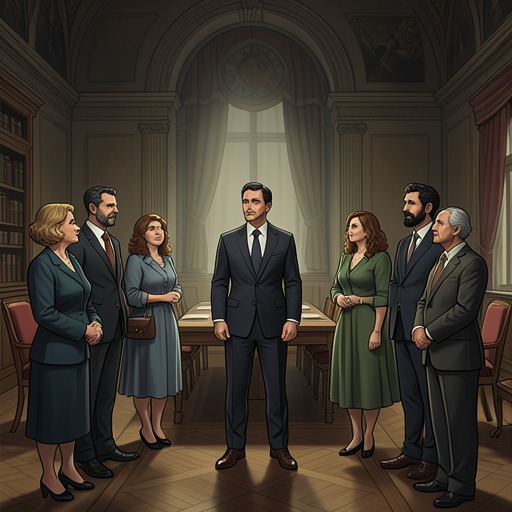
When Rostov asked for the seating arrangement, Propp told him there would be none. Rostov welcomed the decision, confident that the evening would succeed without one. The absence of a plan did not mean an absence of order. The forty-six attendees, he expected, would find their proper places with little jostling; their apparently spontaneous choices would reveal the governing structure more plainly than an official diagram could.
The doors opened at precisely 9:00 p.m. By 9:15, the men had taken seats appropriate to their station. Bulganin, Khrushchev, Malenkov, Mikoyan, Molotov, and Voroshilov occupied the head of the table, with the two central seats reserved for Premier Malenkov and General Secretary Khrushchev. Khrushchev himself did not go straight to the head when he entered. He first exchanged remarks with Vyacheslav Malyshev, the Minister of Medium Machine Building, who sat near the table’s end. Only after the others were settled did Khrushchev pat Malyshev on the shoulder and take the last empty chair beside Malenkov. The delay made the eventual placement no less exact: the arrangement emerged through social movement rather than explicit instruction.
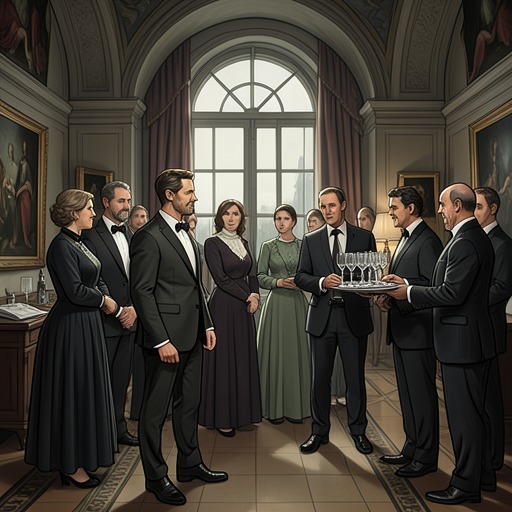
Over the next two hours, the men ate heartily, drank freely, and offered toasts ranging from serious to humorous, all in a patriotic spirit. Rostov kept the meal moving, presenting courses, replenishing glasses, replacing utensils, clearing plates, and sweeping crumbs from the linens. The guests talked across the table, conferred with neighbors, and muttered beneath the general hum. The service routine and the political gathering occupied the same space: Rostov maintained the material order of the feast while the guests enacted the order of rank.
The announcement from the windows
After a toast to Sverdlov, Khrushchev announced that those present had the honor of witnessing another historic event at the Metropol and invited them to the windows. The forty-four other attendees pushed back their chairs and gathered there, where Malyshev was waiting. The interruption redirected the dinner from its internal arrangements toward a public claim about Soviet technological achievement.
Malyshev recalled that construction of the new power plant at Obninsk had begun three and a half years earlier. He announced that it had become fully operational on Monday afternoon, six months ahead of schedule. He then specified the next milestone: at exactly eleven o’clock that night, in less than two minutes, the plant would begin providing power to half of Moscow. The account records the announcement and its stated timetable; it ends before describing the promised start of delivery.
Timing, order, and narrative significance
The dinner’s precise schedule—the doors at nine, the candles at 10:59, and the promised transfer of power at eleven—gives the event a clock-bound structure. That precision resonates with the novel’s recurring attention to measured time, from the twice-tolling clock made for Rostov’s father to Rostov’s reflections on how isolated people mark each endured year. At the dinner, time is not only something endured or contemplated: it organizes labor, ceremony, and the announcement’s claim to punctual achievement.
The episode also sets Rostov’s habitual attention to detail against a state apparatus whose hierarchy is present even when its seating instructions are absent. His work is at once practical and interpretive: he makes the meal run smoothly, while the guests’ self-placement supplies a lesson in power. The final movement to the windows enlarges that spectacle. A dinner whose order has been legible in the arrangement of bodies turns outward to the city, where the announced flow of electricity is to become another carefully timed demonstration of Soviet capacity.